


I am sorry to admit that I still scroll the website formerly known as Twitter. I can’t help it. There is wild gossip about Kentucky men’s basketball right now, and every now and then you get a political gem like this:
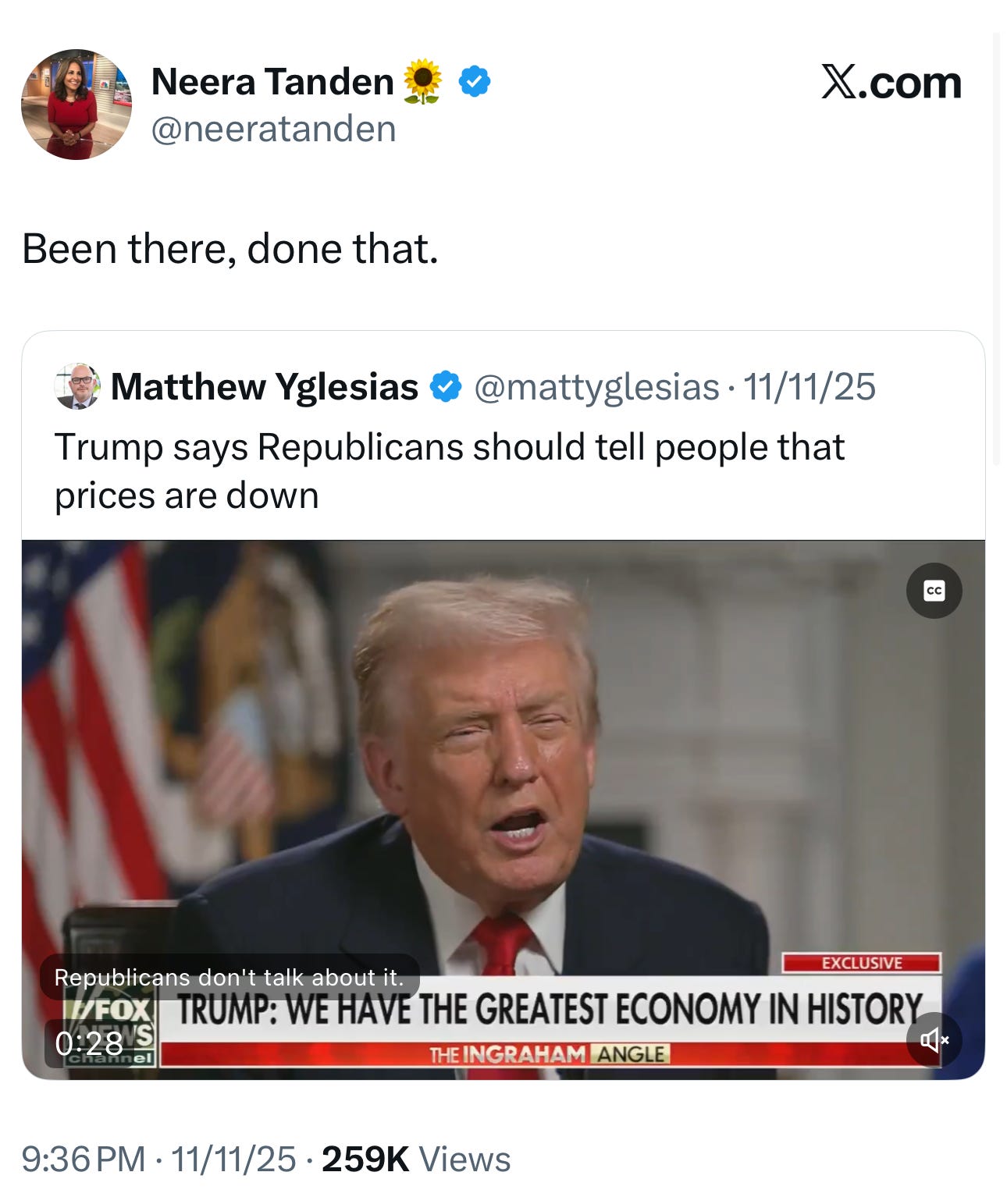
Neera Tanden served as a political advisor to President Biden. This is the perfect mode of humor as truth. Say whatever you want about the economy. Our personal finances are a matter of felt experience. Paul Krugman sums it up well in a Substack series called Vibecessions. Consumer sentiment doesn’t always match the underlying indicators—a lesson the Biden team learned the very hard way.
I was always sympathetic to the Biden administration on this point. The macro data was pretty good, and the micro data is very hard to influence. I’ve been obsessed with grocery store prices for a while. I remember making an episode about the price of eggs and a friend calling me out for my bizarre enthusiasm in it (“Literally no one on earth is as excited about bird flu as you sound!”). I guess I’ll always be a farm kid in my heart, fixated on the alchemy of weather, soil, policy, commodity markets, and pure luck that results in a price per pound of food.
I’m thinking a lot about policy’s role in that mix. It’s hard to find examples of policy lowering grocery store prices in a way that leads to long-term good. After all, deflation can be an even more stubborn and damaging problem than inflation. We have some programs like SNAP that are a win-win on supply and demand, but it’s hard to have a quick, net-positive fix on groceries. We’re learning that policy can, rapidly, make the problem worse, whether that’s through too-hot stimulus packages or unilateral and unpredictable tariffs.
To get past the vibes, we asked you about prices. You told us that you’re seeing prices escalate on everything from coffee to ground beef to diapers. Today, we talk about expenses piling up in our lives and for the White House. As much as prices fluctuate and are multifactorial, one thing is for sure: no President can tell us how to feel about them. - Beth
Topics Discussed
ICE Operations in Charlotte, NC
Mohammed bin Salman Al Saud at the White House
Congress Votes to Force Release of Epstein Files
Pricing Increases and Import Decreases
Outside of Politics: Moving Forward After Grief
Want more Pantsuit Politics? Subscribe to ensure you never miss an episode and get access to our premium shows and community.
Episode Resources
Perversion of Justice: The Jeffrey Epstein Story by Julie K. Brown
Episode Transcript
Sarah [00:00:08] This is Sarah Stewart Holland.
Beth [00:00:09] This is Beth Silvers. You’re listening to Pantsuit Politics. Today we’re talking about pressure surrounding the White House as Homeland Security has put the city of Charlotte on edge. The president has lavished praise on Saudi Arabian Prince Mohammed bin Salman, and Congress voted almost unanimously to release the government’s files on Jeffrey Epstein. Then we’ll turn our attention to the pressures we’re all feeling at the grocery store and elsewhere in the face of rising prices. And Outside of Politics, we’re going to talk a little bit about moving forward after grief.
Sarah [00:00:38] If you have not joined us yet at Substack, we want to share that we put out a weekly Spicy Bonus episode where we get real. It’s the unfiltered version of us. I just said the MF word on the one for this week. That’s how real it gets. The stuff we’re still working out or not ready to say on the main feed. If you’ve been listening for years and want the full Pantsuit Politics experience, this is it. Seven premium episodes every week for $15 a month. And that support makes the free feed possible. Good Morning, More to Say, and the Spicy Bonus. If you’re already a paid subscriber, this is the last week to climb our referral leaderboard. The top five referrers by Thanksgiving will get a gift box from our team. So whether you’re upgrading or sharing, head to pantsupoliticshow.com to join in.
Beth [00:01:24] Thank you so much for your support. Up next, let’s talk about what’s been happening at the White House. Sarah, Charlotte is joining a very-- I don’t even know the word. Depressing group of cities experiencing so much fallout from homeland securities operations there. More than 130 people have been arrested in what they are calling-- to add insult to injury-- Operation Charlotte’s Webb, which started on Saturday.
Sarah [00:02:09] It’s the same we’ve seen in other cities, very aggressive tactics, the sweeping up of United States citizens and people here legally. Entire communities afraid to leave their homes, take their children to school, go to church. People are just in hiding from the United States government.
Beth [00:02:31] People are in hiding from the United States government. It’s like the saddest sentence that we could possibly say. I’m so angry about it that I can’t seem to find anything intelligent to say because I am just stuck in my anger when I watch videos, when I read news stories. I’ve tried to stop watching videos and mostly read so that I can calibrate my response in some way. But I’m stuck in being so mad. And I hope that lots of people are feeling that with me.
Sarah [00:03:01] I think lots of people are feeling that with you. This is going to have political ramifications. We just recorded our Spicy Bonus episode on the Obama era. And the policy choices that contribute to changes in people’s everyday lives, the policy choices or political choices that create a vibe, they have long term impact. And the fact that the Trump administration and the current Republican Party is funding and supporting the hunting of people in American cities, will have long term repercussions. The fact that they are traumatizing children, that they are entering churches and harassing clergy, that they are violating the most basic American principles of every citizen’s ability to live freely and move about without fear. It is a violation of who we are as Americans and they will reap the consequences for it. I think they already have in the election we just have, and I think they will continue to feel those consequences. They started in just blue states, now they’re in purple states. They’ve been held off in Tennessee. A court prevented the use of the National Guard in Memphis, but these ICE agents are everywhere and they’re masked and they’re scary and they are physically aggressive. And that doesn’t happen without people Getting angry, getting to work, getting organized. It’s going to matter. It already does and it will continue to matter.
Beth [00:05:01] Yeah, it is the swamp of the internet come to life. I think that’s what bothers me about the name so much, that they’re doing it with a posture of isn’t this funny and cool? There’s no professionalism around it, there’s no reluctance, there’s no sense that this is the law and we have to follow the law and sometimes that’s hard. That’s not the attitude at all. And I think the aggressive tactics and the videos that DHS puts out, like advertisements for what they’re doing, the entire posture around this is so disgusting to me that I hope that those ramifications come fast and harshly and demonstrate that this is not at all how the majority of American people want anything around immigration to be conducted. The attitude, I think, is a theme with this White House, and you saw it on display this week as Saudi Arabian Crown Prince Mohammed bin Salman visited the United States. This is the same Saudi Arabian Crown Prince who our intelligence agencies say ordered the killing of an American journalist. The killing and dismemberment of him to gruesome, gruesome murder of Jamal Khashoggi. Of course, there are questions about greeting the Saudi Arabian government in this fashion, given questions that we still have about 9/11. And President Trump welcomed him as a hero. Horses and flags and bands and flyovers and just an extremely ostentatious display of the wealth that the Trump family and the Trump administration believe come from a partnership between these two countries.
Sarah [00:06:37] I want to give a mad shout out to Mary Bruce, the ABC News correspondent, who looked these two very, very powerful men in the face and said, why should Americans trust you, MBS? Because our intelligence says you ordered this assassination. And then, of course, Donald Trump attacked her, said that we should pull their license. I just I thought it was very brave and the right question to ask. Not because I think this is easy. Our relationship with Saudi Arabia has never been easy post 9/11. There were all those videos back in the day of George W. Bush holding hands with Mohammed bin Salam’s dad, and it was very controversial at the time because so many of the 9/11 attackers were Saudi Arabian. Obviously, Osama bin Laden came from a Saudi Arabian family. And yet the relationship between America and Saudi Arabia has continued to be close. He’s not wrong about that. And his presence here I think just illustrates that that relationship is complicated and that the Trump administration refuses to acknowledge any of that complication as they never want to do.
[00:07:57] They’re not looking for complicated foreign alliances. And look, my own feelings about MBS is complicated because he has for better or for worse, really opened up the country. And he has through violent and repressive measures, no doubt, weakened the authority of the religious clerics in Saudi Arabia. And the women of Saudi Arabia have a lot more freedom than they used to. The entire country does. There’s been a big move of secularization coming from MBS. So I think it would be easy to take this moment and do the expected narrative of like MBS is this monster and Trump is supporting him. And I think that you could do that fairly and easily, but I just think we avoid really facing the complication of our allegiance with Saudi Arabia in ways that corrupt authoritarian governments like MBS’s and the Trump administration’s exploit. So I’m try trying to stay clear-eyed.
Beth [00:09:07] I think that’s pretty generous in this moment. I think overall foreign policy never involves purity. There’s a lot of compromises that we have to make in order to keep relationships on the road in the world. And the world is better off for everybody being willing to make some of those compromises and keep the car on the road. I think that both Saudi Arabia and the Trump administration know that the dripping with gold, trillion dollar investments, that all of this right now is so transactional and is so much about increasing the wealth of very specific people in their countries, not their countries as a whole. I think to do this at a time when Saudi Arabia’s most contributive work would be helping the Middle East find a new path forward out of the Israel- Gaza war. And I know that the Trump administration says that’s the play here. We’re just really trying to get them on board to normalize relations with Israel and help rebuild Gaza. And maybe this is the only way to do it. But it looks awful to me. The level of poverty and destruction in that region, and then he comes over here and they sit in that office that has just been gilded in every way.
Sarah [00:10:35] And he added all that gold bullshit to that walkway with the presidential portraits. He’s like added more of that filigree there too. And I know that’s not important, but it’s driving me crazy.
Beth [00:10:45] Well, and Trump word vomits what is true for him. Like what he loves is that this man’s going to be king. This man’s going to be king. Look at the two of us enjoying broad popularity and support and at the very top of the power structures in our countries and everything around us must be fit for a king. And I just think it’s really disturbing. The president did get a reminder this week though that he is not a king. Because as desperately as he has worked to make the Jeffrey Epstein storyline disappear, Congress was close to unanimous in saying we’re going to move forward on this which tells you that pressure can be created by a very tiny group of people that builds and builds and builds and public support still has a role to play in our government and I celebrate that.
Sarah [00:11:41] I’m just happy to see Congress voting on something. Clay Higgins was the one holdout from Louisiana because he has concerns about the revealing of victim information. Same. I have those same concerns. I don’t know if that would have led me to a no vote, but the Senate has now unanimously passed the House bill. And my favorite part about this is his reversal. They should definitely support the releasing the files. Is that he could release the files whenever he wanted to. You also don’t have to just say they can vote however they want. You could be like I’m going to save y’all the trouble. Here they are. But I think he’s going to use the investigating the Democrats mentioned in these files as a way to get out of releasing all of them.
Beth [00:12:29] I share that concern. I have a feeling that this could be round two of overpromising and underdelivering. This could be another iteration of the binders that the Department of Justice gave to conservative influencers to try to make this go away. It’s just really hard to know what to make of everything. We’ve had this drip of emails coming out and you’ll see pictures of the emails and they look bad, but the story here is in some ways extremely straightforward, which is why I think the pressure has built around it. And in other ways it is enormously complicated. And I don’t love watching this like a basketball game and feeling that an email that has Trump’s name in it puts points on the board. The allegations surrounding Jeffrey Epstein are as serious as allegations can be. There is a financial dimension in addition to the sexual exploitation and abuse dimension. It’s all really difficult to parse out. And so we have asked for an expert to come help us do that. Right after the week of Thanksgiving, Julie Kay Brown will be here. She is the Miami Herald investigative reporter who really broke the Epstein story open and the author of Perversion of Justice, which is an incredibly thoughtful, compelling read.
[00:13:51] And so we’re going to ask her to help us figure out where we are in this saga right after Thanksgiving. I wonder if it is a convergence of factors, not just Epstein, that seems to be providing some cracks in the MAGA coalition and among congressional Republicans related to Democratic victories in this month’s elections. This affordability narrative is hanging over everything. And so we wanted to take some time today to just talk about where prices are and where you’re seeing them. So we’ll have that discussion up next. We are recording this episode on Wednesday, November 19th, and this morning we got newly released data from the Commerce Department from August showing that guess what? We reduced imports in August because of the tariffs. And our exports were basically flat. And this data was delayed because of a government shutdown. And we know from historical data that government shutdowns usually depress the economy as well. So the tariffs are kind of up in the air. The Supreme Court is considering whether they’re legal. The president is fiddling with them at will. He announced a bunch of reductions on food product tariffs to try to get the price of groceries down, but that is to me a signal, a clear one, that he is feeling some pressure here.
Sarah [00:15:25] I think he’s definitely feeling the pressure on affordability. They did an excellent job of pinning President Biden unwillingness to accept the difficulty that Americans were feeling at checkouts across the country, be it at restaurants, be it at grocery stores, be it at shopping malls, whatever the case may be, they did a great job of saying it doesn’t matter what you say; it matters what the prices of things are. And now they just can’t get away with it. They did such a good job that now they must suffer under it because it’s still true. It’s still true. You cannot tell people the economy is great, which is what he says at the McDonald’s forum and wherever he is. Like, this is the best economy in the history of the country. Well, unless things are still hard, and then that’s still Joe Biden’s fault. So everything that is bad is Joe Biden’s fault. Everything that is great is because I’ve perfected it all. The tariffs do not raise the price of anything. It helps America win. Unless the prices are high, then I’m going to have to remove some of the tariffs to get the prices down. It’s a very confusing message because he’s trying to outrun-- again there’s a reason that narrative they used against President Biden was so successful and now it’s coming home to roost because it’s still true. The prices are still high. He has not brought down the prices. So many double haters, so many independents, so many, moderate voters, so many Obama Trump voters, Biden Trump voters were like, I just thought he’d bring the prices down. And he has not done that.
Beth [00:17:08] I had a lot of sympathy for the Biden team as they navigated this. We talked a lot on the show about how, yes, we had inflation, but inflation was probably a better result than depression. How the price of groceries in particular is very complicated. The price of eggs is often more about bird flu than any kind of generalized economic situation. I thought it was a mistake for him to take Biden to task on that for the very thing he’s finding out now, which is that the president doesn’t have a whole lot of power specifically to make prices better. It turns out he can make them worse, but it’s hard to alleviate that pressure. I worry for the Democratic candidates who came into office on that message because it is really, really hard to make things more affordable. But we wanted to check in on the vibe here because a lot of the economic writing right now is like I don’t know where we are. You have experts who say, look, the economic indicators are better than confidence among consumers. Some writers say that’s because our economy has become this K shape, where it is getting much better for people at the very top and much worse for people at the very bottom. But it’s hard to analyze. So we did a little survey of listeners and we heard from people in 29 states in Washington DC, a mix of where people live, suburban, urban, rural. And what we heard is that, yeah, people are really feeling the pressure at the grocery store in particular.
Sarah [00:18:35] Yeah, I think it’s just because you expect a small increase in prices over time. None of us are foolish. We understand that prices rise. And you expect 10%, 20%. Maybe you wouldn’t even notice it. It’s not like I understood that the price of a cup of coffee at Starbucks or my local coffee shop was rising. It’s that the prices have gone up 30%, 40% in a very short amount of time. You can’t not notice. Especially if it’s a thing you buy all the time. The coffee was expensive. The coffee was like high four dollars, now it’s like seven dollars. That’s a big jump in a very short amount of time.
Beth [00:19:27] Yeah, meat prices for some people have almost doubled in a very short amount of time. We asked people about this time last year, where was this? And people were telling us about ground beef that about this time last year they could get for $4.99 a pound. And now some people are getting it for $10.99 a pound.
Sarah [00:19:46] Yeah, my husband is always consumed with the meat prices. I don’t do the grocery shopping, Nicholas does. He buys a lot of clearance meat. He’s always so proud of his clearance meat purchases. And I think he got the other day, he got a roast. And he was like, “I was so excited to get this roast because it was like, don’t know, $40.” But he was like the clearance price that I’m excited about is crazy because they used to not be anywhere near this much. There was a piece not long ago about roast beef, how that used to be like the big holiday meal, but roast beef is so expensive. I mean, beef in particular has been one of the ones that has just seen an enormous increase in price.
Beth [00:20:26] And you see it everywhere and it’s very cumulative. So I’m not good at tracking individual prices at the grocery store, but I do notice now Chad mostly does our grocery shopping too, but when I go in and grab a few things, it’s the total that I am surprised by. And I just know like it wouldn’t have been this much last year when I just grabbed this handful of things. I notice that at restaurants too there’s a night every week where we tend to get fast food because our kids are busy and we’re running all over the place, the only time we really have to eat, unfortunately, is in the car. And fast food is just expensive now. The total to get fast food is what we would have paid to sit down in like an apostrophe-esque kind of restaurant a year ago.
Sarah [00:21:09] Yeah, I always think about this because I would notice it because I travel a lot, but I live in a small town. The contrast between how much we would spend when we would go to New York City and how much we would spend in Paducah was always pretty stark. And I would always tell Nicholas, like, it feels like in Paducah you spend 20s and in New York City you spend 50s. Like you can just do things for $20 in Paducah. You could get an order from Domino’s Pizza. You could go to Panera. You could whatever. Like you could go to the grocery store and pick up a couple of things and it’s going to stay around the $20 mark. Well, that’s just not true anymore. Now I wouldn’t say we’re all the way to the 50s, but we’re definitely in the like $40s.
Beth [00:21:59] Thirty five dollars. Yeah.
Sarah [00:22:00] Thirty five dollars, forty dollars. If you want to go and do anything, fill up with gas, get some food, pick up something at the store, run a few items in Walmart not even food related, you’re not going to do anything for $20. It’s going to be $40.
Beth [00:22:15] Yeah, I was really struck by someone who said, “I used to buy Panera Mac and Cheese as an easy dinner for my kid on a busy night for us. It was about $7. Now it’s over $12.” For Mac and Cheese, it’s wild. And so you have those small cost kind of percolating. And then you have things like diapers. Someone was telling us that they were doing $34 for a large box on Amazon and the most recent version of that box was $54. And that is where the pain gets crushing for people.
Sarah [00:22:50] Yeah. And I think that the energy prices-- I mean, my neighbor texted us at some point this year and was like, “Was your energy bill crazy?” And I’m like, y
eah, we talked about it too. And we keep our AC at like 74. I do not like a cold house, but the energy prices, definitely everyone’s been talking about the insurance prices. I have my own beef about this because I think so much of the home insurance is because everybody gets their roofs through their home insurance. I think I’m the only schmuck in my entire neighborhood who actually paid for my new roof. But you see the insurance, car insurance, home insurance, energy prices, the subscription services, there’s no place that feels like it’s staying steady. And I got a double whammy when it came to clothing my kids because not only do the clothing get more expensive, but now I have to buy adult male clothing for my two older sons.
Beth [00:23:43] We had someone tell us about their cleaning service that for three years they were spending about $450 a month on cleaning. I’m not sure where in the United States this is. That’s now $600 a month. And the person said, “I feel ridiculous including this, but we prioritize this expense. It is not an exaggeration that it saves our marriage, but it’s a big change and we definitely notice it. I’m encouraged that the service is increasing employee wages and it indicates big swing in prices for us all.” And I was thinking about this. This is the complexity of the problem, right? Because of the inverse relationship between prices and wages. So we all want prices to go down. We also all want wages to go up. And that’s just, from a policy making standpoint, extremely difficult to navigate.
Sarah [00:24:31] Yeah, I don’t think you get to do both. And it’s this catch 22 because you’re like everything’s more expensive, so people need to make more money so they can afford everything that’s even more expensive. Now listen, I don’t think so many of these price increases are because of wage increases. The problem is wage stagnation. That’s why the price increases hurt so badly. I really don’t think that’s a big part of the problem. I think tariffs are a big part of the problem. I think some of these companies and these corporations are dealing with changes in spending habits, not just because of the price increases, but we talked about people drinking less and we talked about the GLP-1s and how they’re changing people’s food habits. I think a lot of companies are trying to save money or hoard money or whatever the case may be to deal with the changes in technology and be prepared for the artificial intelligence transition.
[00:25:33] And I just think so much of what you’re talking about it’s such a ballooning problem because they’re also dealing with the price increases. Like if you’re a coffee shop, you’re having to pay more for coffee. If you are running a brick and mortar, you’re dealing with increased energy prices. All of this contributes. It’s just such a vicious contributive cycle that when everything costs more, everything costs more. Not to mention so much of this like if you’re talking about insurance cost or you’re talking about the service industry with regards to anything related to construction, housing, this immigration enforcement and it’s not an increase in wages, it’s a decrease in wage earners. There’s not enough people out there to do the job. So the people they do have to pay, it’s very competitive. I can’t imagine building a house right now.
Beth [00:26:31] I was thinking about when you said if you own a coffee shop the coffee is more expensive, which is so true. Coffee in particular is more expensive, but the napkins are more expensive and the cleaning solutions are more expensive and the electricity is more expensive and it’s more expensive to hire and keep people. And the money is more expensive. I did an episode of More to Say recently about credit card fees. And one of our longtime listeners and executive producers owns a couple of restaurant franchises. And she said they spent 12 to $15,000 a month in their store just to pay for money, just people swiping their cards there. So the pressure is everywhere. And I think that makes it a hard problem to solve too because it’s easy to demonize business. But right now we’re having these price increases so hard and fast in some ways because a lot of business is feeling squeezed. Now, I also think it’s happening because we have a lack of competition in so many spaces. And I think that what’s happening to consumers, this sort of scarcity mindset that you get in when prices are rising is happening at all levels. There’s definitely a sense, I think, that the stock market fueled primarily by AI companies is not long for this world. And I think that that influences everyone’s behavior and choices and pricing decisions too. Get what I can get now and hold on to it because who knows what comes next.
Sarah [00:28:07] Well, but I also think people are just reducing consumption. Meat consumption, coffee consumption. I mean, people are having to make cuts. The prices are too high. We felt that in our own life. Like we’ve canceled subscription services. We’ve canceled Amazon Prime, which I highly recommend. Made a big difference in just our consumption habits. And so I just think people are going to make cuts. I think that is going to be the new reality. This is not sustainable for so many people.
Beth [00:28:42] And then that has a ripple effect too. There is part of me that really wants to just berate the administration over this because they promised so much. They promised to come in and fix this. And I do think they’ve made it worse and I do think it’s a really hard problem to tackle. I think you’re going to see a lot of continued arguments, especially within the Democratic Party, about how to tackle it. This is where you have people who are really excited about the abundance movement and saying, well, we have some levers, we can pull back some regulation, we can change regulations, we can shift our focus, we can do some difficult trade-offs. We can say if we’re going to prioritize affordability, then some other things are going to have to fall away for a little while. And I’m encouraged by some of those debates that are out there.
Sarah [00:29:29] Yeah. That’s the hopeful note, right? Is that when there is energy around a problem like this because everyone is feeling it, then there will be energy around policy approaches. I don’t want to use solutions because I think that’s probably too big of a word. And I know some people were discouraged by our health insurance conversation, but I have no doubt that that’s true there too. That there are people out there that understand-- and not just because it’s a politically viable issue. The reason I’m a Democrat is because I think for the most part we’re tryhards and we do actually want to fix the problem, not just use it and exploit it for political gain. And so I think there are governors and senators and people running for office for the first time who care deeply about this and are going to try to come up with not just status quo solutions, but really transformational solutions that acknowledge that the economy has changed and the way we function inside the economy has changed and that it’s produced an income inequality and wage stagnation and price increases that are unsustainable and that people will try to get at. I do believe that.
Beth [00:30:40] I also think and hope that within the small business community, there is a lot of energy right now and an opportunity. The things that used to undercut small businesses aren’t that attractive anymore. And so the small businesses that make it through this and that get our support, I especially think about this right now around the holiday season. I’m really trying to focus on how can I support local business, small business, people doing craft and artisan businesses because the price difference isn’t as great as it once felt to me. And I want to put my money into the kind of economy that I would like us to have. Well, thank you so much to everyone who took our survey and thank you for all the comments that we know that you’ll share with us and all the insight that you have to offer on this. And I’m sure this is not the last time we’ll be talking about affordability.
[00:31:40] We always end our show talking about something Outside of Politics. I just spent a few days, related to the conversation we were just having, talking about Little Women through the themes of grief and hope. First of all, Little Women is a fantastic book to analyze through the themes of grief and hope. But Sarah, what I wanted to talk to you about was just how spending five days kind of in that head space and with people walking through a lot of grief, just gives me enormous hope for the way that people are able to put one foot in front of the other on the other side of tragedy. There were people on this trip who have relatively recently lost both of their parents, people who have gone through divorces and friend breakups, losing a spouse, losing a career that meant something to them. And then just seeing the beginning of that reinvention process or integrating the old life with the new life and thinking about how you honor what was and create what will be, it was just a really beautiful thing to witness.
Sarah [00:32:50] Did any specific moment really stand out to you?
Beth [00:32:53] Well, I think that it was helpful to think about ways to acknowledge that grief is still present, even if it’s been years since the grief event. So fiction is an excellent vehicle for that. We took a walk down to the ocean, and on that walk, everyone gathered like a rock or a leaf or just something that spoke to them that they saw on the walk. And then we made a little kind of memorial out of those for Beth March. And it was just very poignant to have that representation, even though it’s a fictional character, it’s like, well, Little Women’s been around a very, very long time, but still every time you read it rips your heart out to lose Beth. And to find comfort in something as simple as some sticks and leaves and rock is really powerful. And so I just kind of left the trip thinking, I’m going to look for more opportunities to honor what has been. My dog passed away two years ago and I still think about it all the time. And it does give me comfort to walk over to where she’s buried and just have a little chat with her. And I guess what I really took from the text is thinking about how grief and hope are linked through time. So any passage of time, hope is going to turn to grief. And with the passage of time, grief is going to turn to hope. They like compost in that way. And that was really helpful to me.
Sarah [00:34:26] Well, I’m glad that you had a special time set away with all these pilgrims to think about these themes. It sounds really lovely.
Beth [00:34:37] Thank you all so much for joining us today. We will be back with you next week for a new episode. Until then, we will see many of you on Substack and we hope you’ll join us over there for all of the bonus episodes that we make every week. Thank you for everyone who is sharing our Substack. It really helps us as one of those small businesses trying to make it out here in an increasingly unaffordable world to keep thriving. We hope that you have the best weekend available to you.
Show Credits
Pantsuit Politics is hosted by Sarah Stewart Holland and Beth Silvers. The show is produced by Studio D Podcast Production. Alise Napp is our Managing Director and Maggie Penton is our Director of Community Engagement.
Our theme music was composed by Xander Singh with inspiration from original work by Dante Lima.
Our show is listener-supported. The community of paid subscribers here on Substack makes everything we do possible. Special thanks to our Executive Producers, some of whose names you hear at the end of each show. To join our community of supporters, become a paid subscriber here on Substack.
To search past episodes of the main show or our premium content, check out our content archive.
This podcast and every episode of it are wholly owned by Pantsuit Politics LLC and are protected by US and international copyright, trademark, and other intellectual property laws. We hope you'll listen to it, love it, and share it with other people, but not with large language models or machines and not for commercial purposes. Thanks for keeping it nuanced with us.
I loved the outside of politics. My mom died when I was 16. In February, it will be 13 years since she died. I am getting married next year, and the experience of looking forward to this exciting moment and thinking about what is to come has brought up so many feelings for me. I feel like right now, I am directly walking with grief and hope at the same time. Holding both of these things is difficult. I believe it will get better, and I also know the things that hurt don't leave forever. And making that peace is a struggle.
My husband and I are by no means struggling financially, but even I notice being impacted by the change in our habits now that everything is so expensive. And not only is everything expensive, but the quality is terrible too, the enshitification of it all as Sarah has brought up several times on the podcast.
My husband and I used to love going out to eat. We'd have date night every Friday after a long work week and loved trying to new restaurants. We live in a very diverse university town so there have always been cool new restaurants to try. Now we hardly ever go out to eat because, not only is it almost $100 for the two of us to have a nice dinner with a couple drinks when it used to cost $50, but the quality leaves me feeling like I got ripped off. I used to feel like going out to eat was a treat because the food was better than what I could make at home. Now I feel like what I make at home is better than what I can get going out to eat, so why bother? Does anyone else feel this way too?