


In late January, I released an episode of More to Say about prediction markets.
Unusually, almost every comment on that episode conveyed the same sentiment: “I had no idea this is happening.” Billions of dollars are flowing through prediction markets with no signs of abating. The main players in the industry, Kalshi and Polymarket, are signing deals with major news organizations, giving away groceries to New Yorkers, and blanketing the subway with ads (as the one and only Norma Stary documented and sent our way).
It’s all very weird. Take these headlines, which came up this morning in a quick Google news search.
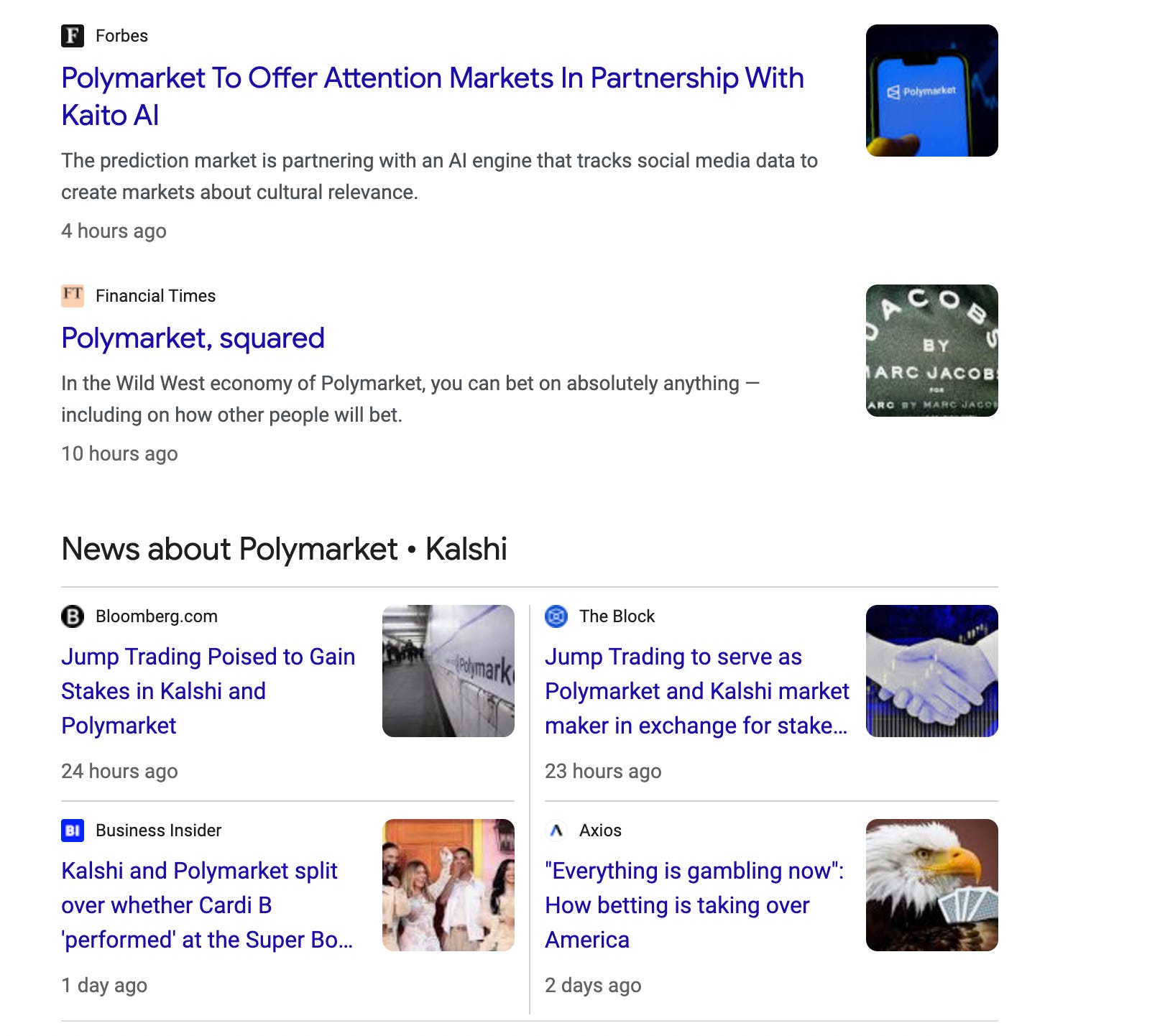
“The prediction market is partnering with an AI engine that tracks social media data to create markets about cultural relevance” is a sentence that makes me want to join a nice off-the-grid commune.
As much as I don’t like any of this, and I very much do not, it’s important to understand it. So, here’s a short overview of prediction markets and what you need to know as they gobble up ever more money and attention.
Prediction markets are gambling but without all the regulation
Prediction markets involve placing bets, but in a different format from traditional gambling. There’s no house setting odds. In a prediction market, buyers and sellers enter into contracts where they bet on the outcome of events. If lots of people believe an event will happen, “yes” gets more expensive and “no” gets cheaper. Bet correctly, and you win $1 for each contract you bought. Bet incorrectly and lose the money.
That’s gambling, and it has similar outcomes. As Kyla Scanlon writes in the New York Times, “Cheap contracts betting on unlikely events lose money at catastrophic rates, often 60% or more, while expensive contracts betting on likely events earn small positive returns.” Because these contracts are structured like financial derivatives, they’re regulated by the Commodity Futures Trading Commission, an independent federal agency that regulates futures contracts. This agency was built to regulate agricultural futures markets. Now, it’s charged with regulating entities that pose questions like “will Cardi B. perform at the Super Bowl?”
States and casinos are frustrated
Because the CFTC regulates prediction markets, they are not subject to state regulation in the way that traditional casinos and sports betting are. States that reluctantly permitted sports betting in exchange for a new public revenue source aren’t getting a cut of the action on Kalshi and Polymarket, and they’re watching sports betting migrate from the sources they can regulate to the Wild West of the prediction markets. A number of gaming associations are pushing for greater regulation of prediction markets, and I imagine their pressure on legislators to do something about prediction markets will intensify. It’s a rare moment when I find myself rooting for casinos.
You can bet on absolutely anything
Prediction markets currently have no real guardrails around them. You can bet on an event occurring—yes, a sex toy will be thrown onto the court during a women’s basketball game—then go to the game, throw a sex toy on the floor, and collect your earnings. My interest in this topic tripled when I learned that an anonymous trader opened a brand new Polymarket account to bet that Nicolas Maduro would be out of power by January 31 and made over $400,000. There was a minor internet controversy about Karoline Leavitt abruptly ending a press briefing 30 seconds before an event contract said she might. When you can place a bet on anything, it’s easy for the internet to believe that every single action—however large or small—is financially motivated.
It’s not hard to imagine these markets leading us to dark places. Alex Goldenberg has written a chilling piece about the national security implications for War on the Rocks. Saahil Desai has written an equally chilling piece about how prediction markets could impact our elections for The Atlantic. If we want to avoid these outcomes, Congress will have to act. The markets won’t regulate themselves. Kalshi’s co-founder has explained the company’s long-term vision as “financializing everything—creating a tradable asset out of any difference in opinion.”
Rep. Ritchie Torres has proposed legislation that would place some limits on government officials using inside information to place bets on prediction markets. It’s a good first step, but I think much more is needed. As listener Liz said in a comment on a recent Pantsuit Politics episode, “we’re all pretty in agreement that some things shouldn’t be for sale.” If we mean that, we need to act because right now, it sure looks like everything is up for sale.
Prediction markets are now news, and news is now prediction markets
A key aspect of the prediction market business is selling data. Both Polymarket and Kalshi are “partnering” with all sorts of companies to offer access to the market’s thoughts as expressed through bets. There are deals to allow New York Stock Exchange customers access to Polymarket data to inform their trading strategies. The Wall Street Journal, CNN, and CNBC all have partnerships with prediction markets. As Scanlon put it, “The news is now read alongside people betting on the news.”
In a world awash in AI-generated slop, it’s hard enough to know what’s real. I don’t think taking in “the market’s thoughts” about what might happen alongside actual reporting is helping.
The Trump family is interested
I’m not holding my breath for the current administration to act. The CFTC slashed its enforcement office to non-existence, and its last remaining attorney just resigned. Its chair has signaled that this administration will look to minimize regulations and maximize innovation.
And why not? The Trump family sees prediction markets as yet another business opportunity. Donald Trump, Jr.’s venture capital firm, 1789 Capital, heavily invested in Polymarket, and he is an advisor to both Polymarket and Kalshi. Trump Media and Technology Group has announced plans to launch its own market: Truth Predict.
The President himself is Trump Media and Technology Group’s majority shareholder.
I had no idea how pervasive this had become. 😳
I feel like this is the clearest sign of the wheels coming off the capitalist project. Thanks to the extreme wealth inequality, the elite are dissatisfied with mere billions while finding it harder than ever to squeeze blood from the stone that is the middle class. They no longer want to sell products or services that require materials, labor and skill — they want to sell something that costs them nothing like vibes or ✨predictions.✨
Kalshi is ALL OVER in game adds right now and kthnx, Ih8it as the kids say. Even my own kids are complaining about it. (My answer (play less phone games) is not a good one apparently.)
I feel like this is just a nightmare in waiting... if it isn't already a living nightmare. I fail to see ANY good that can come of this.