


Opening the The New York Times app reveals a vivid picture of global stress:
Trump Heckles Europe Before Heading to Davos
European Leaders Push Back as Trump Reinforces Greenland Threats
Greenland’s prime minister says he cannot rule out a U.S. attack
Canada’s prime minister says there has been a ‘rupture’ in the world order
U.S. stocks and bonds fall as Trump ramps up his threats over Greenland
With Threats to Greenland, Trump Sets America on the Road to Conquest
Back on January 8, 2025, I made an episode of More to Say about Greenland and what I described as Trump’s “patently ridiculous” talks about purchasing it. Since information helps me cope with stress, I wanted to revisit that research today and share it in a different format.
Greenland’s Geography
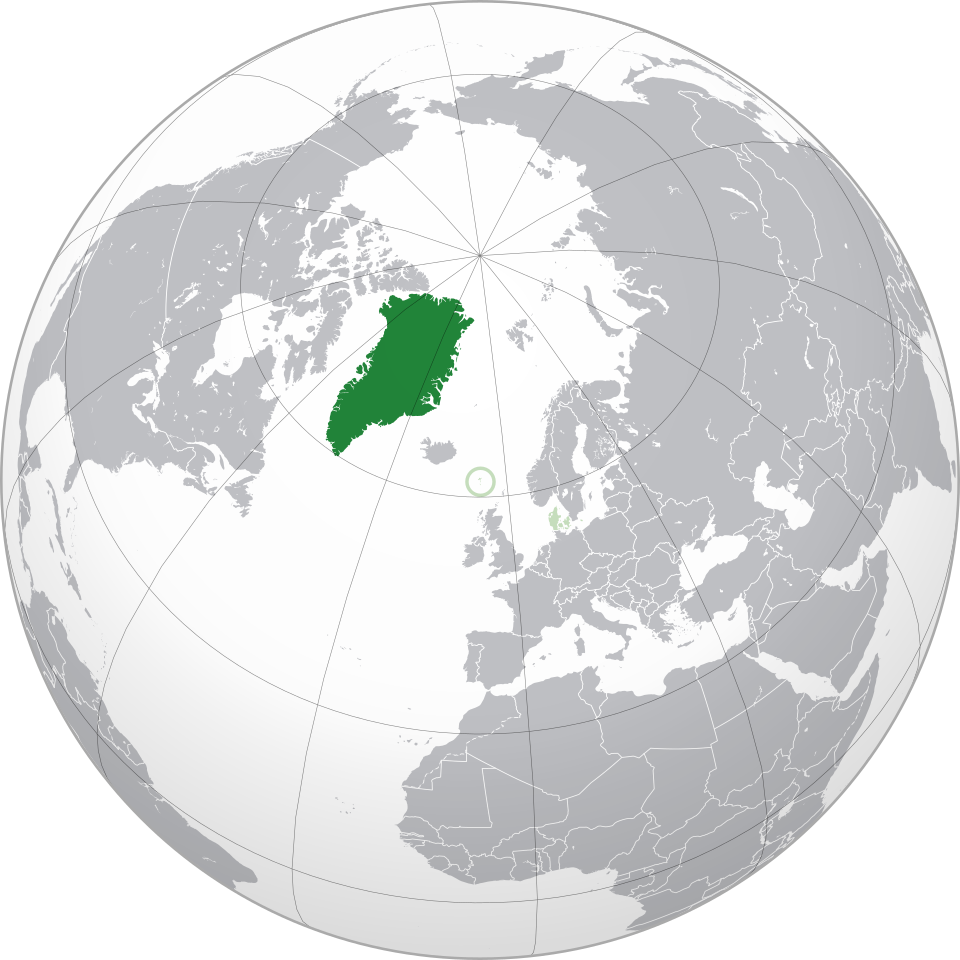
Greenland is the world’s largest island. In terms of land, it’s more than three times the size of Texas. It’s larger than Alaska by a lot.
Two-thirds of Greenland lies in the Arctic Circle. The northern part of Greenland is less than 500 miles from the North Pole.
Four-fifths of Greenland is an ice sheet that’s bigger than any ice sheet outside of Antarctica. The base of it is melting, fast. It is gorgeous and mysterious and hugely consequential.
The remainder of Greenland is coasts and highlands — also gorgeous.
Greenland’s People
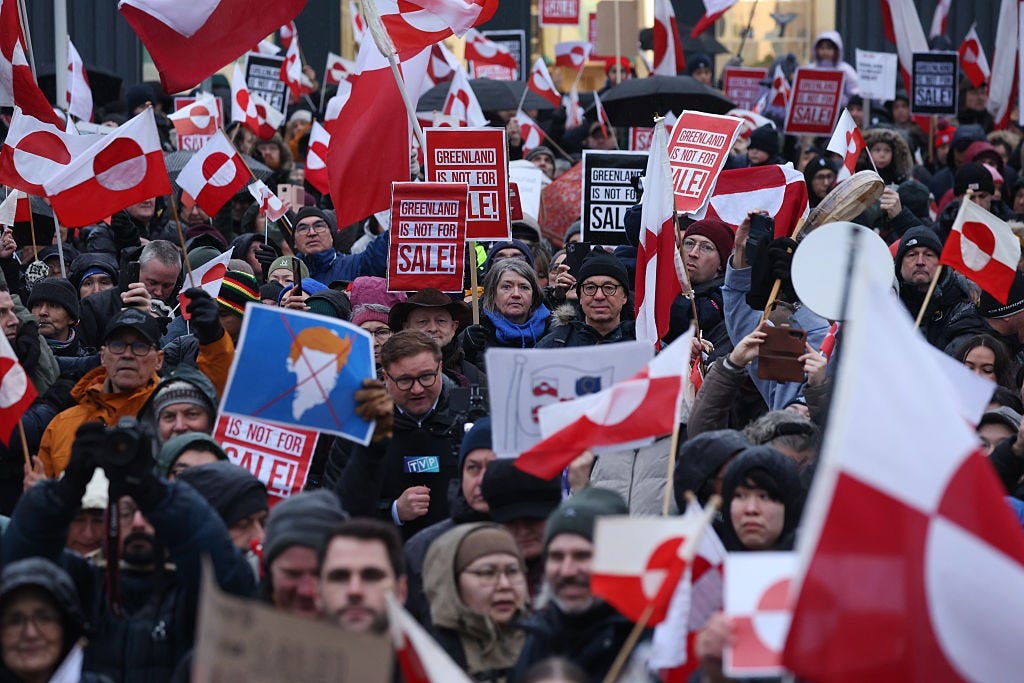
About 57,000 people live in Greenland — fewer people than live in any U.S. state and slightly more than live in American Samoa.
Ninety percent of Greenland’s population are Inuit, the indigenous people of the Arctic and subarctic regions. West Greenlanders identify as Kalaallit. East Greenlanders are Iit. The people of the Thule district are Inugguit.
Ten percent of Greenland’s population are Danish. It’s believed that the Inuit crossed into Greenland from North America over a long period of time. When Erik the Red was banished from Iceland for manslaughter in 982, he settled in Greenland. He told everyone in Iceland how amazing Greenland was and organized an expedition that resulted in two settlements there. In 1721, Hans Egede founded a trading company in Greenland with the permission of the United Kingdom of Denmark-Norway. Greenland remained a Danish colony for more than 200 years.
Greenland’s Governance and Economy
Greenland came under the protection of the United States during World War II, when Germany occupied Denmark. It was returned to Denmark in 1945.
The people of Greenland advocated fiercely for reforms in Denmark’s administration, and Denmark granted home rule to Greenland in 1979. It is now an autonomous Danish colony.
The people of Greenland have accused the Danish government of genocide related to an involuntary birth control campaign launched in the 1960s.
Denmark has also publicly apologized for a 1950s experiment in which children from Greenland were taken to Denmark.
Denmark controls Greenland’s foreign affairs and contributes two-thirds of Greenland’s budget revenue.
The remaining revenue comes from fishing, canning, and freezing sea life.
Greenland has tried to diversify its economy by focusing on tourism.
Nearly half of Greenland’s workforce works for its government.
What Interests the Trump administration in Greenland
Greenland is mineral-rich, but it has limited mining out of concern for the environment.
As sea ice is melting, it’s opening up tracts of land for exploitation.
In 2021, Greenland banned all new oil and gas exploration in its territories.
Greenland has deposits of iron, uranium, copper, diamonds, and 25 of 34 minerals referred to as “critical raw materials.”
President Truman wanted to buy Greenland. In 1946, he offered $100 million in gold for it.
China and Russia are both making inroads in the Arctic because of shipping lanes and mining. As the polar ice caps melt, new potential shipping lanes are opening up that could speed up international commerce.
China has declared itself a “near Arctic State” and has tried to promote itself as a responsible major country in the Arctic. It has icebreaker vessels and research stations in Iceland and Norway, and the Pentagon worries that civilian research will lead to a stronger Chinese military presence in the Arctic Ocean.
What Now?
Truly, I have no idea. I count nothing out of the realm of possibility with this administration.
I’m trying to put the very real people who live in Greenland at the center of my thinking. We know that they unequivocally do not want to be part of the United States. A strong majority of them would prefer to be independent from Denmark, too. Independence from Denmark was already complicated because of Greenland’s financial reliance on Denmark. The United States is making that independence calculation even more complicated. Denmark and its European allies certainly look more respectful and reliable partners than the United States at this moment in history.
My hope and prayer is that the American people, through our Congressional representatives, make very clear that we respect the dignity and autonomy of the very real people who have inhabited and cared for Greenland for centuries.
Thank you, Beth. This was so easy to follow. Now I actually understand all of the dynamics. Greenland is not ours for to pillage or govern. I hope Denmark, the European nations, and NATO will defend their sovereignty.
Thank you for the concise information Beth. I know my knowledge of Greenland is pretty much non-existent, so appreciate the additional info.