


Dear Pantsuit Politics:
I have a question about the Supreme Court’s ruling about districting and the Voting Rights Act. I’m disappointed that they seem bent on disenfranchising people. Can you please speak to why we have districts at all now? Why can’t all citizens place votes in an election and then the state as a whole tally the votes for an elected official? Seems like that would allow for a true majority election? And the districting now seems so vulnerable to cheating. - J.
I love this question. It cuts right to the heart of how our system is designed and how it’s functioning.
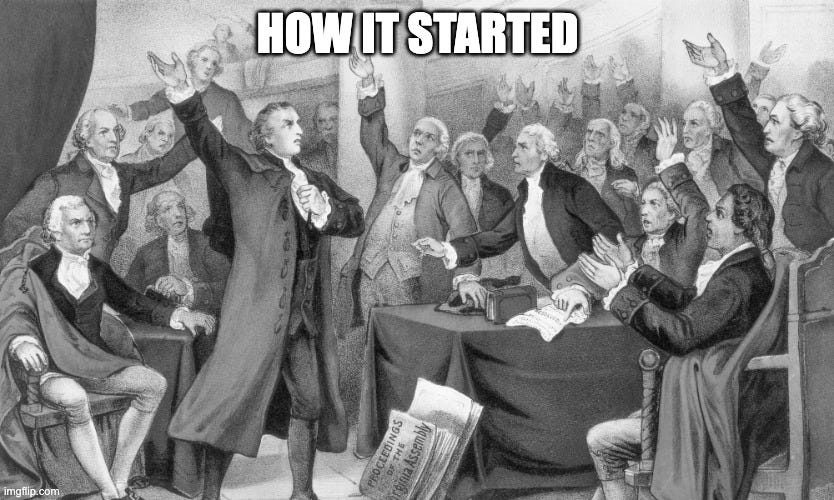
Article I of the Constitution creates Congress with its two chambers: the Senate and the House of Representatives. These chambers are designed to be different from each other:
The Senate is very small-r republican (focused on the rule of law, civic virtue, and guarding against tyranny, either from a monarchy or from a majority) in its design: every state, no matter its population, gets two senators to serve six-year terms.
The House of Representatives is very small-d democratic in its design (focused on the power of the people expressed through majority rule): every state gets at least one Representative with additional representatives apportioned based on population. Article I says that we’re supposed to have one representative for no more than 30,000 people. Each Representative serves a two-year term.
From these differences, we imagine Representatives being more connected to the people they speak for than Senators. This was a brand new idea, and the Constitution didn’t tell the states how to run with it.
This week’s newsletter is sponsored by Babbel

Learn a new Language and get up to 60% off your subscription at Babbel.com/PANTSUITNEWSLETTER
J., four states did exactly what you’re suggesting! Connecticut, New Hampshire, New Jersey, and Pennsylvania elected their Representatives on state-wide general tickets. Georgia and Maryland had general tickets, but also decided Representatives had to live in the areas they’d represent. And the rest of the states drew geographic districts to elect their Reps.
We put this idea into practice for the first time in 1788. In the states that drew districts, there was partisan maneuvering from the get-go. In Virginia, for example, anti-Federalists drew lines so that James Madison would be up against James Monroe, hoping to keep Madison out of Congress. Nothing about the way we live creates an obvious system for drawing boundaries (just think about the shapes of the states), so people brought their personal priorities to the table immediately.
Legislatures across the country made choices that favored their parties, and we soon had a name for this: “gerrymander.” The term dates back to 1812, when Massachusetts Governor Elbridge Gerry’s party drew a district that looked like a salamander to increase their power in the state senate.
From the beginning, we’ve known that drawing districts is a messy business prone to partisan shenanigans. But, the state-wide tickets weren’t faring much better. In Pennsylvania, the Federalists were hugely popular in populous Philadelphia and were cleaning up on the statewide ticket. Folks in western Pennsylvania were not feeling represented at all, so for years, Pennsylvania and other states switched back and forth. Some years they’d have state-wide elections; in other years, they’d draw districts. It all depended on who won and what they thought would serve them the next time.
Eventually, Congress passed laws (the Apportionment Act of 1842 and the Uniform Congressional Districting Act of 1967) to stop the back-and-forth and require states to draw single-member districts: divide the state up into sections; each section gets one representative; that representative is supposed to live there and understand and genuinely represent that section’s concerns. Those laws also had partisan motivations. Human selfishness, group affiliation, and competitiveness have been baked into this system from the beginning.
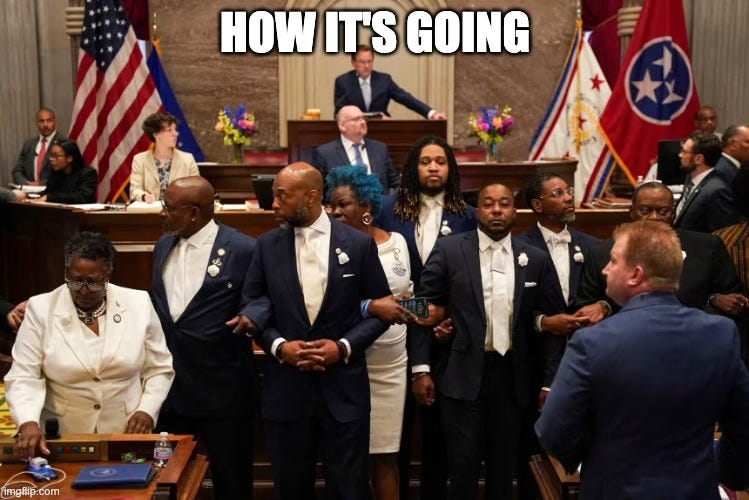
Since we’ve tried it, we know that state-wide tickets for Representatives create the same problems for the House that we see in Senate races: population centers have outsized control. We see even redder or bluer results. State-wide races are expensive to run, so we have even less diversity among candidates for office. I wish the state-wide ticket could be our solution, but I don’t think it is.
I also don’t think there’s a world in which we’ll draw “fair” districts. I think we can draw fairer districts. I am enthusiastically supportive of independent commissions trying to do this. But drawing lines across people and space is hard. My friend Maggie just attended election-official training and came back with so many stories from the county clerk about homes that are in one city for elections and a different city’s zip code and a different district for school. I think constantly about Switzerland and Italy having to adjust the border under the Matterhorn because of melting glaciers. We just don’t live in neat blocks.
Even more fundamentally, we are gerrymandering ourselves by moving to areas where people share our views. Partisanship has impacted our thoughts about where to live and where to visit. And this has ripple effects for daysssss. As states, counties, districts, and cities get redder or bluer, it’s easier for voters who aren’t in the local majority to opt out of the process, believing their votes won’t matter. Some of our most intense negative partisan sentiment comes from people who are red or blue “dots” in opposite districts.
The Supreme Court has taken a hard pass on gerrymandering disputes in federal court, and we know that partisan line-drawing is as old as the country, so…is all lost?
No! There are lots of good ideas about making our union more perfect.
*Cue Sarah*

In 1929, Congress set the number of Representatives at 435, when about 122 million people lived in the United States. I’m not great at math, but even I know that puts us way out of the original 30,000:1 ratio.
In 2026, we still have 435 members of the House for about 343 million people. The average representative now has more than 750,000 constituents. Delaware’s representative has just under 1 million constituents. Wyoming’s representative has the smallest number of constituents, at around 577,000. Still, over half a million people is so many people! If this is the people’s House and we have a lot more people, maybe we need more people in the House.
When we put all these pieces together—geographic sorting by partisanship, partisan gerrymandering, districts that are too large—I think a useful step forward is to make our primary elections more competitive by opening primaries in all states.
According to Ballotpedia:
14 states require open primaries (you don’t have to be registered with a political party to vote in its primary)
13 require closed primaries (you can only vote in the primary of a party if you are registered with that party)
10 require semi-closed primaries (independents can participate in primaries)
5 require top-two style primaries (voters choose among candidates of all parties)
11 give the political parties discretion to decide (*buries my head in my hands*)
There are nuances state-by-state, but let’s stay with the big picture: the fastest-growing bloc of voters is independents. Both major parties are underwater with voters. Any system built on closing ranks around the Republican and Democratic parties as they exist today needs a fresh look. We need more pluralism in everything/everywhere/all the time.
There are other paths forward!
Congress could pass a law banning mid-cycle redistricting, requiring states to wait for a new census before changing the lines. Short of that, Congress could pass a law prohibiting changes to districts in election years.
Congress could pass a law banning partisan gerrymandering and defining the characteristics of acceptable districts for purposes of federal elections.
We could take ranked-choice voting out for a nationwide spin!
State legislatures could pass laws that hold themselves to higher standards on districting.
Voters could advocate for changes to state constitutions that define characteristics of acceptable districts.
There are ideas floating around about using algorithms to facilitate bipartisan negotiations around maps.
We’ve had issues from the beginning, and no system will be perfect. Also? No system has to stay stuck. I don’t think anyone likes where we are (I very much do not). We have options, and there’s nothing more American than continuing to experiment. - Beth
Do you have questions for Sarah and Beth? Let us know in the comments or send them our way at hello@pantsuitpoliticsshow.com
Thanks to Sarah, Uncap the House is my new battle cry. I mention it at every opportunity. It will be my primary question for my House Congressional candidates. Seriously, if they don't want to discuss increasing Indiana representation, I don't want them as my representative.
Thank you J, for asking this question! I was left wondering the same after the discussion of gerrymandering the other day. This was so helpful!