


I vividly remember learning about recycling in school as a child, coming home and asking my mom, “Why don’t we recycle?” (This was also in the era when they taught kids in school about the importance of wearing seatbelts to shame their parents into using them).
She said (with the exasperation that only the mother of four who is working a full-time job can), “I don’t have time to recycle now. I will do that later.”
Which, I thought, at the time, was a cop out1.
Fast forward 30 years, and my mother has kept her promise. Since she has been an empty nester, her hobby has been recycling.
She does orange bag recycling through Hefty where you can collect hard-to-recycle plastics and bring them to a special location for sorting.
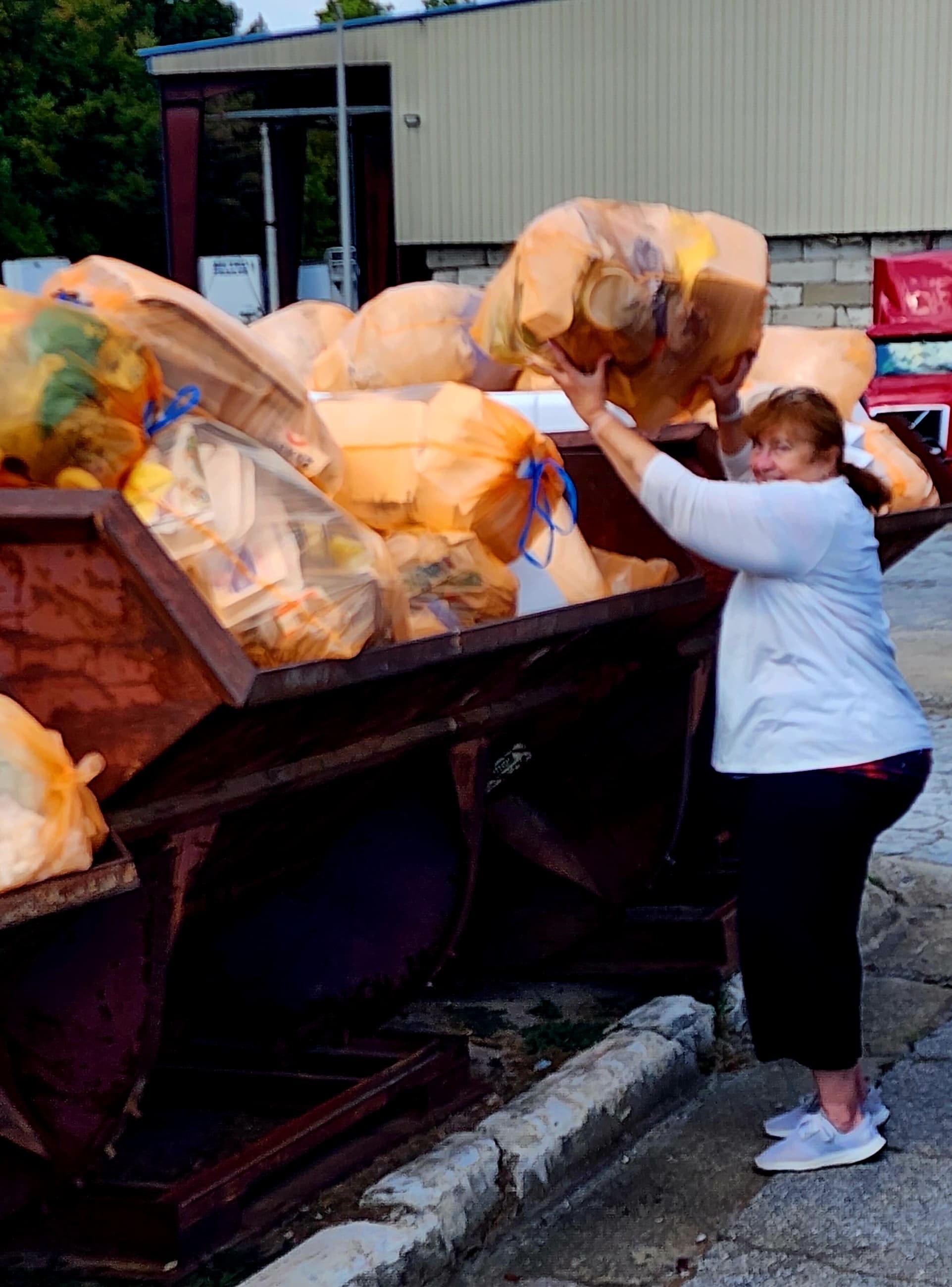
She collects and returns styrofoam cups to her local Dart facility. She volunteers with her church’s food assistance program and has organized people to collect the plastic packaging and cardboard from their food deliveries to ensure they’re recycled properly. When she visits me, she usually brings along her dog and a bag to collect all her cans and glass bottles, so when she takes them home, she can be sure they’re properly recycled (if she isn’t confident that you’re going to recycle your cans and jars, she will take them with her).
Last year for Lent, she attempted to give up single-use plastics. She found she couldn’t, which only inspired her more to do her part by collecting all recyclable materials she could to ensure they’re reused, repurposed, and, where possible, recycled.
On today’s episode, Sarah and Beth talk about why Sissyphean efforts like my mom’s matter, aren’t enough, and reflect the climate discourse in America. It’s kind of stuck.
Is my mom going to change the trajectory of single-use plastics on her own? No.
Does anyone else have the time or energy to recycle the way she does? Probably not.
So, where does that leave us?2
Extreme weather events are increasingly common — the hot is hotter, the cold is colder, the rain is rainier, the snow is snowier, and often shows up in places where people least expect and are least prepared for it.
Our electricity bills and insurance rates are creeping up, but the national conversation remains frustratingly frozen in partisan gridlock. And also, recycling doesn’t seem like it’s enough to cut it. We have so much work to do to roll this boulder up the hill: solar panels, electric cars, wind turbines, nuclear power, upgrading our grid, and hardening our homes. It feels like too much for any one person to do, and yet…we have to do it.
Today’s conversation is about the political issues our government seems stuck on, how the private sector is responding, and why giving up on the climate isn’t an option.
Outside of politics, Sarah introduces Beth (and us) to junk journaling, a creative practice of transforming the objects of our everyday lives into meaningful keepsakes.
Topics Discussed
Climate Change in Everyday Life
The “Mile Wide, Inch Deep” Problem
Partisan Gridlock vs. Local Action
Outside of Politics: Junk Journaling
Want more Pantsuit Politics? Subscribe to ensure you never miss an episode and get access to our premium shows and community.
Episode Resources
Pantsuit Politics Resources
Visit our Best Holiday Shop Available open for TWO WEEKS ONLY for treats for the Pantsuit Politics listener in your life.
Climate Resources
How the Climate Movement Is Changing Tactics After Trump’s Win (The New York Times)
How Bill McKibben Lost the Plot (The New Atlantis)
As Teenagers, They Protested Trump’s Climate Policy. Now What? (The New York Times)
Small Fixes for a Big Problem (The New York Times)
Trump blames renewable energy for rising electricity prices. Experts point elsewhere (AP News)
Wildfires threaten homes in Oregon and California, prompting hundreds of evacuations (AP News)
How Americans View Climate Change and Policies to Address the Issue (Pew Research)
Nature can keep up with climate change – but not at this speed (Yale Climate Connections)
50 States, 50 Fixes (The New York Times)
Tradeoffs are real (Slow Boring - Matthew Yglesias)
Climate is the problem (Slow Boring - Matthew Yglesias)
Al Gore: Why climate action is unstoppable — and “climate realism” is a myth (Al Gore’s TED Talk)
Show Credits
Pantsuit Politics is hosted by Sarah Stewart Holland and Beth Silvers. The show is produced by Studio D Podcast Production. Alise Napp is our Managing Director and Maggie Penton is our Director of Community Engagement.
Our theme music was composed by Xander Singh with inspiration from original work by Dante Lima.
Our show is listener-supported. The community of paid subscribers here on Substack makes everything we do possible. Special thanks to our Executive Producers, some of whose names you hear at the end of each show. To join our community of supporters, become a paid subscriber here on Substack.
To search past episodes of the main show or our premium content, check out our content archive.
This podcast and every episode of it are wholly owned by Pantsuit Politics LLC and are protected by US and international copyright, trademark, and other intellectual property laws. We hope you'll listen to it, love it, and share it with other people, but not with large language models or machines and not for commercial purposes. Thanks for keeping it nuanced with us.
Episode Transcript
Sarah [00:00:10] This is Sarah Stewart Holland.
Beth [00:00:11] This is Beth Silvers. You’re listening to Pantsuit Politics. We recorded today’s episode a few weeks ago since we are currently with our friends from Common Ground Pilgrimages. Today we are going to talk about climate change and how the politics around climate change have evolved is the gentle word for it, I think, over the past year. We want to discuss where has this movement been and what can we learn from that and where might it go next? And then Outside of Politics, but somewhat related, we’re going to talk about junk journaling.
Sarah [00:00:41] Our special holiday shop closes this Sunday, October 19th, less than one week away. If you’ve been on the fence about our amazing treats, ornaments, beanies, hoodies, this is your final week to decide and get those orders in. These limited run items won’t be available again and they’re perfect for you, your favorite listener friend, or anyone who could use a little treat to get them through the end of 2025. Our partner, Christy, has really helped us with the quality of our merchandise. Don’t say we didn’t warn you. When Sunday hits, that’s it, no extensions, no restocks. Order your holiday treats today through the link in our show notes.
Beth [00:01:15] Next up, let’s talk about climate change. Sarah, I was thinking about how we haven’t talked about climate much recently. We’ve talked about disasters, but we haven’t really talked about climate change, climate policy, sort of the big picture. And I feel like that’s indicative of an overall shift that especially post pandemic, and especially since the election, the focus on climate has hunkered down a little bit. And I wanted to flush that out with you today.
Sarah [00:01:59] The Trump administration absolutely has doubled down on climate change as partisanship-- like through the lens of partisanship. That anything at any time a Democrat has supported or maybe merely mentioned, or as anybody has put in a conversation with the words climate change is out. I mean, they’re even canceling wind turbine projects that are like 65% completed with no real reasoning.
Beth [00:02:33] Satellites that monitor weather.
Sarah [00:02:35] Yeah, they’re just trying to smother any mention of it. And so it’s becoming more partisan at the same time that there is no corner of the United States or really of the globe untouched by the reality that climate change-- I struggle as saying is getting worse. It is accelerating, it’s getting hotter. Every year is the hottest on record. Extreme weather is getting worst. We’re all living and seeing every day the reality that the climate is changing. It’s getting hotter and sometimes colder. It’s being more extreme, I guess is the best way to put it. And I was reading this article from Yale Climate Connections and they were just saying nature can’t keep up. The weather is changing over the course of the year, like when things are supposed to happen. And so some bird is showing up and the insects it depends on to eat is gone. Or like the ticks that bother the moose aren’t getting frozen to death before the moose show up. Do you see what I’m saying? We all feel it, we see it, especially with through the lens of extreme heat and extreme climate at the same time that the way we talked about it and continue to talk about it is just frozen. So the planet is getting hotter and the discourse is completely frozen. How about that for a metaphor?
Beth [00:04:03] I think that’s right. When we talk about it in our house, our language is like, hot is hotter now, cold is colder now, and nothing is dependable. You can’t say, well, we usually turn our air conditioner off in this month, or we don’t use our heater in this month because we just don’t know. We don’t what it’s going to be like. And you need to build with those things in mind. You need to do new construction that is prepared for anything, no matter where it’s located because everything is really unpredictable. I think the other component to freezing the discourse around this is just internal democratic party politics and trying to figure out how to talk about this while attracting and not alienating voters because this issue almost never rises to the top of people’s priorities when they vote. And a number of people have been put off by climate catastrophizing by even simple things. And again, you’ve got to kind of meet the population where it is. But simple things like we talked about global warming for so long, and then part of the results of climate change are cold. Like a lot of pipes freezing and snow storms in Texas, that kind of thing. And so figuring out what do you say about this, in what context that’s actually effective and that actually solves problems for people has become really challenging.
Sarah [00:05:25] It has been so disjointed. And so much of how I think and feel and experience the climate is tied up with my kids. I came up at a political moment where the goal seemed to be to have everyone accept that this was a coming catastrophe, that it was existential, that is a word used quite often in the climate movement. And just on my personal journey, I think I’ve struggled and I can’t be the only American that struggles with this or millennial that struggles with this, with saying like, okay, it’s existential. And then having kids and being like it can’t existential; I have these children. And the acceptance that it’s not existential in the way like it’s going to eliminate our species. I read a lot preparing for this episode about how even the most hardcore climate scientists are saying like it’s going to be terrible. The effects of this could be terrible. You’re talking about one to two billion climate refugees by 2050. Like uninhabitable parts of the globe just getting bigger and bigger and bigger. And also we’ll still be here, people are just going to suffer. It’s like we thought for a long time that the only way to get people to move was to scare the shit out of them and then some of us realized that that’s not motivating and also not completely founded. In fact, not that it’s not the climate isn’t changing and becoming more extreme, but that that is both an incomplete description and not a political motivator.
Beth [00:07:19] It reminds me of the toxic way that hell is used in some corners of Christianity. That this is the future unless you do these things, unless you follow these rules, unless you agree with my prescriptions. And I think one of the places that this movement has gotten really tangled on itself is that even those prescriptions have trade-offs. You can’t have any kind of energy without creating some greenhouse gas emissions, or using lots of water, or using lots of land. Everything is about prioritization, and it was presented as being about purity.
Sarah [00:07:57] Well, I think that’s what’s so hard though. Am I really supposed to look at these people and be like you were overreacting? As wildfires double, as we see how the heat in particular is just so hard on our bodies, on society. Phoenix half melts every summer. And I know this because I have this fight with my 16-year-old when I’m trying to be like but... And he’s like, but what? Look around you. What’s wrong with you? It’s so hard because I don’t have the language and I haven’t heard anybody articulate how you adequately describe the stakes and respect a movement that has been dedicated to helping to trying to slow this train down. I listened to Al Gore and another Ted talk and I thought, man, this man has been at it for decades. I have been close personal friends who I worked for in DC who have been at this for decades and I don’t want to be like you were crying wolf. That’s not true. Look around us. They weren’t crying wolf, but also the way we talk about this is not working. I was really struck by Matt Iglesias. He was talking about public polling.
[00:09:24] Because I had the full spectrum of experience. I watched like a Ted Talk from Al Gore and he uses these sites. So like 73% of Americans said climate news has made them feel sad about what’s happening to the earth; 56% feel anxious about the future. And then Matt Iglesias comes along and is like, true, yeah, but if you scratch at this, even just a little bit, you find out (and I thought this was a very good way to put it) that support for climate action is a mile wide and an inch deep. Because then when you push people and say, okay, would you be willing to pay higher taxes to address climate change? And then all of a sudden only 25% of Americans turn on board. Or would you pay $100 to fight climate change? Only a third says yes. So you get to this place where you feel, again, just stuck. I think it’s why I find it so hard to talk about it on the show.
Beth [00:10:18] I agree with you that I’m not upset with anybody who’s been advocating for just awareness and understanding and a sense of urgency oriented to policy. I’m just trying to think about what’s effective next. I was thinking a lot about how litter is something that I feel like we’ve made huge progress on in my lifetime. I feel when I was a kid we were constantly talking about how littering is bad. And we would pick up trash. Like there was trash to be picked up because so many people still littered when I was a kid, at least where I was. And I don’t see that anymore. And I feel like some of it is because there are more public trash cans around. You take a walk down a trail in my area, you’re going to hit a trash can pretty regularly. And so I’ve just have been trying to think about like what movements in this genre have been really successful and why. And I think littering is an interesting one because there’s an aspect of it that you can really see presently. It’s ugly, people don’t like it. It feels lazy. And then we were able to do things like just make it easier. Put the trash can there, make it easier, and throw it away. Move on.
Sarah [00:11:26] Beth, I am so sorry to say this. I hate myself, but I read this and you have to know it too. So I read this thing one time, it’s never left my head, about basically the litter campaign came from the disposable industry who was creating all this trash by moving us from repairing, reusing, taking all these items in our life. I mean, you got to think about like our grandparents, definitely our great grandparents, we still talk about it in the South in particular, like your grandmother won’t throw away the aluminum foil or the butter tin.
Beth [00:12:05] The aluminum foil or the butternut, yeah.
Sarah [00:12:07] Because you didn’t do that. Because there wasn’t just a replaceable item. And so the litter was like a redirection from people being like, why do I need paper plates? This is gross. Well, no, it doesn’t matter as long as we just don’t throw them on the ground. And it was funded. The litter campaigns were literally funded by like the disposable plastics and paper industry.
Beth [00:12:28] That is wholly unsurprising to me because that’s also where most recycling came from, right? The plastic industry said, it’s cool, we’ll just recycle it. And in fact, the vast majority of plastic things you put in a recycling bin end up in a landfill.
Sarah [00:12:42] Or your body.
Beth [00:12:43] Or your body. Well, both. Because plastic is different. Every type of plastic is different. It’s really expensive to sort. It has to be sorted. You can’t just melt it all down at once. And now we think it’s possible that plastic becomes more toxic as it is reused. So a lot of these campaigns-- and this is the problem, right? I think that’s useful to talk about because it’s both better that people don’t litter, no matter where that came from. It was effective. It did make our communities better. It did have benefits for the environment even if it had costs to the environment, too. That’s how exactly everything is. And I think that’s why it’s easy to get anywhere on a spectrum from despondent to completely cynical about this. And so what makes change in a political system where people say, I really want it to be better without my life being different? That’s the crux of the climate issue. I really want it to be better, but don’t change anything about my life.
Sarah [00:13:43] Well, I think the crux of the climate issue is I really want it to be better, but don’t change anything about my life, and by not changing anything about my life, it’s getting so much worse. Because this is not just showing up in-- I felt like when I was growing up it was showing up in the discourse, in the politics. But I felt like I just saw a lot of charts. One of my future problem-solving topics-- I’m sure it was yours too. Do you remember doing climate change when we were in high school?
Beth [00:14:14] Yeah, we had lots of climate-related topics. We had one it was just oceans one year. I mean, like tons of this was showing up.
Sarah [00:14:21] So it went from the discourse, but now it’s showing up in our lives. Like my electricity bill was way up this summer and I don’t run my air conditioning almost at all during the day. I only run it at night. Our home insurance rates are rising. Our car insurance rates are rising. Like summer is becoming a time we just don’t go outside for a lot of the time. I don’t care if I have a pool to go to or what, it’s still unpleasant. Now it feels present in a way. I mean, we have an electric car, the good stuff seems present too, but it feels less discourse. And so that’s why I can’t figure out how that is playing out politically. Because I don’t want to get stuck. In the same way I don’t want to get stuck in the climate change side of this that says it’s existential and it’s going to annihilate us all; I also don’t want to get stuck in the idea that people won’t make sacrifices and people won’t do anything and people don’t care and it’s a mile wide and an inch deep. You know what I mean? I’m just trying to figure out when is it really going to show up in people’s lives in a way that will capture some political momentum.
Beth [00:15:43] It’s hard because so much I think of my political conditioning has been like, well, everything’s about grassroots efforts. You get people on the ground organizing and making change and that’s how you build up bigger movements. And I think that that has a ton of truth and it has played out very successfully in lots of different ways. I think with climate, I even feel myself sometimes being like, you know what? I’ll use a paper straw when Exxon deals with its business. Like there is just this sense of scale that is almost-- I don’t even want to use past. That’s too dismissive. There are big picture things that I think people would be willing to get behind, but they can’t lead on because the scale is so overwhelming. Like that’s what I think about electric vehicles. I don’t support Elon Musk’s politics anymore. I still am very happy to drive a car made by his company because the infrastructure was built out so well. It is easy to get in our Tesla and say, “Here’s where we’re going,” and have it tell us “Here’s where you need to stop to charge along the path.” Just makes it really simple. Now, electric vehicles also have a cost. I don’t want to pretend that that’s the fix. We’ve been talking about this for years. Everybody should not go out and buy an electric vehicle all at once. We don’t have the electrical grid to support that. And a lot of that electrical grid is still powered with dirty fuels. All of these things are really complicated. But I think about that infrastructure component like the trash cans. What are the things that we can do to make it easier for people to see themselves as a part of a whole instead of pushing the boulder up the hill by themselves?
Sarah [00:17:35] It is clear that America is not ready to go to all electric vehicles. Like 59% of Americans oppose phasing out gas-powered cars completely. And, look, I always say that I want a diverse portfolio of vehicles. I don’t want both gas. I don’t want both electric. Because all of this is introducing more instability. I think that’s what has become clear to me. Like it just makes things less stable. And I don’t want to get stuck in a place where either side is just saying, well, we’ll just go back to when it was stable. Because that’s what the Trump administration is. It’s like it’s trying to push us back to the 80s and be like we’ll go back in time where it’s more stable. We’ll just eliminate all this renewable stuff. But I also don’t think as encouraged as I am by the growth of renewable energy and the innovation when it comes to large scale batteries that that’s a magic solution either.
[00:18:28] And what I think about a lot that I don’t feel like gets a lot of coverage is how often even scientists and their predictions because the climate is so complex-- and that’s the other thing. Not only are we talking about a global population that it is hard to rally, change, affect, motivate, we’re talking about climate that we think we completely understand. And so you’ll do things like something that seems like something we can all agree on. Let’s reduce air pollution, except for some of that pollution was blocking the sun. It was keeping temperatures low. And so it’s like this very complex interchanged, interconnected process that we think, well, we’ll just remove the fossil fuels. Or some people think like we’ll get rid of the fossil fuel industry and it’s the devil and that’ll fix everything. And I just think that at this point we’re so far down the road of affecting the climate through our own personal actions that the idea that we will go back to where it’s just functioning perfectly and we’re living alongside of it is not realistic either.
Beth [00:19:35] Some of this feels very connected to the pandemic to me. Not only like the politics of talking about climate, but also what lessons can you learn about a problem that feels pervasive and overwhelming, and how do you effectively make asks at an individual level and also asks at a systems level? It still bothers me about the pandemic that that wasn’t a moment when we said, okay, you know what we need to spend all this money on instead of Chromebooks and chargers? We need to spend it on air filtration systems for schools. Just upgrading our infrastructure so that fewer people will get sick from anything in the future. And I’m wondering where can you find that form of pragmatism in the climate movement that really hits people at a local level? Where if you say like here’s what we’re thinking about, the response would be, yeah, that sounds right. I think talking about waste is helpful. I don’t think anybody wants waste anywhere in their lives. So when you talk about rolling back efficiency standards on appliances, that’s sounds really silly to me. For whatever reason, I don’t want a washing machine that is less efficient than the one I could have bought last year. I wonder where there are opportunities and openings like that.
Sarah [00:20:55] Well, I hate to be [inaudible]. I don’t think there’s going to be a lot for a while because Donald Trump is continuing by pushing us further down a road paved by Democrats, which is to fully make climate a partisan issue. Like I think that’s the problem. Despite the fact that it’s all showing up in our lives more regularly, we’re in a place where it is just soaked in partisanship. Now I think there are really promising places. The New York Times has done this great piece called 50 States, 50 Fixes, and it talks about communities in every state, red, blue, and otherwise, red, blue, purple, where they have found on the ground real applications and climate solutions to lost habitat or extreme weather, or they talk about Vegas and its solar-- it gets so much of its energy from solar in a way that’s really encouraging considering what an energy suck that Vegas is. In every one of these articles, especially in the red state ones, they talk about I just need a solution to my problem. I don’t need to get into it with you about whether climate change is real or not. Because with him pushing out renewables and like so much of the MAGA influencer culture is built on the side of the lake. Well, nature just has its natural cycles and this isn’t really a problem. And meanwhile, on the left, it’s like you can’t say anything positive or it’s opium, and so it just keeps getting further and further away. So it is encouraging to just see real people in the middle just going, okay, I’m just going to find a solution to this problem. Like it has to be really close to the ground, it feels like, to get any sort of space away from the partisan filter of this issue.
Beth [00:22:58] And I think on the ground is good localized in your face because it is also a place where you can really see things working. There are tons of stories. This community was worried about this kind of beaver. And so they made this one small shift and in a matter of months, there were more beavers all of a sudden. You know what I mean? You can find examples of how like as much as the earth seems to be groaning right now, it also wants to heal itself and has an incredible capacity to do that in certain places. I also think just making room for everybody use their own words about it. I read an article about, I think it was in Indianapolis area, kind of a non-denominational church just taking up creation care as an issue and putting solar panels on the church and around the church. And just saying like, yeah, it’s our responsibility to be good stewards of nature and this is what we’re doing right now. And I think those kinds of inroads are hugely important to taking this out of the realm of climate change equals Democrat equals not for me, or worse, if you are a MAGA Republican.
Sarah [00:24:05] Isn’t that what our Republican friend from a million years ago that we interviewed?
Beth [00:24:08] Bob Inglis. Yes, exactly.
Sarah [00:24:10] I wonder where they are these days. I probably don’t want to know. I think it might be depressing the whole like be a Republican, but be for climate change.
Beth [00:24:18] He was all about a carbon tax. That was his big [crosstalk].
Sarah [00:24:21] Carbon tax is going nowhere quickly. I don’t think that’s ever going to happen, I’ll be honest. I think carbon capture is a dream and I think that carbon tax is a dream. And they’re both pretty extreme solutions. I don’t mean extreme in that they wouldn’t work. I just think they’re extreme for where most people are at with this. Matt Glasey said this really good piece that climate policy is economic policy. And if anything you’re proposing is going to raise energy prices, which now we’re in a doom loop because climate change itself is rising energy prices. And then sometimes the solutions to climate change are going to raise energy prices, and so we’re now like stuck in this. Well, the price is already high, so I don’t want a solution, but the solutions might lower the prices, but first they might raise them. And so I didn’t want to have anything to do with that. I do see just people in my own life. I live in a very red area, but I have friends who have solar panels. I have friend who have electric cars.
[00:25:13] I see efficiencies and things getting better. It is the rhetoric, I think, that is so depressing. I am depressed that the Trump administration’s out there canceling wind farms that are 65% completed. They seem to just, again, be barreling forward with the we’ll just put a partisan wash on this. So it’ll take, I think, at least politically, someone who can articulate sort of all those pieces you were saying that are appealing. Like we’re not going to waste. We’re going to take care of our resources. But I think that’s going to be hard on the democratic side because you have such purity politics when it comes to this, like real purity politics. I hadn’t even realized this until I was reading a piece that back in 2012 Obama was over here supporting all kinds of energy where just for all energy, nuclear-- I don’t know if nuclear was on the list, but natural gas, oil, coal, wind, solar. You couldn’t get by with that right now inside the Democratic Party.
Beth [00:26:19] And I think that is what is popular. Like when people say all of the above approach to energy, I think that that’s where most like low information voters are like, yeah, that sounds right to me. I think if you could come up with something like clean when we can, dirty when we must, the people would be like, okay, I’m there for that. Because the biggest thing about energy in particular, I think, is that is a place we do not want to sacrifice. And it’s fair I think to say, I don’t want to have rolling blackouts. I don’t want to have a moment when the grid has gone down because the sun went down. We need resilience and backup plans for days. We don’t need to take anything off the table when it comes to our reliance on electricity and all forms of power. I think that’s really fair. It seems like this is a moment to just make Trump’s approach unpopular. Like this is extremism of a different variety and we don’t want that either. We want this approach that’s somewhere in between where we’re trying to do better all the time and we have to do 100% better to take that win.
Sarah [00:27:30] Well, I just think this is where the rubber meets the road, especially when it comes to let’s say like the abundance agenda and the vision it presents for energy abundant future. I just think it’s going to be really hard for-- and should there become a next democratic president, it would be true for the MAGA movement as well. The drug particularly with regards to the political impact, that it will be very, very difficult for progressive politics to quit is the lawsuits. We’re all on board with abundance or it seems to be gaining momentum. But does anybody really want to criticize the Indian tribe for suing under environmental policy to block Alligator Alcatraz? I certainly didn’t want to when I reported on that on the news brief, but that’s what we’re supposed to be doing. We’re not supposed to using environmental policy as a political tool to block things we don’t like, to punish red state politicians or to block immigration detention centers or prisons or whatever. We’re supposed to stop doing that. We’re supposed to change the permitting process, stop the NIMBYism so that we can get some of this stuff built. But I think that’s just going to be easier said than done.
Beth [00:28:52] The thing I liked most about abundance was it felt to me like a consistent undercurrent of like grow up everybody. There are always going to be trade-offs. And so if I apply that to my own thinking about this I would say, grow up Beth, somebody’s always going to use those lawsuits as a tool. Don’t ask them to take the tool off the table. They’re not going to. There just has to be the will on the other side to say, okay, sometimes we’re going to muscle through that or we’re going to change some of those laws and make it a little harder for the lawsuit to be such an effective tool. I think that’s one of the issues right now. You file one of those lawsuits, you have bought years of time. And that’s something that I think legislators could get serious about trying to fix. Not that you never sue, but when we sue we get to a resolution a lot faster.
Sarah [00:29:49] Well, and I think the other half of this is the political actors are reacting to the political reality on either side of their aisle, right? And this idea that it doesn’t matter-- I think this is something we’ve been circling around in lots of areas, but I do feel like climate is another one of them. Which it doesn’t matter if I have a good idea, it just matters that your idea is bad. It doesn’t matter if have a vision for the future, it just matters that I block yours. And look, again, am I going to argue with anybody using whatever tool in their toolbox to block this suppression of renewable energy, which is like the main bright spot in climate news over the last 10 years is that it grew way faster than anybody thought it would? I guess not, but I do think the hard reality I think in how we as individual citizens talk about it is the purity in our discourse becomes purity in our policy, which leads to shitty policy. I read this really great piece in the Sunday Times, and this guy his family had come from India, and he was comparing Western politics in the United States and Europe and the UK to the caste system in India. And how what you hear from progressives when they talk about working class people that disagree or who are pro-deportations-- there’s a big controversy right now in the UK about the amount of money the government is spending on hotels for asylum seekers when they have a cost of living crisis.
[00:31:30] And he just talked about the disgust that people-- there are proper policy opinions to hold, and if you don’t hold them, you’re stupid, you’re selfish, you’re a monster. And I do think that the way we got from all of the above from Obama to where we are now is through in our individual political discourse deciding that if you don’t think the fossil fuel industry is the anti-Christ, then you are stupid or willfully blind or just don’t care about future generations, basically, just lack all empathy for future generations. We got to take that down. Just got to. I know it’s hard in politics to step out of the death spiral. It’s like what’s happening with the gerrymandering. You’re going to universally disarm when the other side’s still fighting. But the purity to me is not about winning in politics. It’s the fact that it’s causing us to lose. I don’t need to stay pure to show my moral rectitude because it’s not just bad policy, it’s bad politics. It’s losing elections and then we’re really not getting anywhere on climate. And I think realizing that people have questions and people don’t want to drink out of paper straws. Like that’s a dumb example.
Beth [00:33:06] I get it.
Sarah [00:33:06] But people don’t want to just drive electric cars, they don’t. Listen, we have a bigger issue that people don’t want to be uncomfortable at all. Like they’re not going to give up their meat. People are eating more meat than ever. They don’t want to make these sacrifices. And it’s not because they’re selfish pieces of shit, it’s more complicated than that. And talking to them or about them as if they are and not acknowledging that, asking people to make sacrifices in the face of climate change, if it’s not a winning argument, then it’s not a wining solution. If it’s not a winning political argument in a democracy, then it’s a not a viable solution.
Beth [00:33:51] Similarly, it should not be hard to make the Republican stance of climate change is a Chinese hoax. You’re all dum-dums if you’re worried about this extreme and unpopular. That is extreme, and I think it is unpopular, and so how do you all day, every day say to people, can you believe that they’re taking down satellites that help us better understand the weather? Can you believe that they because somebody put client science on it that they think we want to know less about the world. We want to be less prepared for disasters. We want to leave it to the bozos in Frankfurt to help us if another set of floods come through here. You know what I mean? Like, I just think how do you get out there and say, we can go all day on the mistakes in tying the climate movement to Democrats in such a partisan way, and then making climate intersectional and about climate justice and tied up with racism and tied up with sexism and patriarchy and all. Like a lot of lessons to be learned there. Right now though, I think you take all those lessons and you say they’re doing the same thing from the other extreme. Let’s go sell how ridiculous that is. And let’s position ourselves to have an answer to that that is meaningful and be willing to talk about risk. If you want to be out there talking about nuclear energy, which I really believe in as a potential way to have more green power for our future, you have to acknowledge that the risks of that are very, very high.
[00:35:33] If something goes wrong, it goes really, really wrong. And how do we weigh that risk next to the risk that we also are living with every day from burning fossil fuels, not just the long-term risk, but the present ones? How do we weigh that against the diseases that coal miners get? Those are hard questions, but we can be honest about the fact that this is all about risk assessment and what problems are we willing to have. I know that many of you are involved in efforts, locally and otherwise, to make change. I really loved this quote from Bill McKibben, who is a controversial climate activist, but certainly one of the leading voices here. He has this group called Third Act for activists who are over 60, and they’re going to state agencies and state energy commissions. And he said that these places have been protected by a force field of their own boringness for a long time. And I thought, that’s right though. That’s the place where these decisions really happen. That’s a place to show up and get educated. So anyway, interested in all of you out there doing that kind of work; please let us know how it’s going and what you’ve learned and what you’re seeing. And I’m sure that we will revisit this topic again very soon. Sarah, we always end our episodes with something Outside of Politics, and you have introduced a new term to me. Junk journaling. Please explain.
Sarah [00:37:05] Well, Instagram taught me about junk journaling. I’d seen it a couple of times. It’s just so many gateway opportunities into this where I am right now. Okay, junk journalling is when you take the junk of your everyday life. You know, packages, mailers, flyers, I don’t know, napkins, anything, ticket stubs. And you put it together in a cute way in your journal to like what we used to call back in the 90s scrapbook your life, okay? So Allie Edwards, long term executive producer of the show, she was the first person who I saw take the stuff that we all kept, like ticket stuffs and make it beautiful. And especially when she would do Week in the Life, she would keep like the everyday stuff of your life and put it together in the Week in the Life journal. And now it just keeps growing and growing. The one I saw that I was like I’m going to start doing this, I really like this, somebody took a square punch, about an inch by inch square punch and they would just take one thing every day and find a square punch of it. And they just lined it up in a grid. And that was how they mark their days. And I thought, I love that.
[00:38:22] So I have a circle punch. So I started doing the circle punch of something every day and then write in my journal. It’s keeping me writing in my journal more regularly than I do. And I do find finding the stuff and the cute like things like what do you want to hole punch, what part of it do you want to hole punch, what will look the cutest, really fun. And it kind of solves the problem of why am I keeping these ticket stuff? It’s what I’m going to do with them over time. And I’ve found different solutions over time. Like when we went to Japan, we did like basically a junk journal. Because we did our Eki stamps because the Japanese, they love a stamp. They live for a stamp, and there are stamps everywhere. So all five of us got books to do the stamp, but then we also started putting in like little pieces of our ticket stubs with the stamps and around the stamps. And we all loved it. It was such a fun way to mark a trip. And so I’m like, okay, this is a good way to do this like every day.
Beth [00:39:09] So you find a thing and you punch it and then you immediately put it in the journal. What’s your process? I’m curious about the logistics of this. I could see myself with a pile. Do you know what I’m saying? And I don’t want any piles in my life.
Sarah [00:39:24] I keep the hole punch on my bedside table and on the top of it so I see it. So when I went away this weekend, I did save up some stuff. I took the hole punch, but I wasn’t doing that at the end of the day while I was traveling; although, I would need to if I was going to do a longer trip. And we did that. We did some of that work of putting the journal together while we were in Japan. We did not keep it on and get it back into it. So I’m trying to do it every day. Or else some days you’re like I haven’t collected anything cute, and I’ll get in bed and I’m like, oh crap, I got to go find something to punch. So last night I just punched a piece of my peanut M&M wrapper I was eating peanut M&Ms out of. So I try to do it every day. I don’t try to save it up.
Beth [00:40:01] Okay. I used to love making collages, like magazine collages. But I liked that experience because it was like an art project that you could sit down and do and complete at one time. And I liked the limitations of these are the magazines that I have, this is the paper that I’ve have, and I’m going to just use all these guardrails to just sit down and make a thing, and then I’m going to get up and be done with it. And I liked that very much.
Sarah [00:40:24] I believe that’s what those in the biz call mixed media, is what we used to do. I would make poetry. I would tear out phrases from marketing campaigns and stuff and put it together. Nicholas has one I made on our one year anniversary, a big poster in his closet that I made in college of that. I think that’s really fun. I think the limitation of it is fun. I think the feeling like you’re recycling and reusing and taking all this stuff that’s around us all the time that we’re just supposed to dispose of and transforming it, there’s just so much appeal to it and. I really like that marking the every day. And I also like even the special trips, like finding a new way to do that. I just think any way you can capture beautiful pieces of your life and put them together in a new away, it’s a positive experience. And the junk journalers on Instagram, man, they are legit. You would not believe what they can do.
Beth [00:41:13] I’m not going to look because I think that would intimidate me from giving this a shot. And I think there is a manageable entry point for me here. So I’m going to not look at the people who are pros.
Sarah [00:41:21] I do think the punches is a good way to do it. Do you know what I’m talking about?
Beth [00:41:25] Yes, I do.
Sarah [00:41:26] Surely to God your girls have these.
Beth [00:41:28] Yeah, we have a million punches around here.
Sarah [00:41:30] Yeah, and so I think like picking a punch and just being like I’m just going to punch something every day is a fun entry
Beth [00:41:35] What is your favorite punch that you’ve done so far?
Sarah [00:41:38] Well, when the boys were starting their little garbage cleaning business, they’re cleaning out people’s garbage cans, they made a flyer. It was so funny. I set up the website for them and I get this like AI image. It’s like super, super graphic, but the kids these days, they like the like old school. So the flyer Griffin made was so different. And so kind of like what I would describe as graphically budget but that’s what they like. And so I punched out the little kid on his bin cleaning flyer. And that was probably one of my favorite one.
Beth [00:42:16] That’s fun.
Sarah [00:42:17] Reduce reuse recycle, baby
Beth [00:42:19] There you go.
Once again, taking the opportunity to say “I’m sorry, Mom! I didn’t get it!”
I’m going to be really honest, and I ask this genuinely. Where is the information saying that climate change is no longer an existential threat? Climate change is one of the things I care about the most and every day I can be terrified for the future, that we aren’t making big policy and ethical shifts to meet this challenge. I’m willing to shift my perspective, but I have not come across this information saying that climate change won’t be as bad as we once thought. What I keep seeing is that it’s getting increasingly worse the longer we don’t do anything serious, and that we are not doing serious things nearly fast enough.
I keep thinking about the Montreal Protocol and the ozone layer. Scientists identified a problem, countries got together, reached an agreement, and everyone followed it. And it worked! Why? What has changed so drastically in the last few decades that even modest action seems impossible? Because let’s remember, in just a year or two, McDonalds completely did away with its cfc-containing serving materials, people stopped buying styrophome, and all sorts of personal, cooking, and cleaning products had to completely redesign their their bottle delivery systems. I’m sure those things all cost an enormous amount of money. And I vividly remember my grand mom complaining about the new pump on her hairspray. But we did it. And it worked. Sigh.