


Sarah and Beth return from their summer break to discuss how they decide what to cover in today's chaotic political landscape. They dive into the Texas gerrymandering battle and explore the broader shift toward state-level governance happening across America.
Topics Discussed
How We Choose Our Topics for the Show
The Shift from Federal to State Power (and What It Means)
Texas Gerrymandering and the National Response
Outside of Politics: Hosting Parties
Want more Pantsuit Politics? Subscribe to ensure you never miss an episode and get access to our premium shows and community.
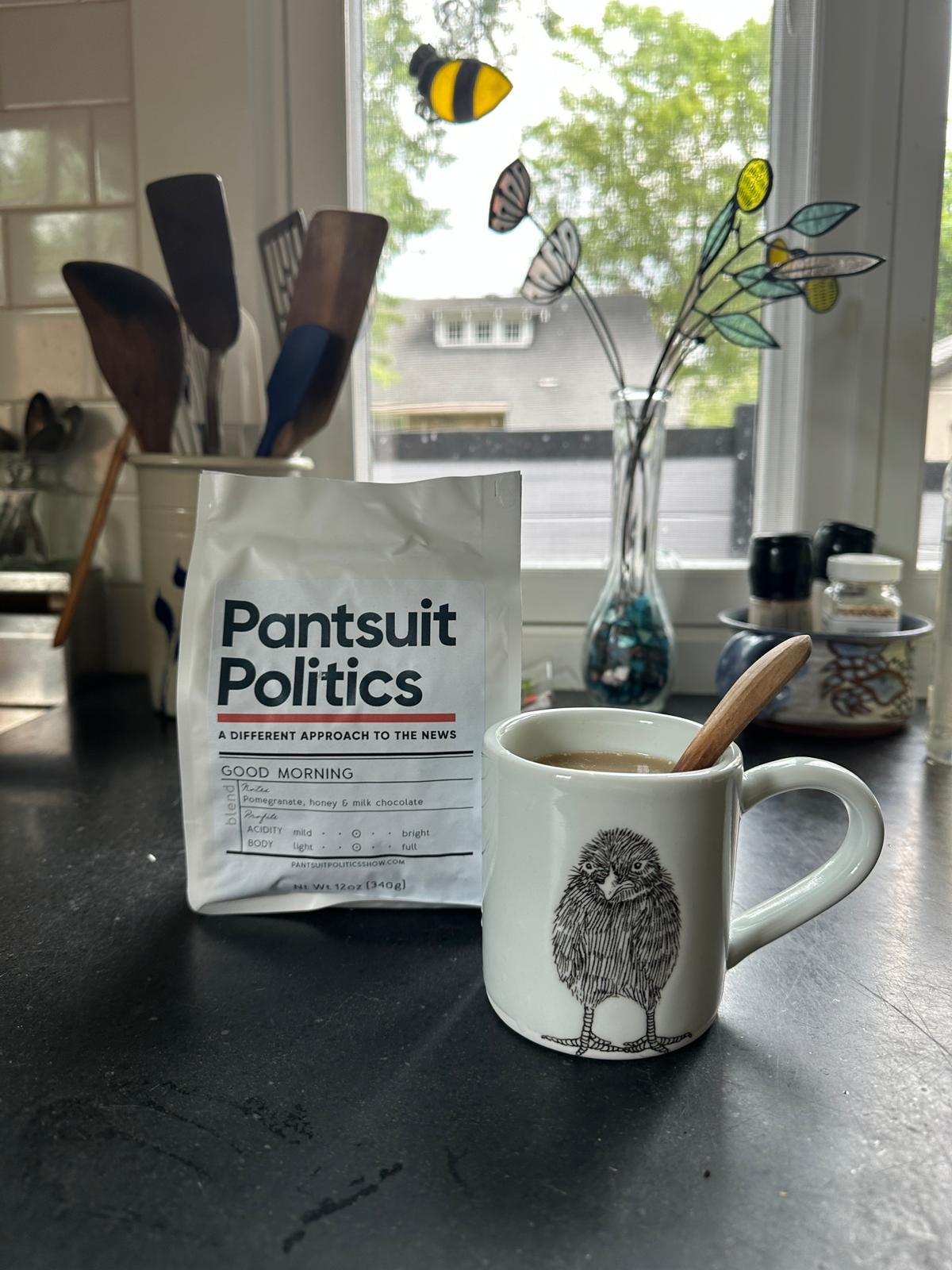
Exciting news! We’ve partnered with our Executive Producer, David Gaines, on a special blend that represents our shared values with his company, La Terza: quality, authenticity, and ethical sourcing. The flavor is smooth and sweet, but with just enough spice to keep things interesting. Get your Good Morning coffee here.
Episode Resources
Why Texas Democrats have broken quorum over the years (Houston Chronicle)
Epstein victims speak out: This ‘smacks of a cover up’ (Politico)
Lip Sync Battle - Tom Holland (YouTube)
Show Credits
Pantsuit Politics is hosted by Sarah Stewart Holland and Beth Silvers. The show is produced by Studio D Podcast Production. Alise Napp is our Managing Director and Maggie Penton is our Director of Community Engagement.
Our theme music was composed by Xander Singh with inspiration from original work by Dante Lima.
Our show is listener-supported. The community of paid subscribers here on Substack makes everything we do possible. Special thanks to our Executive Producers, some of whose names you hear at the end of each show. To join our community of supporters, become a paid subscriber here on Substack.
To search past episodes of the main show or our premium content, check out our content archive.
This podcast and every episode of it are wholly owned by Pantsuit Politics LLC and are protected by US and international copyright, trademark, and other intellectual property laws. We hope you'll listen to it, love it, and share it with other people, but not with large language models or machines and not for commercial purposes. Thanks for keeping it nuanced with us.
Episode Transcript
Sarah [00:00:07] This is Sarah Stewart Holland.
Beth [00:00:09] This is Beth Silvers. You're listening to Pantsuit Politics. We're back together in real time following our summer break and we're catching up on the news and also on our approach to the news today. What does it mean to take a different approach to the new here in August of 2025? So we're going to talk about how we decide what to talk about on the show, how we're thinking about those topics. We're going to address some feedback that we got from our flashback series. And we're going to talk pretty specifically about what's happening with gerrymandering in Texas and the response to that throughout the United States. We'll end as we always do, discussing what's on our minds Outside of Politics. And today, it's getting our people together for late summer fun through very distinctive events.
Sarah [00:00:52] This is my favorite time of year. I would like to make the case that a new school year is better than a new calendar year. So if you're on team new school, and you're looking for a little pep in your new school year step, we've got so much merch, t-shirts, hats, stickers, mugs. And to go in that mug for the school drop-off, we've got something really fun. We have partnered with our EP, David Gaines at La Terza Roastery to create a special good morning coffee blend. It is full-bodied, blended with nuanced notes that linger and help you ease into this new school year. So you can grab that along with a mug for your coffee or a bag or whatever you might need at Pantsuitpoliticsshow.com.
Beth [00:01:33] What a lovely gift for a new teacher too. Speaking of new routines, we are now posting full video episodes of Pantsuit Politics on YouTube. Also, Maggie has been busy creating tons of clips from episodes. If there's just a section that you wanted to share with someone in your life, you can probably find it there in our YouTube shorts. So please subscribe to our YouTube channel so we can be part of your commitment as we approach this new school year of staying informed and engaged. Next up, we're going to talk about what's been going on while we've been on our break. Sarah, while we were off, I had a conversation with my dad, and he said, "I have a real serious question for you, Beth. How are you all deciding what to talk about on your show these days?" I said, "That's a really good question, dad. It's a hard one." And I thought that might be a nice launching point as we come back from our break and have made some decisions about what to catch up on. I told dad the most important thing to me is to handle things in a way that people are willing to keep coming back for. Meaning it is not so depressing every time you tune in that you think all those two have to tell me is how bad the world is, how much the president sucks, and that everything is constantly getting worse. And so we're trying to make really intentional decisions about being clear-eyed about the present, but also looking to the future and also not losing what's happening that's helpful, interesting, good, still a decision point, actionable. So how are you thinking about it?
Sarah [00:03:24] I don't want people to think it's like marketing. Like we're just trying to stay more positive and future-focused so that you'll want to keep listening to the show. The way I think about what we cover is so that I want to keep doing the show. I can't do another 10 years of Donald Trump is the worst and everything is falling apart, and it's the end times and fascism is on the march. I just can't do it. I can't do it because I don't think it was accurate the past 10 years, and I don't think it'll be accurate the next 10 years. And it is less sexy to take a complicated, nuanced approach to the news, especially when it's driven by this administration. But I think it's worthwhile. I think it’s important to see the total picture and very difficult when he occupies so much of the frame.
Beth [00:04:31] I don't mean it as marketing either. I mean it as I want you all to stay involved in politics. I want all of us-- I think that's the same thing as you still wanting to do the show, right? I want you to keep wanting to be engaged with what's happening in the world. I want to keep wanting to be engage with the world, and you're right. It would be easier in a way to just react to headlines every time we show up. Easier in a lot of ways, but long-term I think really corrosive to our personal spirits. And I think it would disengage more people than it brought into the process.
Sarah [00:05:10] Sometimes I think I'm fundamentally reorganizing my idea of politics too. I don't know if politics is the best path to engagement. And I certainly don't think politics is the best path to stay engaged in the world; at least not politics as it is currently formulated or running. I don't even know the word I want. We're in such a deep transition and have been around our understanding of politics because of the media changes, because of the party changes, and it's so difficult to stay clear-eyed and engaged and to swim through the mires of what is just clickbait and conflict-tainment, (a term I just made up right this first second) and that I think we're getting better at that. And I think what we do here helps me try to untangle that knot. And I think lots of places out there are getting better at that. There are so many new media companies that I've just really found and started to enjoy over the last few years that are really trying to sort what is just internet fodder?
[00:06:40] What fuels that sense of outrage, that sense anxiety, that sense of end times perspective? And what is really trying to put together, not just facts, but important perspectives to say like, no, this is what's happening. And because we've lost that centralized media environment, I think that's why that task feels so overwhelming, that sorting, but I think we do a good job of it here. But I will say, in theory, after 10 years, that sorting should get easier. And I find it harder and harder every day to decide, wait, what is important? Because there is an importance to what people are upset about. The fact that people are upset about something, even if it is conflict-tainment, says something, you can't really ignore it, but that doesn't mean it's the most important thing happening in our country, in our lives. And so, sorting those two things out, deciding what to cover, feels more and more complicated every year.
Beth [00:07:56] I told my dad one way I try to manage that complexity is by thinking, what could we say something about that's interesting or that contributes to the discussion? It's not that changes to the Rose Garden or the addition of a ballroom to the White House doesn't matter at all. Of course it does, it matters in all kinds of ways. I don't think I personally have something to contribute about those topics that makes it worth air time in the scarce time that we have in the world. There are things that I think I can personally contribute more on. I think it's nice that we our Substack where we have more space to kind of branch out. Like you might have something really contributive to say about those things. And there are topics that I can lean into a little bit more and I think that helps us. But prioritizing what we cover on the show almost ends up feeling like we are saying things don't matter if we don't touch them. And that is never my intention. It is more to say like, what can we do well with the time that we have in front of us? I want to be sure to respond because our last episode that we aired in our flashback series included an optimistic note that 2025 has not been as horrific as it could have been that we both feel good about. Like long on America, like long-term optimistic that we will still have elections, that the tide will turn a million times from here into the future. And people did not like that. And they especially did not like some words that I put together that Maggie then shared on Instagram just saying I don't think that it has been awful.
[00:09:40] And I want to share that the context of that for me is not that awful things aren't happening or that people aren't experiencing awful things. As I said in the episode, there's a lot going on that I strongly disagree with, that I want to fight against, that I want to stop immediately, including the treatment of immigrants in our country, which I think is awful. It is that as a year, as a total, when you march through history and you look at all that years contain, all years contain true horror for someone somewhere in the world. It is kind of incumbent on us, I think, to try to widen our attention and narrow it at the same time to figure out how we experience it. If you really want to understand the world-- we just ignore the continent of Africa constantly. So if we say, well, there's a genocide right now, yes, there almost always is. Almost every year, somewhere in the world something like that is taking place. A terrible famine, weapons misdirected just so many things. I am also trying to be present with the reality that I expected the second Trump administration to be extreme. And it has been extreme in some ways and not in others. And I'm just trying to keep my head on straight and my feet on the ground and not lose sight of the fact that we can still change things that are happening. I'm going to get really scared when we get to a place where we can no longer change what is happening because of systems, structures being dismantled. Right now people are being detained unlawfully and courts are saying so. So that makes me feel like there's still hope and there's a still a path forward.
Sarah [00:11:31] I'm trying to get back into the habit of reading the daily meditations from Richard Rohr. And this week, the focus is Paul. Not always my favorite, but Richard's really making a case. And the thing he keeps emphasizing is that Paul was the first non-dualistic thinker after Christ. And all I see anywhere when we talk about Trump or politics or the world, especially on the internet, is dualistic thinking. It has to be one way or the other. Human existence contains horrors. Human existence contains joy. It is difficult to hold both of those realities at the same time. And yet that is our work as human beings. It is the reality that I had a beautiful summer while watching a humanitarian catastrophe happen in Gaza. That's just the reality of what it means to be a human in 2025. And I have to hold both of those things. And living in that space of both things is stretching. It just stretches. It feels like you're being pulled in both good ways and bad ways. And I can feel that happening in all manner of ways, particularly around this administration, particularly in what it means to be an American right now and what it means to process the news, these extreme measures, the gerrymandering battle in Texas, the dismantling of vaccine research under the FDA, all these different actions being taken.
[00:13:31] I watch Donald Trump, I watch him call the National Guard, his new favorite pastime. And I think you are authoritarian. You are a strong man. That is the reality of who you are in this moment. But I think the very easy trap is to think that means that's what we are forever now. And I don't agree with that. And I don't think that's true. And I spent a lot of time angry and anxious during the first Trump administration because I thought whatever he does is permanent. And just not a lot of permanence in politics. That's both a blessing and a curse. And just realizing that I can be horrified by the extreme measures he's taken and I don't have to follow that horror down a path of endless anxiety because the end is nigh, I can choose otherwise because I think that is not the reality. That's not the real I've seen over the last 10 years. I think I feel more confident. I I think both of us do articulating why we think this is important, why we're not going to pay attention to this because now we have ten years under our belt of this man on the scene.
[00:14:51] And getting more comfortable being like, oh, I can think of five more times that a story like this took off and you were a bad person if you didn't post in social media about exactly why this story was the end all be all and this was the proper reaction and it turned into a nothing burger. So I just think we have more experiences under our belts at this point, both as podcasters, as citizens, as just political people in the world that take in a lot of news. And I'm just trying to learn some lessons from that. And I think I am getting more comfortable even though I think it is a harder task. The muscles are building in that looking at something and saying, this is a horror and it's not forever. What he's doing is wrong and it is authoritarian and it doesn't mean that I live in Nazi Germany. Just holding all that complexity at the same time is very difficult and it's made easier because I get to come here twice a week and process it with you. And I hope that's what we do for other people, is being present in our processing. But even the constant processing, having the two week break think, wait, what am I doing? What are we deciding? How do I feel about this administration and the emergency orders and the ICE Army and all these things? Like they're horrific. They are not who I consider myself to be as an American. Okay, so what does that mean for me next?
Beth [00:16:24] I've been trying to think about how I can most precisely characterize what I think Trump is doing in different circumstances. And so there's certainly a distraction bucket. I do think he wants to capture the news cycle, especially if there is a risk of the news circle going in a direction that he's uncomfortable with. He's uncomfortable in the tariff mania category. I think that's going to become his new default. He gets in a little bit of hot water, he gets in a position he doesn't like, he's going to go back to tariffs because he feels a lot of space for him to move around that. And he knows that he has a lot of goodwill around that because of a good number of people believing that he's this great negotiator and businessman. So that's a fight he wants to have. What are the fights he wants to have versus the fights he doesn't want to have. When I think about the move to send the National Guard into Washington DC and take over the police force and send all of this federal law enforcement personnel there, that seems like the kind of fight he wants to have. He likes headlines about removing homeless encampments, never mind that he doesn't have a solution to the problem of homelessness. He knows that people don't like encampment, so let's just move those and then hope the problem goes away. To me, that move in DC is consistent with something that I have observed about his second term and I'm trying to confine it just to what he is doing in his second term. Not what he's saying, not what he did the first time, not what said in the interim. But the second term, I think his actions consistently demonstrate a contempt toward local control. He feels contempt for a Democratic mayor.
Sarah [00:18:14] I was going to say democratic local control.
Beth [00:18:17] Yes. Well, but, in general, the idea that if I don't like your mascot, you should change it. If this company's executive wasn't nice to me, it should be punished. Those things have ramifications beyond places with blue local officials. I think he just generally expresses a contempt toward local control. And that to me should set off a real fissure within the Republican Party. And I keep waiting for that to happen. And it also seems to be creating a realignment in the Democratic Party, where you have more interest in and respect for local control. And I think that that's healthy, I hope, for a time, but I'm trying to watch for the sorting of that feeling. How much do we believe as Americans that we should be self-governing and how close to us should that self- governing be? But I think he, as president, just has a real contempt for that notion of self-governance. And that's why he's comfortable on the international stage characterizing Ukraine as like a land swap. We're just going to swap some land and we'll work it out. That is contemptuousness for self- governance.
Sarah [00:19:31] Well, I think this is an undercurrent though that is really important to take and sort out away from him. This Supreme Court, with every opportunity it is given, wants to give control back to the states. That is a ship that is well on its journey. The Republican Party has made it its mission for the last four decades and has seen a lot of successes in the last 10 years to tear down federalism, to weaken the power of the federal government, and to strengthen the power of the states. I think they've gotten some things they wanted and I think there are lots of consequences that they have not yet anticipated. But I do think we are moving into an era of American politics and governance that is more state driven. In part because there is so little transparency and accountability with federal representation. I think this is all caught up in this gerrymandering battle happening in Texas and around the country and with people's ideas around gerrymander generally. And you see it in the tension between this affects the House of Representatives members, but it's under the state's representative’s control. And so you see that sort of attention playing out.
[00:21:13] And I think that's a bigger-- trend doesn't feel like the right word for me, but I think that's just something that's changing in front of all of our eyes. And we are registering it, but maybe not naming it as strongly as we should. The states are going to be more powerful and that's just going to continue to be true. I think the Supreme court is likely to give more power to the states with regards to public education, with regards to religious freedom. We're just going to see this more and more and more. This is the trajectory the American experiment is on right now. And I don't think that's ahistorical to see ebbs and flows and state power and federal power. And I think what's so fascinating about Donald Trump being in the midst of all this is that he both wants to empower states, the right states, the right strongman authoritarian states, and doesn't want to empower the other states. And like I said, this gerrymandering, there's just so many areas where you're seeing all this, especially around elections, tension. And I think you're probably going to see it with more health and public safety stuff.
[00:22:31] So I think that that is something where you have to pull him apart. Not that he's not an instrumental part of this and not just because he appointed many members of the Supreme Court that's leading this charge, but because he articulates some of that. I think he knows people want that. Let's put it this way. He definitely wants to tear down the power of the federal government, at least parts of it. I don't know if he wants to empower the local control, like you said, but he definitely wants to weaken the federal government. At least certain parts of it, not the parts he wants to use for his strongman. You know what I mean? That's what I'm saying. It's so complicated to pull apart.
Beth [00:23:07] It is because I think for him and for a section of the MAGA tent (which is a coalition and has different factions) it's not at all about federalism and the right balance between the powers of the federal government and the state. I think it's more about government power writ large versus the private sector. And that might even be generous. It might just be like what I think is right and how I think things should be. I think a lot of his dismantling is just I think this is dumb. I think it's wasteful. I think its intrusive. I think people should be allowed to do what they want. I knew a guy once who dealt with this and isn't that dumb. Like I think that's where a lot of his philosophy is. I think within the larger movement though, there's a lot of diversity about this. And I think you're right that the Supreme court means it in the sense that it believes the federal state power balance is off and that more needs to be shifted back to the states and that will happen.
[00:24:12] And I think the public probably hears that in a good way and I probably generally perceive it in a pretty good way except that it means our state governance mechanisms need a lot more attention, media coverage, investment in how we compensate our state legislators, what we expect them to do, how often we expect to be in session. I wonder if we'll start to see more economic decision-making invested in the states. We have the commerce clause that lets the federal government do a lot. But the way that Trump is using tariffs to exercise really precise control over certain industries, sectors, and companies, I think will push some states to try to step up and say, listen, we have a massive economy, I'm thinking specifically of California, we are tired of being jerked around like this. What are we going to do about it? He's pushing the limits of his power. We're going to start pushing the limit of our power too.
Sarah [00:25:15] The good news about state control is our state senators and representatives are generally way more responsive. I have a close personal relationship with my state representative. Jamie Comer doesn't know me from Adam, right? And so I do think that there is power and transparency and accountability at the state level if we claim it, if we want it. Over the break, in Paducah, there were two huge news stories that we are going to get an AI data center and that Peter Thiel's company, General Matters, is investing in a private nuclear energy facility. I have so many questions, and I think my local community does too. And I am hoping that because this is so close to the ground and because our mayor and our state representative and our State Senator are in our communities, we can push the state to regulate and to ask questions and to hold these companies to account. I still worry that the states don't have the regulatory power or resources that the federal government-- I don't worry, I know that's true. I know they don't. And I think that's where the rubber meets the road on some of this, where they can be FEMA, they can be the FDA, they could be the CDC. Well, no they can't. They don't have enough money or resources and they can print money either. Most of them are constitutionally prohibited from running a deficit. So there's going to be some real logistics to work out if this is how we want governance to run in America because that has not been the reality for the last century. And so if we want a different model, we're going to have to make some changes.
Beth [00:27:05] That's going to mean more of people in public service. I worry about the pressure on public officials right now. Even as I want them to be more transparent and accountable, I want it to happen peacefully. I want it to happen civilly. I want it to happen productively. The shooting that affected the CDC and stories like that, the kinds of threats and the level of harassment that a lot of people in public service take and even just the general lack of goodwill and admiration. I was thinking about Halloween costumes. My daughters are deep in discussions with their friends about group costume plans for this year. I love that they're planning ahead like this. But I was thinking about how when I was a kid, you saw a lot of costumes that were regular people jobs that we hold in esteem. And I don't really see that anymore. I don't see lots of little firemen and police officers and teachers and doctors running around on Halloween. It's much more sort of entertainment driven. And that's tricky right now. That's tricky because of feelings that people develop during COVID about science and healthcare. It's tricky because of experiences people have with health insurance companies, it's trick because of experiences people have had with police that are negative and the way that we have plain clothes, ICE agents running around with masks on grabbing people off the street right now.
[00:28:36] It's tricky to say, well, let's dress our kids up as police officers for Halloween. I understand how we got here. I also understand that this is the thing, if politics is a bad vehicle for engagement and we end up starving it out, it is only going to get worse. It is only going to be controlled by the people who have the worst intentions or the most comfort with unchecked power. And so I hope that as more of these battles reach the states, it's inspiring to more people to get involved at that county, state, local level and work through the ranks and come up and restore some of that sense that this is someone we admire and respect, that these are careers our children aspire to, that we hold you in good regard. We understand you make difficult decisions, but we believe in your intentions as you do it. So as we're thinking about that state federal power balance, I do think we should spend more of a minute on Texas and the gerrymandering battle. So we'll take a quick break and do that.
[00:29:56] If you took a news break with us over the past two weeks, it might be helpful to just circle up on what's been happening in Texas. At the president's request, Texas Republicans have proposed drawing new districts. So state legislators draw the districts that elect our federal representatives. And usually that's done in connection with the new census. Hey, we have new information about our population, we're going to draw new districts. Texas Republicans have said, you know what, how about now? Without a new census and in advance of the midterm elections, let's see if we can change the lines to create five or so more Republican leaning seats in the Federal House of Representatives.
Sarah [00:30:45] I think that was such a fair and nuanced take. They're just trying to cheat. I do want to be clear that I am both not letting my anxiety get away from me and also want to be very clear and speak clearly when I'm really pissed off about some of the extreme measures they're taking. They're cheating. The GOP holds a five seat majority. They're worried they're going to lose it fair and square in the midterms, so they want to cheat and redraw the districts five years early. And when I say redraw the districts, what I mean is draw the districts to eliminate five democratic seats, five powerfully held democratic seats. Like literally drawing a line to connect San Antonio and Austin. So they can just put all those Democrats in one seat and eliminate a Democratic House of Representative member. It's using the process to get the outcome you want instead of just campaigning and making a better case to the American people. Am I being unfair?
Beth [00:31:46] No, I'm of several minds about this. I find this really complicated and frustrating. The first thing is it offends me. The whole notion of partisan gerrymandering offends me because people still have agency. If you don't like this, the most effective thing that you can do is get everyone you know to go out and vote against people who try to treat you like a data point instead of a human being who is worth persuading in the next election. Because that's what this is in my mind. Republicans know that with complete control of the federal government, they have not been able to make people's lives better. And they in fact have enacted a lot of legislation that polling shows people understand makes their lives worse or threatens to. And so instead of going out and making the case that we're actually doing good for you, we're actual serving you, they want to rely on people voting according to historic patterns or not voting at all and just redrawing the lines to give themselves an advantage with that playing field. So on the most base level, no matter who's doing it, I hate treating voters as data points instead of trying to just draw districts that allow for fair representation and take an advantage that way. And it is true that both parties do it and it is that Republicans in this instance are doing it for the most blatant reason possible.
Sarah [00:33:30] Yeah, there's not a lot of moral high ground when it comes to partisan gerrymandering, but voting for people I don't think is actually going to get it done. I think state by state, we're all going to have to figure out what mountain we have to climb to get bipartisan neutral gerrymandering commissions. Other states have done it, they've accomplished it. It will be of varying levels of difficulty, but if we're going to go to state control, then I guess we're all just going to have to fight this individual battle. Nobody's coming to save us, not the Supreme Court or anybody else. And this is a broken, jacked up system. And it's infuriating. It contributes to people's complete cynicism towards American politics. And it's infuriating. And also at the same time, I'm not mad at the democratic states who are like I guess we'll fight fire with fire. I don't know what to do in the meantime while we're all spending 10 years of our lives trying to get these commissions through state supreme courts and state houses and state sentence that will cheat to try to kill these commissions just as much as they'll cheat to try and draw these bullshit districts.
Beth [00:34:41] It's really tough because Republicans are political cheaters has been part of democratic messaging since Bush versus Gore.
Sarah [00:34:53] It's not just messaging though. They do cheat. They've been doing it in North Carolina for neon a decade.
Beth [00:34:58] Fair. Conceded. Also, hasn't been effective. It hasn't been effective. And we got a large percentage of the populace in both parties that think, you know what, it is just a partisan death match and let's do it. I want fighters. I want people who will go to the wire and push the extremes and do whatever we can to take our advantage when we have the power. And that worries me and I do not feel that. I do not feel that. I am sad that in New York, Kathy Hochul is talking about rolling back that progress toward more neutral district drawing in order to counter what's happening in Texas. I think this is sad and wrong. And what I really want is for somebody to come out and make the case to voters. They are trying to do this because they don't want to have to persuade you. They don't want to have to stand on their records. They don't want to have to spend time with you, getting to know you, understanding your concerns. They want to rest on the idea that you prefer Coke to Pepsi politically, right? And that they're just going to take as many of you as they can. And I hate it. It makes me so angry and sad.
Sarah [00:36:18] Well, it's just a demographic game. I don't know how much it is about politics. Because here's the thing, it's a risk. Who knows if this is actually going to work? People move, man. That's why you only take the census 10 years; although, apparently Donald Trump's going to change that too. I don't know how much the polite professional approach to politics exist anymore in this media environment. I just don't. I'm trying to let that go. I'm try to think, is that real? It's not real right now. It just isn't. I don't know. I hate it. I wish it was different. Right now, going into these midterms, the idea that there's going to be some sort of polite professional politics or approach to campaigns that existed in the wing era, it's a dream. I don't know how that exists right now inside the Trump administration's extreme approach to politics. And until a presidential where the tone can really get reset, I don't know.
Beth [00:37:25] I fully disagree with you about this, because I believe that life is about contrast. And I think that trying to act more like Republicans in tactics provides no contrast. I think this story in Texas could be about Texas Republicans trying to cheat because the agenda is so unpopular. And that is the story. When Democrats break quorum and Gavin Newsom gets involved and Texas Democrats breaking quorum and then going to Chicago, just reinforces everything people think about the parties. And I think it sends everybody back into their camps. Okay, I guess it's just a death march. It's just partisan death march and so we're going to settle in and we're going to try to win because that's what we do. I want someone who can make a different case. I just want someone who can present some contrast. And I think people will gravitate toward it. I think that's why you see the representative from Texas, James Tallarico, surging in popularity because that man is a genuine contrast to Donald Trump. And I contrast can break through more than more of the same.
Sarah [00:38:45] Well, let me clarify. This isn't because I want them to fight like Republicans fight. That's not what I mean. We do have a chicken and the egg problem a little bit. Do Republicans act like this because they've adapted more quickly and, I don't know, beneficially to the changes in our media environment or did the changes in our media environment force them to adapt? I don't know. That's a question for historians. What I'm saying is our current media environment is miles away from the media environment that built that polite, professional, West Wing approach to politics. That's gone. I just think it's gone for now. And I don't see any individual House member. I don't really even see the Democratic Party, a state governor, forging some new path before the midterms in which we become a study in conflict. Because, again, I don't think it's in response to how they do it. I think they're responding to the media environment and for better or for worse, that is the media we all exist in.
[00:40:01] And so I don't see-- and maybe it's a limitation of my own vision and creativity and understanding of politics. Again, I know I'm like a broken record, but it was like six times over the break we're watching something from like the eighties or nineties and guess who comes up? Donald Trump. And every time that happens to me, I think, right, this is different. This is a different universe that we live in. This is not mid-century Walter Cronkite, the news hour. That ain't it. That's gone for now. And so I just think like that's the environment we live in. That's environment every politician who's going to run for office lives in. That's what you have to be responsive to. You have to acknowledge that reality. And so I'm just trying to hold that together and inside all of these stories, particularly this jerrymandering one.
Beth [00:41:02] Agreed. I don't contest any of that. I'm not trying to be naive about it. What I think that Republicans have done that has been so effective in terms of media is that they have created the media that suits their tactics and vice versa. It is chicken and egg. I don't know why it's effective. That is something beyond media. That's something about the public. That's something about our attention spans. It's something about our values. It's something about the way we view ourselves versus the community. What I think is the opportunity for Democrats is to do the same thing. Create the media environment that you want within your own party and see what's more attractive. A really interesting dynamic happening right now in media to me is that with longform podcasts and especially the kind that made such a difference in this election and that have been written about ad nauseam is they aren't loyal to a party as much as they're interested in being contrarian and getting to the thing that's out there and the thing that they aren't telling you.
[00:42:11] Beneath that Walter Cronkite professionalized media that had a lot of merit was also the ability to conceal a lot of really bad things. And we're chipping away at that gradually in this new Wild West where everyone can be an influencer around how people understand what's happening in the world. And so, as you see people like representative Talarico go on a Joe Rogan and there's this longform and his personality is just hanging out there everywhere; there is an opportunity to say we have the more attractive vision. We have the more attractive way to be in the word, just as a human. Wouldn't you rather hang out with me than someone who is just so angry all the time? So I don't know, I would like to see experimentation and I think we are seeing experimentation. I'm not mad at what anybody's doing. I understand what's going on with Gavin Newsom. I understand what's going on with Andy Beshear. I understand I think what's going on with JB Pritzker. I get the moves that people are making. I think that experimentation is healthy. But I also think there is a real lane for somebody to come in and disrupt all the lessons that we think we've learned from Donald Trump about what the public wants. And I hope that lots of people will do that.
Sarah [00:43:35] I don't think the public wants one thing. I think that's what's so hard.
Beth [00:43:39] Absolutely. Yes.
Sarah [00:43:39] I think some people do want to be angry and that is absolutely what Donald Trump tapped. And I think some people want to be distracted and I think that's the really hard thing. And are we talking to Democrats? Are we talking to persuadable people in the middle who don't identify as Democrats or Republicans? This decentralization is what in every aspect the decentralization of governmental power, the decentralization of media, the decentralization of our culture and attention. It's not just news media that you can get a million different inputs from. It's music, it's TV, it' movie, it books, it everything. And isn't that probably well and good and right and accurate for a country of 330 million very, very different people? Yes, but it is so hard. It's something Donald Trump can't always lasso either. You can see the reign slipping in so many areas where he just can't, well, I'll just roll out the National Guard again. That'll do it. And that doesn't do it anymore the way it used to do it.
[00:44:49] You can see it with Epstein. You can it in all these different places where it's so unwieldy, he can't even get his arms around it. And I think I'm just trying to face that unwieldiness and saying, this is the reality of early 21st century America, is it's going to be big and decentralized. And if we want one answer on what the problem is and what the solution is, then we are dreaming because there's not going to be one and there's not even going to be one political message. Even if we get out the way to the presidential that hits and unites us all. I just don't know. I'm just trying to let go of that dream because I think it is that. I think it is a dream.
Beth [00:45:31] I do think what's possible is being really self-critical about what you are trying to do. What is the goal of my action? I think that this breaking quorum with Texas Democrats is for the base Democrats in Texas and nationally. If you are a hardcore Democrat who thinks Republicans are cheaters, that Trump is the worst, that this is clearly about trying to steal the midterm elections, then you're going to go, "Amazing. I'm so glad that they left." Stick it to Governor Abbott, make them come arrest you. But you know, as you're doing it, that probably the result here is that this map is going to get passed. And so you've taken this risk of doing this thing to fire up your base that will ultimately disappoint those same people. Maybe they'll still say, well, you gave it the college try and that's what I wanted from you. But that action to me is not designed for swing voters.
[00:46:38] That is not designed to bring more people in the democratic tent. It is not to educate more people about partisan gerrymandering. And so choose whatever you choose. Different calculations are going to be appropriate at different times. I'm not in Texas. I don't know what's really needed there right now. I do know sitting here that I don't think swing voters are going to look at this and see a contrast between the two parties that motivates them in a healthy way as we go into the midterms. We always end our show talking about what's on our minds outside of politics because as we've alluded to many times today, politics is not the sum total of who any of us are. And we both had some nice get-togethers over the past month, late summer get-togethers. Sarah, I know that you took a bold step and planned your own birthday party this year, and I would love to hear about how it went.
Sarah [00:47:38] Yeah, I was listening to Amy Poehler and Rashida Jones, and she was talking about how she had a dance party every year for her birthday and it was like hardcore. Like you came to dance, we're not talking, we're no visiting, we are dancing in our pajamas eating breakfast food. And I thought, that sounds amazing. But more than that, it just was like, yeah, I should just plan the party I want. Because my husband is so sweet, and he gets people together for dinner parties, and there's just always a little bit of me that's like this isn't what I really wanted. Because only I know I didn't tell him what I wanted, how was he to know? And so I thought, no, I'm just going to plan the party I really want. And I just think the older you get with your birthday, it's just best to just plan the birthday you want instead of expecting the people around you to intuit what you really want.
[00:48:20] So I had a 90s karaoke birthday party that was fabulous. We found this other place to do karaoke in our town that I think we're going to go back to again. And I hosted a bunch of other stuff as well. I've hosted more parties this summer than I have probably in five to six years, probably since COVID. I really kind of came off hosting for a while. But we got a projector, so we did two outdoor movie nights. I hosted an end of summer adults only bash where we had hot dogs and Italian ice, but no kids as a fundraiser for our local food bank. It just was really, I've had a lot of fun get-togethers this summer and thought like, oh yeah, this is why I did this. This is really fun. So it's all coming from the popcorn machine. I'm telling you, this popcorn machine I bought last Halloween has really revolutionized my party throw in life.
Beth [00:49:09] I think what makes a party fun is specificity. It's that hook. General get togethers are stressful to me. If we go with a purpose, we know what we're here to do. Everybody feels like they have a role and an opportunity. I'm way into that. So we try to do something every year for our neighborhood, usually kind of a summer thing and then a winter thing. And so we did a big lip sync battle as our summer party this year, and it was extremely fun. I don't know why people seem to find this more intimidating than the murder mystery parties that I've done.
Sarah [00:49:48] That's funny.
Beth [00:49:49] Now, I think a murder mystery party is pretty intimidating. You got to kind of inhabit a character and wear a costume and everything. The lip-syncs seem to still feel more vulnerable to people.
Sarah [00:49:57] No, I think it's because the Lip Sync Battle TV show with those like viral moments, I still watch Tom Holland do Umbrella.
Beth [00:50:04] It's incredible.
Sarah [00:50:05] So I just think that maybe the bar was just set really high with that show and those moments still live on. So maybe that's why it feels intimidating to pick a Lip Synch Battle song.
Beth [00:50:15] What I also heard though, is that the individual performance aspect is intimidating to people. At a murder mystery party, you're still just kind of milling around and chatting with people.
Sarah [00:50:24] I mean, you're like the focus.
Beth [00:50:25] But being on display is a thing. But it was great. I want to give a big shout out to my friend Maggie and her husband, Chris, who dressed as Jasmine and Aladdin and did a whole new world and brought a rug to be their magic carpet. It was incredible. But a lot of my friends who came and said they could never ever do this, by the end of the night were hogging the pretend microphones and it was joy. It brought me a tremendous amount of joy.
Sarah [00:50:49] Well, what I picked up from all our get togethers this summer is just people are ready to socialize. People are ready be out in the world like really finally five years later-- it's not really five years since COVID. I mean, from our flashbacks, we learned that what really we all thought of COVID stretched pretty much into 2022. So it makes sense to me that now solidly two years or three years later in 2025, we're really shaking it off and getting it ready and being like ready to party and hang out and all of that this summer. So it makes sense to me.
Beth [00:51:23] I also think even if you think you aren't ready, just doing it is really important. This is the thing with the lip sync and the murder mystery. Any specific party like this, I'm sure with karaoke too, you just have to commit to the bit. Because when you do, it's so fun. If you are at all reserved about it, it will not be fun. It will feel weird and awkward to you. And other people won't really know how to support you through that. But if you just go all in, we are ready to hype each other up out here. We are ready to tell everyone how amazing they are and how much fun that was and how incredible your performance was or whatever it is. We want to do it for each other. You just have to go all in for it.
Sarah [00:52:09] I totally agree.
Beth [00:52:11] And take this, I am an introvert guys, but this is how you charge your long-term batteries. You have these really interesting, specific, memorable experiences with other people and it builds relationships that will carry you through whatever else comes.
Sarah [00:52:28] Also, if you are worried about the passage of time and you're a person who says, oh my God, I can't believe it's already the start of school or I can believe summer's over or I can' believe it almost blah, blah blah, this is what breaks up that sensation. You have the anticipatory pleasure of the party. You have specific memories. Comfort leads to us doing the same things over and over again, but that does not lead to distinctive memories that offset our years and seasons of life, like that really marked them because they all just blend together. So if you're doing the same thing because it's comfortable, your brain doesn't know to make that a distinctive memory. It's all just going to blend together. This is what they tell you about vacations.
[00:53:10] You can go to the same place and you'll have a little bit more anticipatory pleasure because you know exactly what's coming, but the post-pleasure, the memory pleasure is not as strong because they just all blend together you're doing the same over and over again. Distinctive vacations where you might have some anxiety going in, you might even have some struggles on the vacation, but afterwards even the difficult things will become happy memories that become fun stories. As my very, very wise friend, Laura St. Ron says, if it's not a good time, it's a good story. And so I think understanding that like these parties-- because I got in the trap of just doing the same party because it was easy and I could throw it together quickly, but they all just run together. And so having distinctive parties and mixing it up, I think is really, really important.
Beth [00:53:56] And the nice thing is you can have a really distinctive party on a tight budget, like without a lot of effort. It just takes some creativity and ideas. And I would love to hear all of yours. What's the most memorable party you ever went to or hosted? Because I'd like to mine those ideas because I love throwing a very distinctive, memorable event. Thank you all so much for being with us. We hope this episode was distinctive and memorable to you in its way. We will be here back with you on Friday for another regular episode. We're going to start talking about artificial intelligence. We've been saving it up for a long time. And between now and then, you can email us, hello@ pantsuitpoliticshow.com. Make sure to check out all of our merch, including the coffee made in partnership with La Terza in the show notes and head to our YouTube page to subscribe. Until Friday, have the best week available to you.
I don’t know if people outside of Texas are indexing the level of pure corruption and cynicism that is permeating our state politics at the moment. The GOP representatives are completely unwilling to even engage in good faith debate or negotiations with their Democratic counterparts. They’re becoming more extreme in ways I would never have imagined.
After receiving millions from 3 billionaire Christian Nationalist donors, Greg Abbott openly threatened to rid the lege of any GOP legislators who refused to go along with school vouchers, then he made good on his promise and passed vouchers last legislative session. The GOP tabled every single amendment Democratic lawmakers proposed to the bill.
James Talarico is an extremely appealing, level-headed politician. The reason he’s getting so much national attention is he understands the moment and messaging in ways that people can identify with. But make no mistake, his message is that Greg Abbott and Donald Trump are using a fascist playbook to try to cheat voters. Dems fleeing the state gave him the media attention to prosecute his case on a national stage. He’s been articulate and appealing for his entire tenure; the reason you’re hearing about him now is the blatant cheating the GOP is trying to ram through and its implications for the country as a whole. He’s sounding the alarm bells before he’s gerrymandered off the political stage. I guarantee that they are coming for him, just like Jeff Jackson in North Carolina. The GOP understands where the threats are, and they’re willing to use any and all power they can wield to eliminate those threats politically.
I really hesitate to critique or add negativity to the environment, but I’m leaning on all the times you ladies have said you value feedback. I respect each of you immensely and deeply value your perspectives. Thank you for sharing your hearts and lives with us. You have said that you pride yourself on people saying that Pantsuit Politics is the place where they come for their political therapy, so this is the best illustration I can provide for my perspective:
It’s like going to couples therapy (which I have done for years). In between sessions, you have been storing up the issues you want to talk out with your partner and therapist present. You are sitting there ready to go, and the other two spend the entire session discussing something else… and you walk away going, “what about all this incredibly important stuff we needed to talk about over here?”
I’m not asking to live in the anxiety and be distracted by all the DJT’s antics (we don’t need talk about him on the roof of the white house or paving the rose garden), but there is A LOT out there that is extremely worrisome and I’m looking for help in processing it all.
What about…
- JD Vance’s speed to the Claremont Institute where he gets real close to blood and soil language about what it means to be an American (he IS the VP, and DJT said he was the most likely successor. And should be seen in the context of ICE recruiting on the premise of “protecting culture,” and Hegseth reposting a Christian Nationalist who believes the 19th Amendment should be repealed).
- The firing of the head of BLS, how do we trust data coming out of this administration?
- RFKJ completely trashing our medical institutions. Kicking out all credible doctors, scientists, and organizations that help direct policy. No vaccine guidance anymore…
- Small businesses collapsing under the weight of tariffs and manufacturing actually decreasing
- Ghislaine Maxwell being moved to Texas, and the very few authorities out there to approve that transfer, looking at you Todd Blanch
- Trump meeting with Putin on U.S. soil. Putin normally can’t leave Russia for fear of arrest but we welcome him…
- The corruption… have you read The New Yorker article about how Trump is profiting off the presidency? Ugh.
The list is extensive and I’m sure you could make a much much better one me (this one isn’t complete, just an illustration of what was on the top of mind).
I hope that kind of paints the picture from where I’m listening from…
Final thought, in relation to the gerrymandering conversation, the Democrats leaving, to some, at least looks like fighting, bringing attention to problem. They have very few options, but denying the quorum is one of them. And not fighting, was one of, if not the biggest critique the Democrats heard after 2024. It also pushes the Republicans to look more and more extreme- issuing arrest warrants, calling up the FBI. The move looks the Republicans in the face and says “your move.” For that I support it. I’m with you that it’s not good, it’s not what I want.
To me… this points to a constitutional amendment needed… nonpartisan map drawing (& getting money out of politics 😉)
Thanks, ladies. ❤️🤍💙