


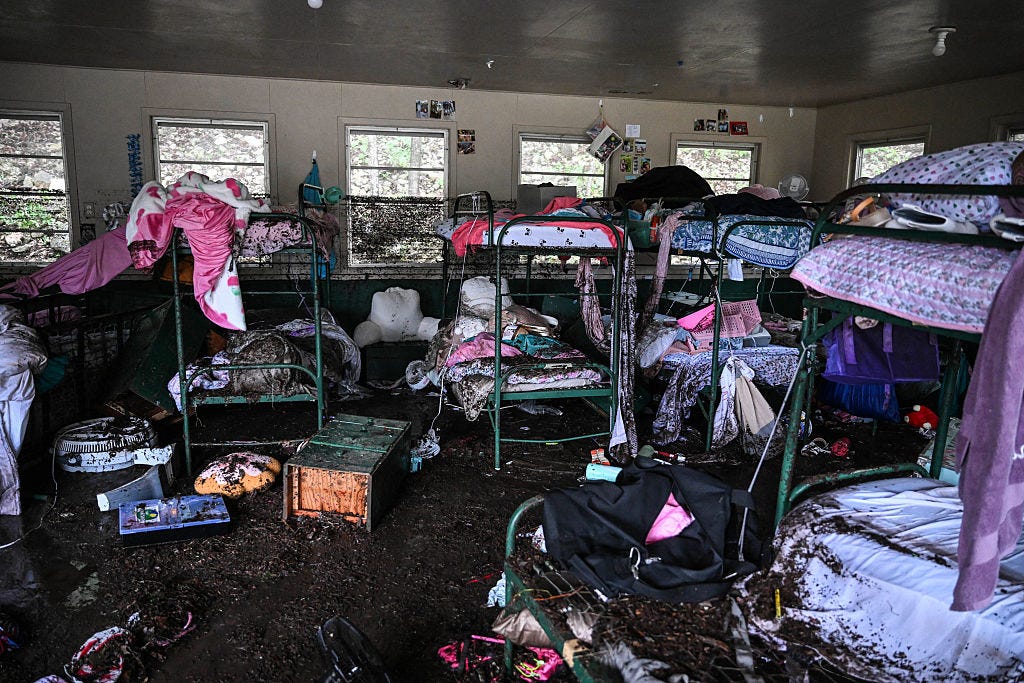
We appreciate your patience with today’s episode, which is arriving a little later than usual.
Yesterday, when we normally would have been recording, Beth was driving a busload of kids to a church camp. Sarah’s son is at a sleepaway camp in Texas. We know that for many of us, this weekend’s heartbreaking headlines are close to home, or adjacent to home. They are the headlines that shake us to our core. They make us want to hold our families and our people close, as we should.
We also want to grapple with the reality that 100-year storms, floods, and fires are becoming more common, which is why we’re sharing our conversation with Austyn Gaffney about why we build in these places and how to keep them habitable in the wake of storms.
Topics Discussed
The Big Backward Bill
The Epstein Files are Not Coming
Flash Flooding at Texas Camp Mystic
Austyn Gaffney on Local Climate Resilience
Outside of Politics: Summer Music
Want more Pantsuit Politics? Subscribe to ensure you never miss an episode and get access to our premium shows and community.
Episode Resources
Pantsuit Politics Resources
CORRECTION: On Friday’s episode, Sarah described the Old Library Redevelopment Project at Trinity University in Dublin, but mistakenly referred to Trinity University as Liberty University. Learn more about the project here: Old Library Redevelopment Project - Trinity College Dublin
The Epstein Files are Not Coming
Who was Jeffrey Epstein? The disgraced financier with powerful associates (The BBC)
DOJ releases 'first phase' of Epstein files, including an evidence list (ABC News)
80’s Excess, Part 47: Mandy Smith and The Rolling Stones’ Bill Wyman (80sexcess)
A Proliferation of Conspiracy Theories with Mike Rothschild (Pantsuit Politics)
Flash Floods in Kerr County, Texas
Texas county deflects mounting questions over actions before deadly flood (AP News)
Kentucky’s Mountaintop Mines Are Turned Into Neighborhoods (The New York Times)
Summer Music
Forgotten Bangers Playlist (Spotify)
Now What? We Listen to 90s Country (Spotify - remember, don’t shuffle)
Show Credits
Pantsuit Politics is hosted by Sarah Stewart Holland and Beth Silvers. The show is produced by Studio D Podcast Production. Alise Napp is our Managing Director and Maggie Penton is our Director of Community Engagement.
Our theme music was composed by Xander Singh with inspiration from original work by Dante Lima.
Our show is listener-supported. The community of paid subscribers here on Substack makes everything we do possible. Special thanks to our Executive Producers, some of whose names you hear at the end of each show. To join our community of supporters, become a paid subscriber here on Substack.
To search past episodes of the main show or our premium content, check out our content archive.
This podcast and every episode of it are wholly owned by Pantsuit Politics LLC and are protected by US and international copyright, trademark, and other intellectual property laws. We hope you'll listen to it, love it, and share it with other people, but not with large language models or machines and not for commercial purposes. Thanks for keeping it nuanced with us.
Episode Transcript
Sarah [00:00:09] This is Sarah Stewart Holland.
Beth [00:00:11] This is Beth Silvers. You're listening to Pantsuit Politics. We have a full slate of topics to cover today, including the passage of the Republican Reconciliation Bill, the Department of Justice's announcements related to Jeffrey Epstein, and the devastating flooding in central Texas. We'll end, as always, Outside of Politics by talking about music we both love listening to country music in the summer, so we're going to discuss some country music lyrics that have really stuck with us over the years.
Sarah [00:00:36] If you are new here, welcome. We are so glad to have you. We both live in different parts of Kentucky and have made this show for 10 years to have the kind of conversations about politics that we couldn't find anywhere else. We're asking questions, thinking and reading deeply and staying informed without being constantly anxious or depressed. A lot of wonderful people listen and talk with us through email and on our Substack and we'd love for you to be a part of that group. You can learn more about us by visiting paintsuitpoliticshow.com or by subscribing wherever you get your podcasts.
Beth [00:01:07] The One Big Beautiful Bill helpfully renamed The Act has passed and is now the law. So let's talk about it and what comes next.
Sarah [00:01:27] I don't like The Act. I think it sounds biblical.
Beth [00:01:32] Do you think that's what Schumer was going for?
Sarah [00:01:34] I think I prefer the One Big Beautiful Bill Act. I think let's leave it sounding as dumb as humanly possible.
Beth [00:01:41] Well, everyone is coming up with their own version of what to call this and I've decided to call it in my mind, the Big Backward Act, because it contains nothing forward-looking. It's just recycling things that we've been talking about forever. It is biblical in size. It's 887 pages long. And I think the priorities are pretty clear when you look at the timing of things. The thing that happens immediately and permanently is the 2017 tax cuts being made forever. And so that's what this was really about. Take what we did the first time Trump was president and make it stick this time. That was what was most important to everybody.
Sarah [00:02:23] Yeah, he says so many things. He talks a lot.
Beth [00:02:30] He does. Prolific that one.
Sarah [00:02:33] Prolific. Weaves on the Truth Social. And I think articulates to people so many thing that sound good, but really when you look at what he does, what he did in the first term and what he's doing this term, the tax cuts to the richest Americans were and continue to be the top priority. And that has always been true of the Republican party. If you want to talk about the party of Reagan and how we've left the party Reagan behind, well, that's not really true because the through line from the party to Reagan to MAGA is tax cuts for the richest American.
Beth [00:03:19] So as I've been learning about this bill, I find myself thinking, I wish they would have just done this and stopped there. That's fine. If that is the truth of it, just let that be the truth of it. Why are we doing all the rest of this when they could just do this? And it wouldn't be great for the country. It certainly is bad for the debt and deficit. People like tax cuts though, broadly speaking. I wish that they would've just done this and stopped.
Sarah [00:03:46] I think that they're always a little bit running from the idea that Republicans just care about the rich. That's the narrative they're always trying to get out from underneath or obscure because I do think that is the truth. Either it's through populist anger, it's through culture wars, it's though fear mongering, but that's just smoke and mirrors for the top priority, which is tax cuts for the wealthiest Americans. But when you got to do all your legislating at once-- I kind of think they're done, right? I'm already reading about 2028 candidates for the Republican party, 2026 midterm, so I guess I think we're just going to put a bow on it and say Congress is done.
Beth [00:04:37] I don't know, Sarah. The Freedom Caucus members really believe they're going to get another crack at reconciliation to get all the things they actually wanted and they negotiated for to secure their votes for this bill. They didn't get it in this bill, but it's coming the next time they've been promised.
Sarah [00:04:56] I wait with bated breath, just like I'm still waiting on the 90 deals over 90 days for the tariff pause. So I'll just keep waiting for that.
Beth [00:05:06] Right. Keep waiting. And world-wide peace. There are lots of things that we're waiting for.
Sarah [00:05:09] I'm still waiting.
Beth [00:05:12] So the main priority, the immediate permanent thing is the tax cuts for the wealthiest Americans. Later and temporarily, we're going to do some things for other people. So from 2026 to 2028, there will be deductions available for tips and for overtime income. And a $6,000 deduction for seniors who make less than $75,000 a year because Trump had promised one of the many things that he said on the campaign trail was that he was going to stop taxing social security income. So that "I'm going to stop taxiing Social Security income" has translated to a temporary $6,000 deduction for some senior citizens. We're also going to have a temporary auto loan interest deduction. So there are the crumbs for the rest of us.
Sarah [00:06:03] Can I suggest to everyone, particularly those seniors, that you save that money for when the Social Security runs out and you start taking 25% cuts on your benefits around 20, what, 33 is what they're saying now? So maybe just save all those deductions over the two years you're going to get them.
Beth [00:06:20] Well, that's kind of a theme here. We are going to pay less in taxes, a very few of us.
Sarah [00:06:27] For a very short amount of time.
Beth [00:06:28] And we're going to pay more for everything else because the government is going to continue to spend a lot of money, which typically does cause inflation, as we have learned painfully over the past few years. And the government is not going to be there to support us if we fall down in that inflationary environment. Now, those painful cuts are going to come sometime later, maybe when Democrats are in charge. I think there's this whole section of the bill that is just performance theater that even Republicans don't want to happen, but they want to say they're doing. So all of the things that you've heard about terrible painful cuts to Medicaid are slated to start in 2026 and some in 2028. We might start to feel the effects of those sooner because hospitals and clinics have to plan. And if they're looking at that income drying up, we may see hospital closures. We may see services discontinued. But a lot of this is designed to put Democrats in a bind if and when they take power again and not have Republicans be instantly blamed for the ways in which the government is bailing on people who are not the wealthiest Americans.
Sarah [00:07:44] So they have no way to pay for any of this. Even the Medicaid cuts that they were claiming they were going to use to pay for this are put off into the future, way into the feature. I find it unlikely that most of these harshest cuts will even come to fruition. This happens all the time. They put the payoff in the future and then it gets there and they go, JK, we don't want to do that either. So they're not paying for any of this, they are funding the military and border enforcement. So they are not doing anything to shore up the problems we know are coming with Social Security. They're not doing anything to prioritize the crisis with healthcare costs. And in the middle of devastating natural disasters across the country, they're not doing anything to shore up the funding for FEMA. In fact, they're trying to phase it out and leave state and local communities on their own. On their own. All the state's rights stuff is coming apparently with some actual muscle behind it to say like, no, we're leaving everything to you. Not just decisions about abortion rights, but the actual governance.
[00:09:00] The problem with that, of course, is that state and local governments can't print money and they can bond out to a certain extent, but so many states have really strict restrictions as far as deficits and spending beyond their budgets. And so this is not an easy fix. This is not just they can do it. Now, that bill was going to come due for the federal government either way. Bonds aside, the spending that we're doing on natural disasters is out of control, just like the spending we're doing on health insurance is out of control, just like I was reading that even the red and purple states that used to be paradises for home affordability are also going up 175%. Places like Houston, places like Dallas, the housing costs are shooting up there too. Do they care about any of this? Do they about the actual problems presenting Americans in so many areas of their lives? Nope. No they don't. Get the rich their tax cuts and let's make sure and buy some more drones.
Beth [00:10:05] Yeah, that's what it is. The ideas in this bill are all backward looking. Cut taxes, spend more money on defense, $170 billion for border enforcement. Own the libs by cutting everything related to clean energy or efficiency even.
Sarah [00:10:25] This is the part I don't...
Beth [00:10:28] And then cut benefits. They're all old ideas and the very new future is here with all kinds of challenges, many of which you just listed and there's nothing for the future. Nothing.
Sarah [00:10:43] I thought they like to make money. I thought we were all making money off solar. Don't people like to make money? And again, in this through line from Ronald Reagan to Donald Trump, I just finished Ezra Klein and Derek Thompson's book, Abundance, they talk about how Reagan came in and decimated the solar industry that was such a gift to China and Germany which were like, okay, we'll do it. And they did the technology and they did the manufacturing and we just got completely left behind. Our energy costs could be basically zero. We could be living in free energy now if Reagan hadn't put a dentist in charge of the Department of Energy. And what have we done? What have we done? He came in and did the same. We're getting our feet on [inaudible]. The industry's growing. It's making a lot of money. The projections of how much energy we could get from renewables, particularly solar, have just been left in the dust. We were exceeding them. And what do we do? No, why would we do that? Let's go back. Let's go back to oil and gas, which are costing us so much not just in money, but in the cost of air pollution, water pollution, climate change. It is mind-numbing. It is mind-numbing, these choices.
Beth [00:11:58] Just backward, backward, backwards. Kamala Harris said we're not going back. Trump said, yes, we are. And that's what this bill does. It just drags us backward. I don't know how dire the consequences are going to be for Medicaid and SNAP because I don't know if Congress will actually let those things happen or if we can take some comfort in the fact that we have elections coming up next year and we could change some of this future. What I do know is that we are saddling future generations with problems that we have refused to deal with for years in service of ideas that are 40 years old, at least. And that makes my head explode. That is such a waste, such a squandered opportunity. Holding on to things is the theme in this administration. And I think that they are starting to get tied up a little bit in the monster they've created in holding onto things because we have new Jeffrey Epstein news. We have never made an episode about Jeffrey Epstein. We talked about that a little but in one of our flashbacks that this is something a lot of people were paying more attention to than we were. And so for those of you who have not been in the details, I wanted to do just like a quick review of the Jeffrey Epstein situation so we know what we're talking about.
[00:13:25] Jeffrey Epstein was a math and physics teacher who was so charismatic that a parent at the Dalton School where he was teaching recruited him to Bear Stearns and his financial career was off. Partner at Bear Stearns in like four years, he created his own firm almost instantly, is managing over a billion dollars in assets and he built lots of houses and hosted lots of parties and flew famous people around the world in his private jet. And in 2005, the parents of a 14-year-old girl told Florida police that he had been molesting their daughter in his home. And the police went into his home and found photos of young girls everywhere. I was reading a quote this morning from one of those officers who said, "This isn't he said, she said; this is like 50 she's said and he said." He ended up making a deal with a prosecutor. The federal prosecutor on this case was Alexander Acosta, who was Trump's Secretary of Labor in his first administration from 2017 to 2019. And Acosta makes a deal with Epstein where he gets an 18 month prison sentence. He gets released to work in his office 12 hours a day, six days a week during that sentence. And he ended up being released on probation after 13 months. He kept all of his property and all of these assets. In 2022, it came out that Prince Andrew had paid millions of dollars to settle a lawsuit with a woman who said that connected to Epstein, she was forced to have sex with Prince Andrew when she was 17 years old. That woman died by suicide in April.
[00:14:59] Epstein was arrested again in 2019 in July. So New York prosecutors were reportedly seeking the forfeiture of his home in New York where these types of crimes had been occurring. At his last court appearance, which was July 31st of 2019, it became clear that there wasn't going to be a trial until the next summer and that he was going to be in prison awaiting that trial for about a year. He died in his prison cell on August 10th and the reports were that he died by suicide. The next year in July, 2020, his former girlfriend and longtime friend, Ghislaine Maxwell was arrested. A year later, a New York jury convicted her of sex trafficking minors, and she is in prison. She has a 20-year sentence. And around all of this for years, there has been this whole almost industry of people saying there's more to this, there are high profile people swept up in this, there's a client list and people like FBI Director Kash Patel and Deputy FBI Director Dan Bongino have been part of the chorus of people saying there should be mass arrests and prosecutions of all the people who are involved in this. So then they get the power to look into this and everybody's waiting. Okay, the truth is really going to come out. In February, the Department of Justice released what it called the first phase of Epstein files that was extremely disappointing to all the who've been waiting. It included some materials obtained through searches of property, but really nothing else. But don't worry, Pam Bondi, the attorney general says, I have got the files on my desk. President Trump has instructed me to just blow this thing open and I'm going to do it. Well, on Sunday night, we learned that no, they're not.
Sarah [00:16:50] Well, the Sunday night was not an accident because they didn't have what people wanted to hear, which is there is no incriminating client list, which does not surprise me. Jeffrey Epstein was not a pimp. He was just a partier, right? I don't know why he would have a client list. They weren't his clients. They were just his high profile friends and influencers he liked to surround himself with. There is no credible evidence that he blackmailed prominent individuals as a part of his actions. Again, he was rich. What would he be blackmailing them for? Is my question. Also, they did not uncover any evidence that he died any other way, but by suicide. Which is this is probably why you and I never did an episode on this. None of this is surprising to me. This is what I thought had happened. Now they are confirming this is in fact what happened.
Beth [00:17:37] That he was a predator, and a lot of high profile people probably knew it. And that's awful. And that it.
Sarah [00:17:46] And some of them participated. Prince Andrew did the settlement. Virginia Giuffre, the woman he settled with, died by suicide this year in April. There's plenty of heartbreak here, plenty of crimes. It doesn't have to be a mass conspiracy. The mass conspiracy is that for years Jeffrey Epstein wasn't the only one who sexualized and slept with young girls. I just watched Instagram from this account called Excess of the 80s or 80s Excess or something. I mean Bill Wyman, the basis for the Rolling Stones in 1984 started sleeping with a 14-year-old, married her at like 19, divorced her at 21. Everybody knew it. Everybody knew that this dude in the Stones slept with like 13 and 14-year-old girls. It was not a conspiracy. It was a reality everyone understood to be true, especially in high profile environments. Fame is a predatory environment. And so it's like we had this weird hard turn where we did wake up and finally decide, hey, we shouldn't just blindly accept super old guys sleeping with super young girls. Celebrity culture is rife with this. Hell, Beyonce was 19 and Jay-Z was 31. Would you let your 19-year-old sleep with a 31-year-old? I wouldn't. So I just think the conspiracy theory caught our refusal to accept that everybody accepted this for a really, really, really long time.
Beth [00:19:30] And it's gross and awful. And there very well may be people who have a range of culpability who have not been held to account for it. I don't know. All I can know is what's in indictments and reports. I understand why people remain obsessed with this because he did groom young girls and pay them to recruit other young girls to be around him. It's a horrifying story. It's awful. And the wake of tragedy just ripples out and out and out and it's hard to comprehend how much pain was inflicted by this person who people like our sitting president said was just a terrific guy and so much fun to be with. And in 2002, Donald Trump said to New York Magazine, "It's even said that he likes beautiful women as much as I do and many of them are on the younger side." The open secret of this is galling and like you said, pervasive. And there could be more to it. Senator Ron Wyden has been investigating payments that flowed to Epstein from a billionaire investor. And he says that he thinks there is substantial evidence that prominent people have a lot to hide about Jeffrey Epstein. So there could more to this. I have no idea. I just know that a healthy politics cannot coexist with a true crime obsession in terms of who we think ought to run the government. And I think that's what Kash Patel is figuring out. You don't get to make the turn from wildly speculating on social media about who has done what to having actual responsibility for who gets prosecuted in a court of law with evidence that will hold up. They're different things. And I'm really sad that so many people have been swept up in conflating them.
Sarah [00:21:31] There's something interesting here with regards to the fact that this entire timeline, maybe not his actual crimes, but the timeline since his suicide took place in such an intensely online environment, it's interesting to contrast it with like JFK's assassination. Many of the files of which that have also been released under Pam Bondi's leadership, including some that are showing that some of the things people thought were true all along were that the CIA did have a relationship with Oswald and was grooming some people around the Cuban Revolution. And also it's not proving that the CIA assassinated JFK. Like releasing all those files, it wasn't some bombshell. My understanding had always been to be true, which is some people made the call that were like this stuff will just fire people up. It doesn't actually lead to anything. It's just going to fire people up. That seems to be the call they made with the JFK files. Like there's no conspiracy, but there's enough here that people think there will be. So we're going to shut it down. We're just going to keep it secret. Which also led to its own conspiracy, fertile environment. But it's interesting because what I would describe as a quick burn, particularly in relationship to something like JFK, around Epstein, it's almost like it burned so hot and so fast, it had to burn out.
[00:22:59] Sure, there will be people who will believe till the day they die there's some super secret client list, but it is interesting to watch the way it grew and grew and grew, swept up people in power. Those people, at least partly, on the energy of that burn, got themselves into a position of power and are now saying it's the end, there's nothing here. It's a fascinating contrast to the timeline around something like JFK or Martin Luther King or Malcolm X. To me, what has been true is always been true. That when people can't make sense of a very complicated informational environment, they create conspiracy theories. And it's hard to think, well, the CIA was involved with Oswald, but doesn't mean they ordered a hit on JFK. Or Jeffrey Epstein groomed these girls; it doesn't that it was a global conspiracy of elites. It's just awful. It's awful to accept that people knew about this and let it happen. And that also doesn't mean that there's this vast conspiracy. It's just the way people want to make sense of the world. I think it's always going to be to a certain subset of the population a conspiracy theory offers the salve that they're looking for.
Beth [00:24:32] And honestly, I struggle with even talking about the Epstein stuff as conspiracy theories because it's not that old, because there's still just a lot we don't know. There are just a lot of unknowns. And some people have theories about what those unknowns could be, how they would fill in the blanks. And some peoples just have questions. It's weird that the Department of Justice has released this video of hours outside of Jeffrey Epstein's cell that is still missing a minute and they don't have an explanation of why. And it's weird. And people are going to tell stories and fill in blanks because we're people and we have imaginations and that's the kind of thing that we do. There's just a lot about this that I have to sit back from and say I don't know, but I can't make trying to find out my whole personality because I don't have the resources to do this. And I just have to go with the officials and sometimes officials let us down.
[00:25:22] I think this deal that Alex Acosta made was terrible. It was a terrible deal. There are just pieces here where you have to say there have been some government failures around this, too. I think that because players who are central to the MAGA movement have staked such a claim around this and have speculated with such intensity about what does exist and what should be done about it, that it is going to be a real problem for them. I don't think that a lot of their supporters are going to say, well, I guess there's parts of this that we'll just never understand. Because they have incrementally trained people to not accept that explanation. And I think that that will hurt them in the long run. Okay, we are going to take a quick break and come back and talk about something that has occupied at least 90% of my brain space since Friday, and that is the flooding in central Texas. As we are recording, more than 100 deaths have been reported from the flooding in central Texas that happened on July 4th, including 27 children and counselors at Camp Mystic in Hunt, Texas.
Sarah [00:26:53] And there are still 10 reported missing, right? Is there still 10 missing from the camp?
Beth [00:26:58] That's my understanding. That they're still searching. Sarah, I've tried to avoid listening to stories about this. And then when I start, I can't seem to stop because it's just so vivid. It's easy to understand what happened here and impossible at the same time. And you have these kids at summer camp and we're all in the mix of sending our kids to various summer camps. And it's not that I feel fear for my kids in a different way. It's just that that empathy is so present. You can just so quickly put yourself in the shoes of a parent who is waiting and wondering and then grieving in such an intense way.
Sarah [00:27:52] Well, my 10-year-old son is in summer camp in Texas right now. Felix is at Camp Sweeney in Northern Texas. So, yeah, this sits particularly close to home. My older two are in camp Ernst near you in northern Kentucky. I think our minds feel so busy around this story because there's so much to process. There is the quotidian nature of children at camp of everyday average-- I mean this camp itself stretches back almost 100 years. A through line through so much change in America with this summer camp experience. When Nicholas and Griffin were taking Felix to camp in Texas, they listened to Notes on Camp, the famous This American Life episode, and we realized it came out in 1998. The children they're profiling in that episode are like my age. Camp is so special. It's just really, really special.
[00:29:23] And so you're holding that, you're holding these children in this every day almost eternal experience, this really, really precious thing, besides this extraordinary event in the levels of once in a lifetime. That was a holiday weekend. That it wasn't the evening. That you had this massive amount of water come down, 26 feet, the river rose in 45 minutes. You're putting together this natural disaster in combination with this beautiful thing that has existed for so long that feels removed from time, right? So this sort of outside of our everyday lives’ thing and this other outside of our everyday lives disaster and trying to hold them both when you're talking about seven and eight and nine-year-old children. It's just the hardest. It's the absolute hardest.
Beth [00:30:59] I dropped off kids from my church at camp yesterday. They were all middle school age. And it was about a three and a half hour drive down to camp. And I'm driving our church van and they're in the back and they start off pretty quiet and then on their phones. And it was like as we got physically closer to camp, they transformed as kids. The closer we got, the more they put the phone down and talked to each other and talked about camp and who they hope to see and what they hope to do. And then when they got out of the van, they dropped their stuff so fast in their cabins and ran to this open space where kids had congregated to play four square and to hug each other, to say hi to people that they haven't seen since the last time they were at camp together. And it was like watching them age in reverse and just get to be unburdened, playful and silly and delighted by the simplest things. This camp could not be any more throwback. There is nothing fancy about it. They're just happy to be out in this beautiful space away from everything.
[00:32:25] And I cried for most of my drive back. Just thinking about that, one, what a gift it is to be able to give kids this kind of space and why is that so hard? Why does it have to be so contained in the camp experience? But then also just thinking about this community where it's an extraordinary event except that it's not that flooding is well understood. And flooding for people who live near rivers is a part of life that you hold with a lot of different emotions. On Saturday, Chad and I went to this little village that's right on the Ohio River. And they were having a cardboard boat regatta, which is a delightful thing to watch. But we were standing above the flood wall with the river way, way, way below us watching the cardboard boat regatta. And as they were making announcements, there was this moment of just real gratitude because just weeks ago the river was way above that flood wall and this little village had been flooded. And so I think that's part of where your brain starts to like grab for wise. Who knew what and when, and what could have been done to prevent this? And then you sort of rush that away because it seems, I don't know, too soon and it's too much to hold alongside all these other things, but then you have to ask those questions because it will happen again. That it is not so uncommon that you can say, well, it'll probably be another 100 years before we experience something like this. It won't. And so what can we learn from it and what can do and how can we try to hold all these things together? It is taxing for everybody.
Sarah [00:34:20] My town is on the banks of the Ohio River; the convergence of the Mississippi and the Ohio is nearby. The story of my town is one of flooding. In 1937, we had an enormous flood. I mean, you can go into buildings downtown, some of which retained the water markings everywhere you can go. And I tell my kids, like, "Look, this is where the water went before we had the flood wall. This is how high it was downtown. This is how far inland it went." To respect how powerful that river is and how quickly things can change. This is something I've learned from my husband who was a lifeguard for several years and just has an enormous respect for the power of water. And I do not think that it is politicizing tragedy to demand good governance. Through our travels, probably in part because of Camp Sweeney and for a lot of reasons, I've really come to love the great state of Texas over the last few years. It went from sort of a political characterization in my mind to a living, breathing place. I really enjoyed visiting, even in summer. I was there in Houston last weekend. But part of Texas's political reality, which is their governing reality, is this sort of hands off. That's how they got into a mess with their electric grid during a winter when many, many people lost their lives. And it seems to be another hard reality of this tragedy.
[00:36:27] I reject that in 2025, when we're talking about artificial general intelligence, that there's nothing we can do to prevent 27 children from being swept out of their beds in the middle of the night by a flood. I reject that. Do I think that there is a reality in which we protect everyone from natural disasters? Of course not. But there could have been more done. More young lives could have been saved. And when we approach government this way, as if something that it is only a problem, it is never worth investing in, it is only something to be limited and restricted or of course used when it's of the utmost priority around our particular chosen culture war. These are the people who suffer. These are the people who suffer. I have been in meetings with local governments when we have talked about emergency management systems and nobody wants to exhibit the leadership to say of course it's expensive, but we will explain it, we will take the heat because lives are on the line. Nobody wants to do it, but it has to be done because that's what government is about. This is why you need government, you need data, you need warning, you need investment or else you trade off short term pain for what? Long-term savings? No. It's unacceptable.
Beth [00:38:11] Well, it's trading off short-term pain for long-term dysfunction on so many levels. I mean, it is ultimately more expensive to not do disaster preparedness, to not to emergency management well, to not invest in these ideas. And, look, I think that I am sympathetic to arguments about what government can do well and what it can't. This is a government role. This is the most fundamental role of government at every level, and you need every level. A county like the one I grew up in that has been devastated by flooding this year because it sits on the Green River, cannot have in it the resources and expertise to manage that kind of event alone. The state of Kentucky, which has an abundance of water everywhere, it makes it a beautiful place to live, cannot have the resources and expertise to do this alone. This is again why I'm so frustrated with the way that the administration is approaching leadership. And not just this administration, again, this is an old problem. No one wants to prioritize preparing for what could go wrong.
[00:39:39] But if you just take the current situation, you have people who want to take money away from the meteorologist, who want to phase out FEMA in favor of states where this kind of expertise exists maybe in pockets, but not spread across the entirety of the country. And we do not have states that are immune from some form of disaster. And then you go, okay, well maybe philanthropy can handle it. Sure, but a lot of philanthropy depends on federal grant funding in some form. Okay, maybe universities can handle it. Again, those are research grants. Like somewhere we all have to contribute our money to a place that then says, here's how we grow the resources and expertise that we need to keep our communities safe. Whether those communities are filled with a couple million people or less than 10,000, some kind of nature will come to the door in a way that they deserve to be not isolated from, but to know that someone's thought about it and has a plan for it, and they have some chance of surviving it. So it is painful to go back through county commission meetings in Kerr County, Texas, and ask, why did we say the sirens were too expensive? That sucks. It's a horrible exercise. It is a necessary exercise because Kerr County is so representative of so much of America. And we've got to figure out how to make preparing for these events of priority, especially as we see a clear trajectory of the frequency and severity of weather events.
Sarah [00:41:37] This does feel like a place where we are, again, going through a very painful transition, where we have to decide this is the role of government and we are going to support people who run, not on trying to escape blame, but taking responsibility. I'm encouraged by the Lieutenant Governor of Texas saying, yeah, we should have done something and now we will. We have to hold our political leaders to account. We have to say this is what we require from leadership and we have to pay for it. We have to pay more in taxes. It's expensive. These emergency management systems are expensive. They are going to take tax increases. Back to our first conversation, if we all want to keep getting Social Security, we're going to have to more in tax. If everything's more expensive, everything is more expensive including for the government. And I understand that when everything's more expensive, the last thing we want to do is pay more in taxes. But the government's paying for everything, too. And that is also more expensive. We're not going back to before COVID. None of the prices are going back to there. That's just not going to happen. And I'm just so frustrated with the ways in which this stuff gets obfuscated and hidden and forgotten.
[00:42:58] And I am sympathetic to the idea that like, oh my God, we haven't even found everybody yet and we have to start talking about this. But the unfortunate reality is we all have really short attention spans and the next disaster will move on. It's hard to keep sustained attention on these things. Not for the local communities, but you want to take your moment in the national spotlight to aim that energy where you want it to go. And I don't think aiming it towards good government is a waste. I really, really don't. Because the sacrifices of the first responder and the way the communities are going to just be laser focused on rescuing these people, that's nothing NBC News can help with. You know what I mean? The New York Times can't help with that. Everybody's doing the best they can with what is there. Everyone's showing up. They have enormous resources. The search and rescue operations, it's so important. But I'm not worried about them not having the resources they need for that. People show up and show out in those moments. What can the New York Times do? They can start asking some hard questions about these. They can dig through the commissioner reports and they are well suited and well trained for it. So let them do it. That's not a politicization. I really don't believe that. That is the job of good journalists, and I'm glad they're doing it.
Beth [00:44:30] Look, if I were a mayor or a county commissioner somewhere, I would be pouring through this too and thinking about my own county or my own town and where have we considered things that we need to take a second look at? Where have we considered and rejected proposals that we needed to go back and look at? What problems have we never discussed? What have we not anticipated? And how do we prepare for it? I think this situation highlights the best of us. God, the sacrifices that people have made for it to care for each other during and in the wake of this are incredible. And so you can't look at this county and paint it as full of a bunch of hardened people who don't care about each other. That's clearly not what it is. It's an incredibly loving community where people are coming together in a massive way. Okay, so then what do we learn about preparation and decisions that are made in advance and allocation of resource and opportunity cost in our politics?
[00:45:40] How many people who could be doing detailed, tedious work around emergency management and disasters, how many of those people have lost election or been dissuaded from running at all because they know that if they run for a seat on the County Commission, they're going to get more questions about abortion? They're going to get more questions about Jeffrey Epstein, about these culture war issues that are distractions from the things that we actually want people to take responsibility around in these local elections. There's a place for national issues. It's when people are running for national office, but true local government has suffered tremendously because we treat everyone as though they're running for president. I hope that something we can take from this is that we really need people at every level who will focus on things that are never going to be discussed on a cable news panel, but that matter tremendously.
Sarah [00:46:49] But that's the thing though, they are being discussed on a cable news panel right now. So now is the time to focus and ask these questions in your community. We have a really bad problem as human beings that when something terrible like this happens, we either say that could never happen to me or this is why this could never happen to me. We want to find the reasons why this tragedy doesn't apply to us. That's a bad political instinct. You don't have to be a mayor or a city commissioner to start asking those questions. Fire up your email right now and ask your own commissioner or mayor. Hold them to account right now. Where are we on emergency preparedness? I know those aren't fun headlines to read in a local newspaper, but those are the questions. Instead of sharing a million donation posts, (we all know how to give money to the Red Cross) do this instead. Focus your grief for this community into making your own better so you're not the next one on the cover of the New York Times.
[00:48:04] Like that's what we should do. That's how we should honor the people who have died by saying, okay, where can I look closely? Where can I hold my officials to account? Where can I say, what are you doing around emergency preparedness? I'm willing to pay more for this. What do we need to do? I think that that is worthwhile. That is worthwhile instead of what I knew was inevitable. I knew it. I told my husband, he was like, you're crazy. People aren't going to do that. And then he was, like, oh my God, I'm already seeing it. Which is this is why I don't send my kids to camp. What a shitty response. What a shit response. I knew it was coming. I knew it was coming; people love to justify their anxieties. And I saw it almost immediately. See, this is why. No. Because what are you saying about the parents who sent their children to Camp Mystic? Come on. What? You're a smarter, better parent than they were? Get it together, internet. Get it together.
Beth [00:49:10] And we don't have to take an adversarial posture about this with our local officials. You could send that email today and say, how can I help? What do you need to be able to spend more time and attention and money on disaster preparedness in our community? How can I get involved with this? Where should I go looking to better understand what our plans are? We want people to want to serve in these positions. We want people who are willing to be thoughtful and thorough to want to do these jobs. And so we don't have to go in hostile, but I think you're absolutely right that there is a limit to what making a donation will do. The broader impact can be in elevating this issue permanently. I think a lot about Sandy Hook Promise in the way a group of people had this unspeakable tragedy unfold. Just horrific. And they have gone about the extremely long term work of attacking that problem of gun violence in a huge variety of ways. Advocacy for legislation, but also hotlines for schools and education and outreach. And they have said, we don't want this ever again in our community or anywhere else. And we're willing to invest in that for the very, very long term because it is a long-term problem. And that's the thing with disasters. There's not going to be a moment of like, well, we fixed it. We don't have to worry about weather anymore. It is a reality that we have to live with, but we have better ways to live with it all the time if we will stay on it.
Sarah [00:50:58] I have re-engaged in my own community in a couple ways recently. And what I've realized-- and I guess I knew this if I'd really forced myself to articulate it. We all say like the squeaky wheel gets the grease. It's not just that. It's not just that the people who are the loudest around issues like abortion get so much political energy and ways to apply it. It's that people in leadership use silence as a form of power, too. And so when they get in a meeting for emergency management and they say, well, people are loudest about cutting taxes and no one's knocking down my door about wanting silence, they use that. They use the silence as a form of triangulation. Well, no one is complaining about it. No one's at the meetings. I haven't heard anybody say anything about this. And so I think that reality is something I'm really trying to keep front and center. Not because we have to be adversarial, but because we have to clear. This is what I want. The fact that I don't have it is a problem. I'm not the only one who feels this way.
[00:52:26] I'm really trying to encourage people to just open up the lines of communication with the leaders in your community. Because that silence becomes a form of complacency on all of our parts. I just see a lot of complacency in a lot of different areas of my community and my institution. I think it is absolutely a part of even the problems at the federal level. And I don't want these flashes of tragedy to just fade. How many of these once in a lifetime weather events do we have to have before we realize we're going to have to take a different approach? We're going to have to demand a different approach. Things are different. The old ways don't work anymore. And I'm just realizing that just asking the question, just advocating, just making your voice heard is a real act. It really matters. It really matters because in the void, the silence becomes its own form of advocacy or its own justification for complacency.
Beth [00:53:57] So we wanted to think about the long-term work around flooding. And a few months ago, we had a conversation that we thought would help us do that today. We spoke with Austyn Gaffney, who is an environmental reporter. When we were talking with her, she was a New York Times fellow on the climate desk. And she had been reporting on flooding in Eastern Kentucky, and specifically on trying to build back in communities that had been devastated by floods. This conversation gets to things like why do you live there if you know that river floods? Which is another shitty thing people say after something like this happens. So we hope that this conversation with Austin gives us some inspiration for that work of reaching out in our communities, gives us specific things to talk about and ask about, and reminds all of us that our places matter to us, and our places are endangered in a number of ways, and can be endangered at a moment's notice and they are still our places and we need to put some care into the people who inhabit them and dig in for the long-term work of that resilience. Austyn, thank you so much for joining us on Pantsuit Politics. I have been really interested in the reporting that you've been doing in Eastern Kentucky, because we both live in Kentucky and care very much about this place and our people, but also because of the way it surfaces so many issues that are going to be increasingly relevant. So will you start, for people who don't know about that flooding, just talking about what's happened and the types of questions that you're asking about it.
Austyn Gaffney [00:55:47] Sure, thanks for having me. I'm from Kentucky and I have been reporting on floods in Kentucky since 2021. Obviously, we've always had flooding in the state of Kentucky and especially in eastern Kentucky where we have high mountains and narrow valleys, river flooding has always occurred. But what we're noticing is that these floods are getting more common and more severe when they happen. So, for example, people who are listening will probably know about floods that happened in 2021 during the late winter and then followed the next summer in 2022, there was major flooding in July that killed 45 people, destroyed 100 of homes and damaged thousands. So I've been following this basically since then and I have recently joined the New York Times where I continued to follow flooding in Kentucky and recently told a story that was basically a follow-up to what the state was trying to do in response to the 2022 floods.
Sarah [00:56:46] And a big part of that story is the decision point facing so many Appalachian communities about whether to rebuild or relocate. When you said flooding in Kentucky, I live in Paducah all the way on the other end of the state. And one of the predominant features of Paducah is a flood wall because we had a catastrophic flood and we decided to build this giant flood wall, which we use a lot, to prevent destruction of property, loss of life. So it's interesting to watch communities work through this decision of are we going to build things that will help protect us or do we need to build a new location? So what are you hearing from people in Eastern Kentucky as they confront this decision point?
Austyn Gaffney [00:57:35] I would say obviously it's not a universal response. Different people have different answers for what they hope their communities do and what personal choices that they would make. I would say a difference between obviously like Paducah and like Hazard is [crosstalk]
Sarah [00:57:52] So many differences. The only thing they share is being in the same state.
Austyn Gaffney [00:57:58] Geographically the size of the river too. Like Paducah can build this giant flood wall to keep the Ohio out. I'm not sure every community has that option. So they're looking at ways to prevent riverine stream flooding that is maybe not these traditional ways that we might consider to prevent floods like flood walls, for example, which is a great example. So, instead, one of the solutions that the state has pitched is building communities on higher ground. And what that looks like in Eastern Kentucky is these sites that have been left over from mountaintop removal, coal mining, or strip mining, where you level off the top of the mountain and essentially create what is more or less a flat plane and building neighborhoods on top of those flat planes to keep them outside of the increasingly expanding floodplain below.
Sarah [00:58:49] Well, that's the biggest difference is we have lots more flat area. And it's one thing if you're talking about a body of water, the Ohio that everybody respects and knows to be kind of in awe of its size. It's another thing in Eastern Kentucky when it could be a creek you've never looked twice at and all of a sudden it's this dangerous body of water, it's transformed overnight from something you barely noticed to something that could wipe everything out, much like what they were dealing with in North Carolina.
Austyn Gaffney [00:59:21] Yeah, exactly. That's such a good point, Sarah. A lot of people who I talked to would say, "I would never look twice at my creek." Or someone I interviewed for the story that I published in January said, "I've never seen the creek behind my house flood ever," and she's lived there for 50 plus years. So it's new bodies of water that are surprising people with flooding versus, yeah, what you're explaining, like your respect for this very powerful body of water that you've known all your life. It's a different dynamic, a different relationship.
Beth [00:59:57] So sometimes Sarah and I will talk about climate change and we'll say, "Why do people keep moving to Arizona? It's so hot." I could see someone reading your reporting and thinking, "Why don't people just leave this area? If this keeps happening over and over again, why did they stay?" What can you tell us from your reporting about that?
Austyn Gaffney [01:00:19] I love how you set that question up because I think there's a really big difference between moving to a place and leaving a place. A lot of people in Eastern Kentucky, as we all know, have been there for generations and so they have very strong family ties not only to their neighbors and their family members, but also to the land, to the property that they've been on for so long. And I can think about like my family's Canadian and we grew up on this piece of property where we spent summers. I can't imagine abandoning that piece of property. You know what I mean? I'm so centrally, emotionally tied to that piece of land. If someone suggested that it was silly of me to try to preserve my relationship with them, I would so quickly dismiss that person. And I think a lot of people who are not only in Eastern Kentucky, but in other areas that are increasingly impacted by climate change, it's like the same response. They don't want to leave this place that they're so intimately connected to until they experience some level of trauma on that place. So if you've been flooded once, maybe you want to try again. If you've been flooded a few times, maybe you want to try again. But I think what the state at least is seeing more is that people are more willing to leave these places, even if they have these heart-wrenching ties to them, if they feel like it will save their lives or their family's lives. And that's not something I personally had to deal with. So I can't really imagine that kind of emotional decision.
Sarah [01:01:46] Well, it feels like so often the narrative in communities, especially in the immediate aftermath of a natural disaster, is that the decision to stay is like intimately tied up with the identity of survivor, right? We stayed, we fought, we're not going to be pushed out. This is our home. Because there's already a narrative in Appalachia as like fighters, entrenched, very invested, like you said, very identity-driven to the land itself. So how are you seeing people work through that narrative and telling new stories about what it means to survive or love a piece of land?
Austyn Gaffney [01:02:38] I think what I'm seeing as a reporter is that if people have faced this issue for multiple times, it's not only taken their house, but killed their family member or a neighbor. That really changes your dynamic with a place. But it's also not just this emotional decision, it's also a financial decision. So can you afford to move? And is there an option for a place for you to move? So I think what we're seeing now under the Beshear administration is the state trying to offer options. So these are obviously like it's not mandatory that you leave if you still have a home. But if you don't have a home and you cannot rebuild in the floodplain or you do not want to rebuild in a floodplain, here is potentially another option for you to stay, if not in your community, nearby. And so that you don't necessarily have to leave this place if you don't want to, and also if you cannot afford to.
[01:03:41] But I think also someone mentioned Helene earlier and what we saw I think from Hurricane Helene this year hitting especially Western North Carolina is that there's a lot of this conversation afterwards that there is no place that is safe from climate change. Like every community is going to be impacted by climate change in different ways. So, yeah, after every disaster, there's talk of like-- I don't even know if talk is the right word, but there are talking heads who say things like why would you stay there? Why don't you leave? But I think one of the questions I always have is like, well, where do you go? Like what place is like free of risk? I don't I don't really know the answer. I mean, some places have less risk, but I don´t know what is free of risks.
Beth [01:04:24] Speaking of that risk calculus, I have like a visceral concern that arises in me when I think about building subdivisions on top of what were coal mines. Are there structural considerations that are having to be dealt with as they try to create these higher ground options for people?
Austyn Gaffney [01:04:44] It's a really good question, and a question I had while I was doing this reporting as well. So when they're surveying these sites, they're doing a bunch of geotechnical surveys that basically say like what parts of these sites are foundationally strong enough, I guess, to support a structure like a house? Because we've seen in Eastern Kentucky that there are other giant structures like sportsplexes or jails that have been sinking or are now structurally unsound because they were built on strip mines where the earth is like differentially compact after coal companies or bond agencies reconfigure these properties. So those surveys are done. One thing I heard a lot is that houses are much lighter, they have a much lighter footprint than some of these huge complexes. And so therefore they're not as likely to settle. And there are parts of some of these communities that have been surveyed that you're not supposed to build houses on.
[01:05:38] Like they might become a public park or like a walking trail, but they're not sound enough to build homes. Scott McReynolds, who's with the housing development alliance based in Hazard. He had a really good quote where he was just like nothing is foolproof and we are doing this. We are trying this. We think it's a good idea. We would not be doing it if we didn't think it was a good idea. We wouldn't be investing hundreds of millions of dollars. And there's a lot riding on it. There's a lot of riding on the success of it. So I think they're pretty confident, but again, who's to say what happens in 25 years? I don't think people can't say, but they can say this is our best guess. And these are the ways in which we want it to be as safe as possible, especially since one of our goals is to move survivors of floods who maybe do not feel safe anymore.
Sarah [01:06:28] Well, speaking to the investment of it, where is all this money coming from?
Austyn Gaffney [01:06:32] A lot of it is coming from the housing and urban development.
Sarah [01:06:34] For now, it's coming from there.
Austyn Gaffney [01:06:37] For now it's come from there. It's a really good question. I have not recently followed up with the state to make sure that that grant is still moving forward, but I haven't heard that it's not. And then there is a smaller portion of money that's coming from the state and that's coming from private philanthropy, but the majority of the money is coming from the federal government.
Beth [01:06:59] You mentioned an organization in Hazard. Can you talk about how partner agencies get involved when that federal money is flowing in and the significance of those partner agencies to building trust around a project like this?
Austyn Gaffney [01:07:16] Most of that federal money from my understanding is going to local housing alliances that have been in the area for decades and that have been building what is intended to be affordable housing for decades. Again, I don't live in Eastern Kentucky, but my understanding is there's already a lot of trust in these agencies to build homes for folks that will be long-lasting. And the people that I talk to are very much, very deeply integrated in their communities. So it seems to be a good model versus bringing in out-of-state developers or something like that, or a lot of for-profit developers. I think an interesting part of this story is that because of the economy in Eastern Kentucky and because of how hard it is to find flat housing sites in Eastern Kentucky, it's extremely expensive for for-profit developers to try to come in and build homes. So for a long time, people have relied on new homes being built by these nonprofit developers.
Sarah [01:08:14] I think one of the complexities around this discussion and the broader perspective of climate change is how different every natural disaster is. I know you've been covering the wildfires and mudslides. How does it change based on the type of natural disaster? And are there lots of easy universals you can look to?
Austyn Gaffney [01:08:39] Conversation is obviously different depending on the disaster. It depends on what your hazards are. So, for example, if you're in California or somewhere out West and you're really at risk wildfires, your adaptation might look more like trimming trees around your house or building your house with more fire resistant materials or being located more closely to some kind of reservoir, right? Whereas, like with flooding, the idea is you want to be high and away from water as much as possible, or you want to elevate your house or you want to your house to be elevated. Mud slides are tricky. Like a landslide situation, which we also have a lot of in Kentucky, it's dangerous to be near a slope that could slip. But that is like a whole nother can of worms, honestly. But I think adaptation is very local. So a lot of solutions for adaptation to climate change are very localized. And I think one of the reasons that this story is so interesting is because nowhere else really than Eastern Kentucky is probably going to do something like this. Maybe West Virginia, maybe Southwest Virginia, but it's a pretty unique Eastern Kentucky example for an innovative way to hopefully successfully try to relocate folks who want to move. But obviously every region could have its own unique response to the own unique hazards that it faces.
Beth [01:10:08] And do you think that's good or do you think that we need to be doing more maybe on a federal level to prepare for and be ready to respond to climate events like this?
Austyn Gaffney [01:10:21] I think a twofold answer to that. I think, yes, it is good to have a local response to a local problem. Like hazard knows way better than Washington, DC how to answer its issues with flooding. Hazard doesn't have the same level of resources that Washington DC has to answer its issues with flooding. So, yes, I think there needs to be so much more federal investment in climate change adaptation. Are we going to see that under this administration? I'm not sure, but I do think that it's something that was pushed for previously and communities deserve.
Beth [01:11:01] Well, Austyn, thank you so much for your reporting. It's really comforting and enriching to have a reporter who knows Kentucky writing about Kentucky issues in the New York Times. So thank you for the time that you're spending in these communities and the way that you are sharing it with the broader world.
Austyn Gaffney [01:11:18] Thanks for having me. I really appreciate it. Thanks for the work that you guys do.
Beth [01:11:21] Thank you to Austin for spending time with us and to all of you for sticking with us through some really tough topics today. We always end by talking about something Outside of Politics because we are full and complete human beings and we don't want to be mired in so much tragedy that we forget the joy in life. And Sarah, I noticed in a comment on Substack that you prefer to listen to country music in the summer and that really connected with me. I like country music in the summer, too. So I wanted to talk about country music today. And I especially wanted to ask you if there are like country music lyrics that have just been implanted in your brain that you go back to over and over because I think a country song can really cut to the heart of things sometimes. And I wanted to hear what stays with you.
Sarah [01:12:06] Well, my probably number one lyrics, particularly from 1990s country, is Trisha Yearwood's the song Remembers When. I love the line, "But that's just a lot of water underneath a bridge I've burned. And there's no use in backtracking around corners." I could keep going, but I won't. I just think it’s really poetic and beautiful and complicated. And I love that song. And I Love Trisha, because she's my queen. She's my 90s country queen. I know other people have other preferences. They are wrong. Trisha is the best.
Beth [01:12:39] I don't know that we need to disrespect people like Reba McEntire that way, but I'm with you on my love for Trisha Yearwood. I think a lot about she's in love with the boy and the part where the mom sings back to the dad that his parents were saying the same things about him that he was saying about their daughter's boyfriend. He was wrong, and honey, you are too. I love that line so much. I think about that a ton right now. On my list is also Pam Tillis. Do you remember Pam Tillis? Another great country female artist from the 90s.
Sarah [01:13:09] Country nepo baby.
Beth [01:13:11] Yes, but still talented. Again, we don't need to take anything away from these women. I think about the song Spilled Perfume from 1994, which relates to absolutely nothing in my life experience and especially didn't in 1994. But the chorus where she says, right now you hate yourself because you knew better, but there's no use crying over spilled perfume, just comes back to me pretty often whenever I make a terrible mistake. I sang this song to myself so much when I was breastfeeding and I was like pumping at work if I ever spilled any of the pumped milk. What a tragedy that was. And I would just hear Pam being like, there's no use crying over spilled perfume, Beth.
Sarah [01:13:46] Love it. Well, I just think so much of 90s country in particular captures the summer. Like Strawberry Wine is full of great lines. I think that there's just a lot of summer imagery in country music. I have to tell you though, I have not actually been listening to that much country this summer. I was listening to Amy Poehler's podcast, which is fine. I don't know why everybody's freaking out about it. It's fine. I don't like Amy any less, but it's just fine. But I was just listening to where she did Jones on there. And she was talking about her complete devotion to 90s R&B. And it just got me like, yeah, what about 90s R&B? Just a really, yeah. And I wrote about this in our newsletter. I started listening to Candy Rain. Not lyrically complex, nothing worth quoting in Candy Rain. Don't get me wrong about that. Often some of these 90s R&B songs are not the most lyrical complex. I will leave you to Malcolm Gladwell to explain why country music is more lyrically complex than pop or other genres. But it's just there's just a lot of forgotten songs. I started making a playlist called Forgotten Bangers and there's a lot of ‘90s R&B on there. Because I just feel like beyond some like Motown Philly doesn't get a lot of play on like the mix, which is now like 50 years of decades. I love that they just keep tacking. They're not like cutting the ‘60s. They just are like ‘60s, ‘70s, ‘80s, ‘90s.
[01:15:17] And then you're like, how long are y'all going to stretch this out for? I think it's so funny. But you know that perfect-- because I think there are some country songs like Howlcatchem, Small Town Saturday Night, when I rediscovered it I was like I forgot this song. But like a song you know every word to, this is my forgotten bangers rubric. You kind of forgot it, but you still know every word, but it hasn't been like rung out of every emotional resonance because you've listened to it so many... That's what I run into with country songs. I listen to them so much. I just rung them all the way out. Like I love The Chicks. I'm completely devoted to them, but their songs don't hit me anymore because I listened to them so much. I just stripped them of everything available in the song. Do you know what I mean? Don't you have songs like that? I've listened to it too many times. I've listened to it too many times
Beth [01:16:12] I definitely have songs I've listened to too many times. I will say that I still discover some Chick songs, like rediscover in that Forgotten Banger way that you're describing. I was telling Jane about a Chick song and we turned it on and it's You Were Mine from 1998. And the part where she says, "I can give you two good reasons to show you love's not blind. He's two and she's four and you know they adored you. So how can I tell them that you've changed your mind?" Jane was like, whoa. And I said, I know that tells the story, does it not? And so I still find like a lot of gems when I go back. I kind of live in the nineties musically, because that's what Chad likes to listen to. And we listened to that podcast, 60 Songs that Explain the '90s and now the 2000s kind of religiously. So I'm sort of back in this universe all the time. And I know that everybody's attached to the music of their childhood, but I'm pleased with ours. It was good stuff.
Sarah [01:17:09] That Chick song always reminds me of Shania Twain, Home Ain't Where His Heart Is Anymore. You may still come home but I live here alone. Why was I so into songs in high school about dead marriages? I don't know. But no, I totally agree about the 90s. I used to really not love 90s music. I'm not going to lie to you, even though '90s country was probably my gateway drug back into the '90's. Because there's not a lot of like 90s pop music. I do not understand Chad's devotion to '90s one-hit wonders. I think the '90s were the worst of the one-hit wonders. Maybe the aughts, maybe they have worst one-hit wonders. It's a tough one. But every once in a while, somebody will grab a song because they are good. Some of the forgotten bangers are often one-hit wonders and I think that's why they get lost. You also forget how much happened in the 90's where it was just the whole album. Like if you go back and look at the top 100 for those years, it'll be like somebody's entire album, which I feel like doesn't happen anymore. I mean, that Who's Bed Have Your Boots Been Under by Shania Twain, that's like 10 songs on it. Eight of them were like number one hits. It's a crazy, crazy high proportion of songs on that album that went number one.
Beth [01:18:28] Well, the albums were exciting because CDs had just become a thing. And you would buy the CD and you would have the little book with the CD that had all the lyrics. Like you engaged with it as an album in a different way than you do now. And in a different way than you ever did with tapes. Like it was just this perfect marriage of audio and visual and tactile, something to touch and hang on to. And so I think about Shania Twain, I think About Alanis Morissette, I think about Celine Dion, Garth Brooks these CDs that I can picture the little booklet from the cover in my hands still because I spend so much time with them that way.
Sarah [01:19:08] Well, Garth Brooks put out that box set of all his number ones. That's what I had that I was super, super obsessed with. Garth Brooks also has a lot of great lines in his songs. I mean, again, country music is known for that, but yeah I'm really in it. I'm having a 90s karaoke birthday party that I cannot wait for. I cannot wait for it. I cannot wait. I found another forgotten banger. Do you remember Can We Talk by Tevin Campbell. That's my other R&B.
Beth [01:19:34] I do remember Can We Talk.
Sarah [01:19:35] God, that's so good. And I want to Be Down by Brandi. I wore that Brandi album out. I loved that album. I want to be down.
Beth [01:19:43] Bonus, this is all really great music to work out to. It's perfect for a little workout.
Sarah [01:19:48] I don't know if I would recommend Home Ain’t Where His Heart is Anymore to work out to.
Beth [01:19:55] The balance not so much.
Sarah [01:19:56] The balance not so much. Yeah, no, it's so good. I'm really feeling it. I'm in it deep.
Beth [01:20:07] When I was, I think, 11 years old, I went on a trip driving to the Florida Keys from Kentucky with my grandparents.
Sarah [01:20:17] No, you should not drive all the way to the Florida Keys from Kentucky. That's too far.
Beth [01:20:21] Well, we did it. And my grandfather loved country music. And so we would drive until the country music radio station got all crackly. And then he would just surf until he found the next one. And this was the summer that Alan Jackson's Chattahoochee was everywhere. And so, we listened to the song Chattahoochee approximately 30,000 times on our drive from Kentucky to the Florida Keys as we found the new radio station and it played it again. And I was thinking about that song so much while I was driving my kids to camp and thinking about Texas. And because Chattahoochee is about a river, down by the river on a Friday night. And I love the line, "But I learned how to swim and I learned who I was, a lot about living and a little about love." And I really hope that as many of our kids are at camp right now, that that's what they're getting. That they're learning how to swim and learning who they are and a lot about living and a little about love.
Sarah [01:21:22] There's just a lot of coming-of-age songs in '90s country music. Just a lot that particular coming- of-age genre. And the way I know that is because after the release of our second book, if you're like desperate to engage with '90s Country after this conversation, I made a playlist called Now What? We Listen to '90s Country, and it has a timeline. You are to listen to it in order. It's not to be shuffled, people. It goes from like small town, coming of age, falling in love, having kids, falling out of love, because you often have a second love. We're going to get a second. Sometimes the love is eternal with Randy Travis, but sometimes you get a second chance at love in country music. So I put them all together along the timeline of a life. If you're interested in this, we will put the link in the show notes. And you can send me your forgotten bangers, but I'm not going to open the playlist up because I don't trust you people. No, I'm just kidding. I am just a control freak. But I am interested in people's forgotten bangers of all genres that I might add to my playlist if they're good enough.
Beth [01:22:32] Sarah, you have said at least 60 things that I want to argue with you about in this segment, but we're going to let it go for today. We cannot pick every battle. I really appreciate all of you being with us. If you are not already subscribed to Pantsuit Politics, we would love for you to spend more time hanging out with us anywhere that you get your podcasts. We'll be back on Friday to continue our summer flashback series, and we'll be with you between now and then on Substack. Everybody, have the best week available to you.
Great episode. Like you both and so many of us, I haven’t been able to stop thinking about the Texas floods too. Sarah’s point about taxes and that THINGS COST MONEY and we all need to chip in is so important. I’d already been thinking about taxes and how to overcome some Americans absolute aversion to any type of common good funded through taxes. I don’t know how to get past decades of propaganda that government is taking their hard earned money and spending it on whatever the strawman argument of the day is. And meanwhile these disasters keep happening and we’re stuck looking backwards. It’s frustrating.
I’m going to kindly push back on “no one wants to prioritize preparing for what could go wrong” because Oregon has been leading the way in this for a while. I gotta just brag on us a bit. We have been preparing for the apocalyptic cascadia subduction zone earthquake for over a decade now. Our coastal communities have pretty good* evacuation notification systems in place and have for decades. Our communities, especially in Central Oregon, which is prone to wild fire, are hardening our communities against wildfires and smoke. We’ve invested in a pretty good* notification/alarm system. We’ve changed our building codes for new builds to require zero scape landscaping both for wildfire protection and water conservation. We’ve implemented requirements for current homeowners to harden their landscapes. We do controlled burns every spring. We’ve moved people out of parts of our most vulnerable forests so we can do fire prevention (this was highly controversial but as someone who works in homelessness, I support moving people out of high risk areas). Our power companies shut down when there’s a significant risk of high winds and lightning induced fires. Our people are running their campaigns on this stuff because it matters so much to us and our communities.
*pretty good notification systems - text, calls, super loud tsunami alarms. And our local law enforcement and county actually does a good job with evacuations when they are necessary - I’ve evacuated 3x in 9 years. Of course it could all be better - our Santiam canyon fires are a testament that more work needs to be done. But even in that tragedy, we only lost 2-3 lives - which is tragic. I don’t mean to downplay that but it could have been sooooo much worse because the fire roared out of control in the middle of the night and was moving at 200+ miles an hour.
All that to say, I personally feel like Oregon is doing the hard work of preparing for and preventing disasters.