


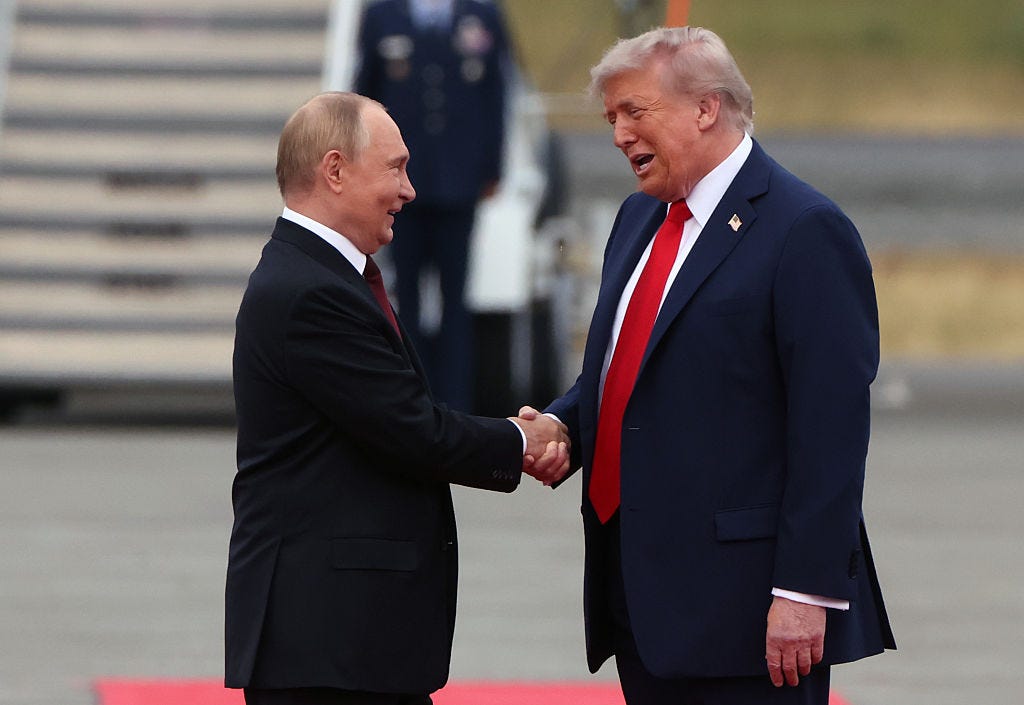
Today, we're discussing President Trump's summit with Vladimir Putin in Alaska on Friday – a hastily arranged meeting that has raised serious questions about diplomatic protocol, the optics of legitimacy, and what was actually accomplished in those negotiations over Ukraine. We'll discuss whether this red-carpet treatment for Putin serves America's interests or simply provides Russia with a propaganda victory.
Then, we'll turn our attention to the ongoing fallout related to Jeffrey Epstein, including the cover-up, conspiracy, and prison transfer of Ghislaine Maxwell following her meeting with Deputy Attorney General Todd Blanche, Trump's former personal attorney. Sarah and Beth have some strong disagreements about what makes this story different: is it just a sensationalized headline, or is it something else?
Outside of politics, for no reason whatsoever except that we all need it right now, we're going to talk about where we find the most relaxation.
Topics Discussed
President Trump lays out the red carpet for Putin
What can we learn from the crimes of Jeffrey Epstein
Outside of Politics: Relieving Acute Stress
Want more Pantsuit Politics? Subscribe to ensure you never miss an episode and get access to our premium shows and community.
Episode Resources
Pantsuit Politics Resources
Save money on your annual Pantsuit Politics Premium Subscription with our summer sale
Film Club: August 19 — join us on Substack to discuss Barbie and Réponse de femmes: Notre corps, notre sexe
Putin meets with President Trump
Trump-Putin summit: What to know about Alaska's Joint Base Elmendorf-Richardson (Axios)
Russia Is Suspected to Be Behind Breach of Federal Court Filing System - The New York Times
No deal, and no answers, after brief Trump-Putin talks on Ukraine in Alaska (The Guardian)
Russian Attacks Kill 10 in Ukraine, Hours Before Trump-Zelensky Meeting - The New York Times
What can we learn from the Crimes of Jeffrey Epstein
Perversion of Justice by Julie K Brown
More to Say about Jeffrey Epstein (Pantsuit Politics Premium)
She Exposed Epstein and Shares MAGA’s Anger (Opinion | The New York Times)
The Epstein Story Is Both Conspiracy Theory and Genuine Scandal (Opinion | The New York Times)
When a System for Protection Goes to Far (Pantsuit Politics Premium)
Diddy and Predator Culture (Pantsuit Politics)
Some kids need more protection from ultra-processed food. Here's why (NPR)
Outside of Politics: Relieving Acute Stress
Birdfy Smart Feeder (Amazon Affiliate Link)
Show Credits
Pantsuit Politics is hosted by Sarah Stewart Holland and Beth Silvers. The show is produced by Studio D Podcast Production. Alise Napp is our Managing Director and Maggie Penton is our Director of Community Engagement.
Our theme music was composed by Xander Singh with inspiration from original work by Dante Lima.
Our show is listener-supported. The community of paid subscribers here on Substack makes everything we do possible. Special thanks to our Executive Producers, some of whose names you hear at the end of each show. To join our community of supporters, become a paid subscriber here on Substack.
To search past episodes of the main show or our premium content, check out our content archive.
This podcast and every episode of it are wholly owned by Pantsuit Politics LLC and are protected by US and international copyright, trademark, and other intellectual property laws. We hope you'll listen to it, love it, and share it with other people, but not with large language models or machines and not for commercial purposes. Thanks for keeping it nuanced with us.
Episode Transcript
Coming soon…Sarah [00:00:07] This is Sarah Stewart Holland.
Beth [00:00:09] And this is Beth Silvers. You're listening to Pantsuit Politics. Today, we are going to discuss the talks President Trump held with Russian President Vladimir Putin in Alaska on Friday. Then we'll turn our attention to the ongoing fallout related to Jeffrey Epstein and Outside of Politics, for no reason in particular, we're going to talk about where we find the most relaxation right now. But before we get into our conversations, we want to let you know about our end of summer sale happening right now on Substack. We're offering 15% off annual subscriptions. That's a whole year of extra shows, community discussions, deeper dives into the topics that we cover here on the show and we know that you will love it if you join us.
Sarah [00:00:52] My favorite thing we recorded last week was the spicy Pantsuit Politics on Thursday. I don't think you were alone in that. We really got to some stuff. I named that I think the problem in American culture is the attitude of you owe me perfect and I owe you shit. Seem to really hit people where they were at. If you want to hear that whole conversation, go ahead. Go use the end of summer sale and listen to that spicy Pantsuit Politics from last Thursday. Okay. Speaking of all the fun things happening on Substack, tonight, Tuesday, August 19th at 7.30 p.m. Eastern is the final film club hosted by one of our most beloved listeners, Norma. They're going to be talking about Barbie and Reponse des Femmes, Notre Corps, Notre Sexe, which translates to women reply, our bodies and our sex. It's a second wave feminist project where she asked all these women, what does it mean to be a woman? It's only eight minutes long, if you've already seen Barbie, listen, you've done the majority of the work if you want to join the film club tonight.
[00:01:54] Also, I wanted to share again that the first ever Common Grounds Pilgrimage about Jane Austen's beloved novel, Emma, is taking place in May, 2026, and it's led by me. It's going to be amazing. It's going to be in East Sussex. The place we're staying, the Alfriston, is so beautiful. We're going to have sacred reading practices around Emma. We're going to take long walks in the British countryside. It's going to be phenomenal. So if you're looking to treat yourself, go on over and check out the Emma pilgrimage happening in May, 2026. There are a few spots left. It's five days, four nights with me talking about Jane Austen in England. I really feel like that sounds like a good time.
Beth [00:02:39] And now for a very different kind of conversation, we are going to talk together about the President of the United States and the President of the Russian Federation hanging out like buddies for just a few minutes in Alaska on Friday and all that has taken place since then. Sarah, when you heard that President Trump would be meeting Vladimir Putin in Alaska, I would like to know your first thought.
Sarah [00:03:16] Well, I was reading something recently that said we shouldn't even call Vladimir Putin president. It gives him too much legitimacy that he doesn't deserve. And that was my concern when I heard about this summit, is that it gives him a lot of legitimacy that he doesn't deserve to allow him to meet with the president of the United States on American soil, makes it seem like it's some meaning of equals, which is exactly how they sold it in Russia. I read about they gave manuals to their state media on how to cover things, which is again, to the point of he doesn't deserve the title of president in some wash of democracy because that's not what is happening in Russia right now. And the manual was all about like play up. These are two superpowers. This is two equals. They're standing on equal footing. It was to build up Vladimir Putin's image to have him walk down a red carpet. With Trump to get one-on-one time with the American president. That's what it did, and that was my initial concern.
Beth [00:04:21] My first thought was, I'm sorry, Alaska. Why Alaska? Why are you doing this to Alaska? Now, I read that it's probably because it's about an equal journey from Moscow to Joint Base Elmendorf-Richardson right outside of Anchorage and the flight to DC, roughly equal. But to your point, again, if we're talking about roughly equal on all sides, that is a very different posture than I think any previous president would have taken. Especially in light of Putin's activities over the last 10 years.
Sarah [00:04:55] Because we're not equal. I think it's really easy when you talk about countries through the lens of war, violence, occupation, to have them grow in stature in your imagination. Cold wars, hot wars, trade wars. I think that has happened over and over again. One of my favorite pieces I read over the summer, I think it was in the Atlantic, and it was like all our talk about this axis of China and Iran and Russia, it's empty. These are paper tigers in so many ways. Russia should not be on equal footing because they are not that level of threat. Now, I don't mean to downplay the damage and destruction that they have wrought on the Ukraine, but the idea that their economy is the size of ours, that their military is the size of ours, that they have some grand stature in comparison to other countries, in comparison to other superpowers, it's just not true. And so to give any visual media, public relations furtherance to that idea, I think is really problematic. That's why you plan these out, these diplomatic situations for years. They threw this together in two weeks.
Beth [00:06:19] I think what you're naming about that contradiction where Russia has simultaneously become overblown in our imaginations because of this war, while it has weakened itself through this war internally and otherwise, is just true in so many ways. And this summit is another one of those ways. I think that President Trump, whatever his intentions are...
Sarah [00:06:48] He wants a Nobel Peace Prize. We know what his intentions are.
Beth [00:06:51] I am really trying to push myself to also believe that he wants actual peace, that he wants a substantive peace too. I'm trying to not just make him a caricature in my mind, but look, it's hard, I'm sure, for anyone listening around the world to hear us criticize Putin for his treatment of the press when you think about Trump. We cannot give President Trump high marks for democratic rule, especially as he is flooding Washington D.C. with National Guard members and ICE agents and especially the way ICE is conducting operations right now. There are a number of places where he's really falling behind. So do you think about Russia vis-a-vis the United States without consideration of these leaders? Maybe in some ways you do. But I think that Trump thinks he is elevating his stature in the world as this negotiator, this peacemaker, this person who's willing to break all those diplomatic rules to try to get a deal done. But he is also reducing hours because putting us on equal footing with Russia in this scenario makes us look foolish to the rest of the world. And so both of these guys are out there like trying to build their stature and weakening it at the same time.
Sarah [00:08:06] I'm hesitant to do this but we're just as bad.
Beth [00:08:11] I don't think we're just as bad. I just mean glass houses.
Sarah [00:08:15] I know, but I don't think you can play glass houses on the global stage. I've been doing so much reading about the Geneva Convention post-World War II. You had a United States that was in the midst of Jim Crow, and I'm still glad they stood up and said, no, we're going to prosecute the Nazis and we don't have a damn problem doing it. So I just think on a global stage, if you're trying to wait for a perfect party, you're going be waiting a long time. And while we're far from perfect, we know we're near Vladimir Putin. I don't like Donald Trump, but I don't think he sends agents to poison his enemies in airports and other countries yet. And so I do think that he wants a deal and there were moments where I read about the coverage of this meeting where I thought, okay, I think he gets it. The center point of so much of the negotiations that took place on Friday is Donetsk. This part of the Donbass region that that Russia has claimed about 75% of, but they think to get that last 25% is going to be a real slog. And so what they're trying to do, what Putin wants is you just give us all of it. You just give all of us of it and I don't want to talk about a ceasefire. I should be able to negotiate while continuing to drop bombs. And that's another thing that he has basically claimed.
[00:09:34] If you remember when they first invaded Ukraine, there was all this talk of any moment where we thought they're going to get to the table, they're going to negotiate. But it was always premised on a ceasefire because what happens when you let someone come to the negotiating table while continuing to fire on their enemies? Well, I'll just make it harder. I'll make the stakes harder. I'll make what I've claimed bigger. I'll make the price to pay to not settle with me harder. Like it creates this incredibly perverse incentive to negotiate, to listen to them. If you say, yeah, sure, we'll do this trilateral agreement while you're continuing to drone swarm Ukrainian cities. So going in, it was going to be a ceasefire, ceasefire, we're going to do all these economic sanctions on them. And then the ceasefire faded away and now it's like, well, we're not going to talk about a cease fire. We're just going to try to get on the path to peace. And by the way, what I require for peace is all of Donetsk, which I only have 75% of. And I was encouraged to read that Trump was like if this is the center point for you, then we're not going to get very far, which feels like what happened. It was so short.
[00:10:50] A lot of what they planned didn't happen. The press conference was short. They didn't have the lunch. So I'm trying to give the benefit of the doubt. Okay, they got in there, saw that Donetsk was the center point of his demand and was like we're not going to get anywhere. I also read John Bolton, who's not a fan of Donald Trump, obviously, saying a ceasefire is also dangerous for Ukraine because that hardens the boundaries. The fronts become boundaries. If you stop it and you freeze it, wherever they're fighting, that becomes the new front. But hell that's still 75 parts of Donetsk and not 100. So I don't know. I think it's so hard to decide who's winning and who's losing because I think everybody's winning and losing.
Beth [00:11:36] The clearest, most concrete truth today is that at least 10 people, including a one-year-old are dead because of Russian bombs that were dropped. Right after the summit and before Zelensky goes with the European Union's equivalent of the Avengers to the White House. They are meeting as we are recording. So we do not yet know how that meeting played out as we're talking. I worry that the plot is being lost here because this has gone on for so long. And we know this as Americans, as well as anybody, you get into a conflict, you stay in the conflict. An exit is so hard. Doesn't matter who has the cards, as Trump likes to say. It doesn't matter who is stronger. You get into a conflict, it's hard to get out of it. And I just think the statements from Trump's advisors who all seem to have just read a whole lot of fiction in their lives and love to make everything as dramatic as possible and to romanticize it and to be quippy about it; when I read comments like, "We just got to get the buyer and the seller at the table,"| I think, well, first of all, this is not just a land deal, and who do you think is buying and selling in this situation?
[00:12:54] I don't think that they get, and they certainly don't communicate well to the American people, that for the Russians, this is like deep cultural stuff, not just land. And that's why it's just a struggle with Ukraine. It's not like, just give us your Crimea and we'll get out of your hair. It's like, no, we're talking about what languages are we going to speak and what holidays are we going to celebrate and what are we to teach our children about our history? And self-determination. I don't know. I worry that Trump is banking on people forgetting what this was ever about and just being tired of hearing about it. So a deal is good. As long as there is a deal, it doesn't matter what the substance is. A deal is good.
Sarah [00:13:42] I'm trying to distinguish between people I disagree with and people who I think aren't serious. And I do want to be clear that I think there are a lot of serious people from the Trump administration at this table. I think Marco Rubio is serious. I think he understands a lot about Russia and Ukraine and ongoing conflict that the United States is tangentially involved in. And I listen to him speak about this and the 20,000 Russians that they're ready to continue to put through a meat grinder. And I think, okay, you're a serious person. I disagree with you a lot, but I think you're a smart serious person trying to do your best here. With regards to the deeper cultural concerns, I don't know. I don't know how Russians feel about this because Russia's creeping up on North Korean territory here with complete lockdown of dissent of any form, much less criticism, polling. I don't even feel confident or comfortable talking about how Russia feels about Ukraine, because I think it's a lockbox.
[00:14:57] I was reading this piece in the New York Times about the border regions of Russia that have been swept up into this conflict as Ukraine has gotten bolder with using drones to cross over into Russian territory and exact cost from the Russian people. And in this very authoritarian process, complex dance, they use corruption charges to basically take out critics because it's important to note that it is completely illegal and a death sentence to critique the war effort at all, at any point, anywhere in Russia. So if they fail, they have to give people something because they've crossed over into their towns and people are dying, but they can't really lock you up for criticizing it because it's almost like that is acknowledging that something is happening and it is a cost to the Russian people, particularly in these border regions. So they're using this obfuscated corruption process to eliminate people who are problematic or who maybe failed or they thought should have caught the drone attack. God only knows, again, we're all just guessing, right? And so I just think that this other completely difficult aspect of this is like, who knows? Who knows who's actually critiquing it?
Beth [00:16:19] Let me be clear, when I say the Russians, I mean the people calling the shots.
Sarah [00:16:23] I don't even know who that is.
Beth [00:16:25] Well, we know that it's Putin and the people surrounding Putin-- he went to this meeting with Lavrov and Yushakov, people who've been with him forever. Lavrov rolls in wearing a USSR sweater to this base that was central to the United States efforts to monitor the Soviet Union during the Cold War. They have a sense of history and purpose and mission- the people at the tip top here. I agree, what the Russian people are up for, I have no idea. I wondered if Rubio decided to use that meat grinder quote in hopes that some of that filters into Russian media somehow. Because it is such a disgusting framework. And for so long, that kind of phrasing has been coming out of the Kremlin. Like the little bit that we get, you hear that exact thing. We have more people to send and die than Ukraine does. And that is why we ultimately win. And I wondered if Secretary Rubio decided like let's put it in the most awful terms possible. Because we need some pressure coming from the Russian people on Putin. And if their economy is in shambles and India is being punished for buying their gas, we're trying to apply pressure points where we can. And they hear that their leader has no respect for the folks who are going off and dying, maybe it helps, but I have no idea if that's going to be effective or not.
Sarah [00:18:04] Well, you have a very complicated situation in Ukraine. Zelensky, they're still under martial law, they still haven't had elections. The people are ground down in a very different way. And I do think there seems to be more acceptance that an end to this conflict, if it's going to come any other way then the removal of Vladimir Putin at Russia, which I don't think anyone sees as likely, then it's going to come with the sacrifice of some territory and some security guarantees. But Vladimir Putin's requirement that it come with a complete prohibition on joining NATO and the complete sacrifice of Donetsk. I read a really interesting thing in the Institute of War and they were talking about that let's say the Ukrainian people and Zelensky and the leadership go fine, we'll give you Donetsk, where the front is and where they would have to retreat to is an incredibly dangerous situation. It would weaken their defensive capabilities and would require a level of security guarantee and complete cessation of military exercises that no one believes Vladimir Putin is going to agree to, much less follow. So the fact that his center point, this sacrificing of Donetsk, basically, it could not, as I understand it, coexist with any real security guarantee, which the Trump administration is crowing about. Maybe we got them close to thinking about a security guarantee. So it just feels like this went nowhere. It feels like it went nowhere except for Vladimir Putin getting some recognition on the global stage that he can try it out in his state media.
Beth [00:20:06] And that's why this is also frustrating. It's hard to even know how to analyze it because there are so many pieces. And as an American, what do you center in your analysis of it? If Putin were a trustworthy negotiating partner, maybe you make the case for doing something that previous administrations wouldn't have done. Maybe you say, we really believe that we can make this happen. And in order to make it happen, we're going to have to flatter him a little bit. And so we're going to make this gesture even though we understand the diplomatic downside of it, but we think that this can happen. But everybody knows that anything you get from Putin right now is just for now. And it's very likely that you go into a meeting with Putin and you come out of it and you say, "He agreed to this." And his people say, "No, he didn't. That wasn't discussed. That's not our understanding at all." And with those factors in mind, why then do you allow someone who has committed war crimes, who invaded a sovereign state, who antagonizes our allies, who antagonize us still constantly-- on August 12th, we got this big report about evidence that Russia has been hacking into our federal court system. And that's a really significant thing. Actively right now, judges are having to tell people if you've got something to file under seal, you can't put it in our electronic record system because this is still a problem.
[00:21:40] So Russia is always an adversary to us in a real and present way. And for him to then roll out actual red carpet, shake the man's hand, hop into the beast like they're in a buddy movie, and do this when the likelihood of success is so evasive, I cannot understand it. Well, I am hopeful as I look at the clock and think about where this meeting might be, that there are some productive conversations happening with Ukrainian President Zelensky and his European allies, our European allies, in the White House today. And we will certainly follow up on that when we have more information. But right now, we're going to turn our attention to another persistent problem that the Trump administration cannot seem to shake. And that is the continuing fallout surrounding Jeffrey Epstein. Sarah, when we took a summer break, I tried to go to school on the Epstein situation by reading Julie K. Brown's book, Perversion of Justice. And it makes me want to start this segment by just saying, I'm sorry, everybody, that I was so late to this story because there is so much here, not just about one person's crimes and the many, many people those crimes affected in a huge variety of ways, but the way our government responded. This is a much bigger story that I put on a shelf of something that interests other people, but not me. And that was wrong and I feel bad about it.
Sarah [00:23:26] That's so interesting to me. I still have not learned anything that shocks me out of my initial analysis of the Epstein case. Even when you were texting me things, I listened to that. The author of that woman was Ross Douthat. I read a David Wallace-Wells piece that was really good. And he talks about we don't need more information; we need more meaning. Do you feel like you ignored information? I'm confused by that take.
Beth [00:23:55] I feel like I decided that because a lot of crazy started to surround this, I decided it was a story for people who like the crazy. And this is a story, if you care at all about criminal justice and equal justice under the law, that is galling from start to finish. The way that Epstein was incarcerated, but not really going back to Florida. The way that Florida prosecutors did the judicial equivalent of catch and kill with his case. They took it to a grand jury on one count of solicitation of prostitution. And that is an offensive charge when you think about the ages and the numbers of girls that he was raping and molesting. On through the non-prosecution agreement with the federal government that we still don't have a sense of the scope of and the number of co-conspirators who have not been charged because maybe something to do with that agreement. The fact that he probably never would have ended up in jail were it not for the Miami Herald's reporting because so many powerful people got together and said, no, we're going to give this one a pass. And still now our attorney general saying things that seem contradicted by the entirety of the record in this matter.
[00:25:18] It does feel to me like exactly what Thomas Massey has been saying. This transcends partisan politics. There are people involved of both parties at high levels who had close relationships, who at the very best case scenario saw awfully weird things that should have concerned them and seemed to do nothing. And about how our system was bought by this person. No one else who was a registered sex offender could have purchased an island in the U.S. territory and gotten $100 million in tax credits for building stuff on that island as a registered offender. It runs right through me to think about the huge web of people who, in one way or another, facilitated over 1000 victims being used by this guy. And I just do feel like there is something much more significant here about the justice system itself. It's not to me a true crime story. It is about who are we and what is the responsibility of people in positions of trust? When they see this going on and allow themselves to be if not blackmailed, because I don't think that's technically what happened, but purchased.
Sarah [00:26:45] Yeah, I don't disagree with any of that. I'm just not surprised by it. And I don't think this is a special case. I don't think this any different than what happened in the Catholic Church. I think it's a degree of scale and application. I think about people in my life who were abused by people of power in their community and the way it was this exact situation. It just didn't involve celebrities and people in power. The justice system didn't work. People in power decided how things were going to go because they thought they knew best and the victims were really not the number one priority of anyone involved. Kentucky just passed this pretty aggressive communications law. Because this happens so often with teachers, coaches, students, you see it in church, boy scouts. I can go on and on and about when there is status and power and wealth and celebrity at play. And celebrity can look a lot of different ways. Celebrity can be a former president or a New York City real estate mogul or celebrity can be the local football coach, but it's the same shit.
Beth [00:28:05] Here's why I disagree though. It is the same shit in a lot of ways and we have failed in so many respects. You and I did talk about the abuse in the Catholic Church though. This to me is a special case in the sense that we are a news and politics show and the people who turned a blind eye and facilitated this are politicians, elected leaders, people in the Department of Justice. The trust that this situation destroys politically is similar to the trust that has been greatly hurt and in many cases destroyed within churches, within the scouts, within other organizations. This is our lane and we should have covered it. And I just feel more and more convicted about that the more that I learn about it. Because in all these spaces it matters and it's all connected. What really upsets me thinking about this is that I just did all these focus groups with teachers to talk about school attendance, and I thought about how every single person I spoke to is a mandatory reporter. If they had seen anything, like what was happening with Jeffrey Epstein, they would have had to report it. But he is photographed with all kinds of people.
Sarah [00:29:19] But that doesn't happen. That's true, but it doesn't happen. It happens all the time that teachers and people see abuse within the systems and they don't do anything about it.
Beth [00:29:28] But some people do. And here are all these people that we elected to positions of trust who think that nothing constrains their conduct. They had no obligation. If you saw a grown adult man with a 15-year-old girl at a party and he made no effort to conceal what was happening here according to everything that I've read, if you saw that and didn't even raise a question and you saw it over and over for decades, different girls, and you don't feel as an elected leader or a prosecutor that you have some obligation to get to the bottom of that, then what do you believe about your responsibility to other people? I think there is something deep and perverse that is right in our lane here that has been worth getting to.
Sarah [00:30:24] Well, here's the thing. It's not that we ignored it, and I'm not defensive of us. I'm not trying to defend us. I think we probably should have talked about it more. I wasn't not talking about it because I just thought it was the purview of crazies. I just though there wasn't a lot more to say. It seemed to me that his crimes were obvious, that he exploited a system with very good lawyers, like lots of people do, and that this was a very extreme case of something that happens all the time. I guess what I'm pushing on, because this is sort of a thing I really try to check myself on, there are people that do that all the time. That dude at Penn State walked in to a shower where he was raping a boy and did not call the police. And I don't think it's because that guy is also a villain. What I'm pushing on is instead of saying I would never, we should all say I would. People I know and love do. People in my community do. And why is that? The David Wallace piece that I think is so good, he says, we don't need more facts. And that's what I didn't want to feed in our coverage of Jeffrey Epstein. We just need to know more-- no, we don't. It's right there in front of our face. We don't need to know more. We don't need more fact. We need more meaning. And what I mean by meaning is, let's get real. When it particularly comes to sex abuse, it's prolific because we turn a blind eye when it's someone we love, someone we know, someone we're scared of. Like this is basic human behavior that pops up in every institution. So why?
Beth [00:32:05] Agreed. I feel like we're talking about two different things though, because to me, right, I don't need to know more about the specifics of how Jeffrey Epstein abused, recruited, paid girls. I don't need to more about that, it is obvious. What is worth knowing more about is how our government responded to it over and over again throughout the course of his life. How our government responded to people bringing them the evidence, to people who came forward even though they were terrified of this man. And our government let them down consistently. And yes, our government does that all the time too, but that doesn't mean we don't talk about it. The pervasiveness of child sex abuse probably means we need to talk about all a lot more. And the pervasiveness of the criminal justice system operating one way for the wealthy and powerful and another for the not, also means we should talk about it more. And the fact that this case did capture people's attention around both of those things, and a lot of us did not talk about it much, I think creates and feeds that trust gap between the parties.
[00:33:17] This got corrupted somewhere along the way in terms of the discourse around it too. And that's why I feel really strongly about doing my homework on it now. And doing my homework so that I can be credible when I do talk about it, because there are people who've spent years covering it. I never wanted to be a podcaster who exploited this. And that's a fine line whenever you're talking about crime. That's why we don't do a lot of true crime here because there are people for whom their stories get turned into entertainment and that's gross. And I don't want to do it and I don't want to do it for the click bait of Epstein and the title of the show. But there was something real here that more right leaning people were speaking to in a clearer way than left leaning people. And so I'm just trying to reach out and say, you guys got this one right to some extent. And I am sorry where I missed that. And I'm willing to get up to speed and try to close the trust gap as much as I can around this topic.
Sarah [00:34:26] I guess I just struggle because, yeah, they got it right while empowering Donald Trump, who was a piece of this all along. And so I don't want to reject it just because it's a different side of the coin of what I said about Marco Rubio. I want to take you seriously, even though I don't agree with all your conclusions. But there's this great line in the David Wallace-Wells piece where he says, it also belongs to another paranoid tradition in which those epicycles of analysis don't demystify, so much as re-mystify, layering over legible facts with something foggier and more darkly mythic. And that to me is what I saw happening with Jeffrey Epstein. I think that is still happening with the Jeffrey Epstein case, where that book I read this summer, Blazing Eyes Sees All, Love Has Won False Prophets and the Fever Dream of the American New Age, this is so crazy, she talks about like back-- I swear to God, I think it was like the mid-1800s. They couldn't explain why there were lemurs in two places. Follow me here, I swear it's relevant. There's lemurs in Madagascar and India. No other place. And back then, they couldn’t explain it.
[00:35:35] Well, now we know it's because of the continental shifts and the way it broke apart. But this one dude was like, well, I think there might be this place called Lemuria and that's where the lemurs came from. And I swear to God, Beth, if you go to like a new age conference in 2025, people have built whole things about Lemuria and it's like this big deal. Still it's like the Atlantis. Just because this one dude was like I wonder why there are monkeys in two places. I feel like Epstein is the Lemuria. We put our hooks in this and it stops being crime or even any sort of cultural analysis and it becomes conspiracy. And then it becomes a shield to ask those tougher questions. It becomes, no, once we figure this out and the secret and we solve it and we know everything there is to possibly-- I don't need to know anything. I know what happened. He fucking got away with it because he was rich and powerful because that's what happens. And everything you described with regards to the government's pursuit of him is not shocking to me at all.
Beth [00:36:41] You don't find it shocking that he was released from jail for 13 hours a day to go sit in an office and while police officers sat outside his door they continued to deliver young girls to him which he abused in that office.
Sarah [00:36:56] No, I don't. Do I find it wrong? Of course. Do I found it shocking in the face of Michael Jackson, Bill Cosby, the Kennedy cousin who raped and murdered a girl and got away with it? No, I don't. I don't find it shocking.
Beth [00:37:09] So then to me that makes the case that it is worth talking about our criminal justice system a lot more and if people are interested in this case, use it as a vehicle to do that and to say over and over again the levels of corruption here run deep. Now that is tough on a podcast where we have spent a lot of our 10 years talking about the need to trust our institutions and to try to build them up. And again that's why I want to lean into these contradictions. There is a living contradiction right now with the transfer of Ghislaine Maxwell. So she was his accomplice. I did not realize until I read this book that she also participated physically in the abuse of these girls. She had a sit down with the deputy attorney general, Todd Blanche, who used to be Trump's personal attorney and is now the deputy attorney general. Five hot minutes ago, before he was elected, Todd Blanche was defending Trump on criminal charges in New York. And now he is the deputy attorney general sitting down with her, saying that she's a cooperating witness. With what? The FBI has told us it's done. With what is she cooperating? And the deputy attorney general would never take a meeting like this. To say that that's unusual is like the understatement of the century.
[00:38:27] But we know that meeting happened and we know shortly after it she was transferred to a minimum security facility in Bryan, Texas, that typically would not see a convicted sex offender who is serving a long sentence. And we don't know why that transfer happened. And so her lawyer comes out and says, "I'm so disappointed to see my progressive friends not recognizing that she also deserves to be safe in prison, and she was not safe in Tallahassee and that's why she was transferred." I believe people deserve to be safe in prison. So a bunch of things could be true at one time. That she was transferred properly because of a safety issue, that she wasn't, that this conversation with Blanche is totally above board and about some kind of ongoing investigation that the government's just not telling us about, that Blanche is actually still acting in some ways as Trump's personal attorney, I don't know. But those are all matters of public interest when it concerns the president of the United States. Certainly when we think about the kinds of matters that special councils have been appointed to investigate about presidents in our lifetimes. There is something here that needs to be answered. There is a live current question, I think, about the administration's handling of this episode. Did they make this problem for themselves? 100%. This is on their plates because they put it there, but it's there now. And these questions need to be answered.
Sarah [00:39:59] I guess, for me, the questions I have-- I even bristled just a little bit with the idea of corruption. And let me say why. I think we get in this place where we think, well, it's these people. Once we root out these people, we won't have this problem anymore. Once we really ask the questions about what these people did inside our justice department, and then we hold those people who let it happen inside our justice system responsible, then we'll fix it. But we're just going to have more people come in and fill the roles who are more susceptible or equally susceptible or, may God willing, less susceptible but still susceptible to what is clearly a very human condition of exploiting your power, status, wealth, celebrity to be a predator on other people. And then even if you're not the predator, you become afraid, you become defensive. I don't know. I just don't think we do. And I think none of us-- it kind of goes back to me like instead of thinking you would never think, you would and why. And what could happen to disrupt you doing that? What could be and what processes? Is there a process in place? Is there a psychological off ramp? Because I'm not sure we've gotten there yet. We do a lot of things.
[00:41:37] We do a lot of mandatory reporting. Well then we get into these situations like we talked about on our Substack where you have automatic reporting where people who are not abusing their children are getting taken away. So I don't think there's like some magic automatic process where we go, well, this will fix all the future Jeffrey Epsteins. But I think there are such important questions about human nature-- I don't want to sound cynical but philosophical-- ethical moral questions about what we see play out over and over and over again to the point where I am not surprised or shocked at the level of depravity people will pursue when protected by status, wealth, celebrity, power. And there is a little part of me that's like, okay, well, this is the human pursuit. This is what happens with human beings and we just always have to be aware. But I don't want to be cynical. I don't want to go like what are we going to do about it? I do think there is something we can do about. I just don't think like if we could all magically download every scintilla of information about every person that ever had interaction with Jeffrey Epstein, that would fix it. I don't think that would reveal anything new.
Beth [00:43:00] Well, I am not advocating for that. And part of what I did in the episode that I released for our premium community yesterday on More to Say is say, I don't think when we say release the Epstein files we know what we're talking about, or we're getting at what we really want. I do think more transparency is important in this situation. I think that's step one. You're right. There are deep problems here that are as prevalent as human history. One of the things that really jumps out at me is how many of these victims were vulnerable because someone in their lives had already abused or neglected them. So what happens to children that is abusive and wrong crosses every socioeconomic bracket. You know that there are no limiting factors on that, which means that it is a hard problem that we need to lean into even more. On the government side of this, I think transparency has to be the first thing. And then you start to probe those questions.
[00:44:05] I think you're right. There aren't going to be math problem-like answers to how we prevent people in positions of power from abusing that power. But the threat of transparency is important, and public shame is important. And this is a situation where public shame could be very strong and already is, and I'd prefer that it be accurately directed instead of directed at random out in the universe and based on your political priors. So on the government side, I think that matters a lot. On the individual side, talking about this case in factual terms and getting experts involved to say, here's what we know about child sexual abuse, it's really hard, but here's what we're learning. Here are open questions. Here are things that have been effective in helping this and things that failed. I want to learn more about all of that as a result of spending some time thinking more deeply about this one person. And that's what good news and politics coverage should do. Where you recognize it's not just this one story. This one story is a reflection of a wider phenomenon. Okay, now that I am thinking about that wider phenomenon, what am I called to? And what can I learn more about and where can I help with that?
Sarah [00:45:27] And I just feel like the narrative around this Epstein situation has shifted a little bit. And for a long time, I think particularly around his death and the coverup narrative, it was so much adjacent to like QAnon and Pizzagate and the elites are in a Cabal.
Beth [00:45:52] Antisemitism, for sure.
Sarah [00:45:57] I don't want to feed any of that. That was definitely my aversion to this story because the Cabal isn't easy out. You don't need to convince me that people in power-- again I just told you i wasn't surprised by that. But the Cabal. Again, that's how you end up in a QAnon once the right person gets there and as our savior and they'll take out the Cabal and then we'll have fixed it. No, dream on dude. I think that's the tension here, particularly around the Epstein story, is acknowledging the exploitation, facing it transparently without feeding this Cabal conspiracy that I think is so toxic. And, look, I think they're always used to be a small percentage of Kuk’s, (I'm sorry, that's the word I'm going to use) who this was their hobby, this was their thing, they did it for JFK, they did for MLK, they did is for Malcolm X. And a solid six to eight percent of people in this [inaudible] spare time, I don't really care. I think that's probably like no harm, no foul. The problem is the internet just supercharged that. And it took the 6 to 8% made them truly unhealthy and then swept up another good 20% depending on the circumstances of their own personal loneliness or lives. And I think that's the difficult part of this too. Is the way this just became such fertile feeding ground for such toxicity inside our politics.
Beth [00:47:36] And I think that there are a bunch of things worth paying attention to in that, understanding why this was that fertile ground, because it did have a political impact. So if you want to do politics with the populace that we have, not the populace we want, why did this hit? What is effective in speaking to that need that is based in 100% truth instead of some truth? And then for me, just personally, and one of the reasons that I do have a profound sense of regret about not doing this exercise earlier, just realizing I did treat this as the stuff that crazy people are into. And that's really dismissive of the fact that a lot of this does sound crazy and also is true. And so I want to be more careful in really interrogating what is the kernel of this from which it all grew? And what can we say about that kernel that contributes something positive instead of just feeding what doesn't work?
[00:48:47] I'm listening to this short series that Donie O'Sullivan made for CNN called Persuadable. It's about QAnon. And I really love how in the first episode, he says, you don't have to be crazy to believe crazy shit. And he talks about his own mental health struggles and how he really understands why some of the people that he has studied fell into QAnon. He really gets it. And that perspective of compassion instead of condescension is really speaking to me and just making me examine how I've treated a lot of the things that have given birth to portions of the Trump coalition. I feel like you've done this kind of exercise around Make America Healthy Again. Like, what is the kernel of this? No one thinks that a wall of beef tallow at Steak N' Shake is making meaningful public health progress. But people have gotten there. Why? They got there for reasons. What are those reasons? And what's the call to action around those reasons.
Sarah [00:49:54] Well, that's exactly what I was going to say. I think that this muscle is one we are all going to have to build. I'm really on a Davis Wallace-Wells kick, I swear, but he wrote this other piece about everything is toxic. There is plastic in everything. At the depths of the ocean, plastic got there before people did. In our blood, in our cells. And so, where is the line? How do I talk about that and acknowledge, yeah, you're right, there are toxic chemicals everywhere. And also, your Kardashian cleanse is probably not going to fix it. I think about this in a lot of ways. I think there's so many areas where we have to figure out how to say, yeah, this is messed up. The status quo, be it academia, be at politics, be at institutions we trusted, be it the scientific community got us here. What do we do with that? What do you do when the scientific community or academia or somebody we trust that said, no, it's okay, based on the information that they had, maybe in good faith at the time and now it's not true anymore? Well, how do we talk about that?
[00:51:12] How do we say yes and, I still am going to have to trust the scientific information available to me right now. Yes and I agree with you that people are unhealthy. I shared in our team, there was an NPR piece just this week about how some people, especially children, are very susceptible to ultra processed food. It's not neutral. Food is not neutral and so how do we talk about that? How do say, yes, there was really good things when we were trying to pursue a neutral approach towards food based on psychology and cultural understanding and also the new science is pushing us in a new direction. What do we do about that? I just think that this muscle where we're going to have to walk the line between what we knew now, especially because information particularly due to artificial intelligence is going to be shifting and changing so rapidly and what we understand to be the truth could change from day to day based on studies, based on new information. And acknowledging that there's a problem, it doesn't mean I think everyone in charge is the problem.
[00:52:26] It doesn't I think every expert is a part of the Cabal. It doesn't mean I should just do my own research on my own body and scrap every medical study. I just think we're in this really difficult place with expertise in particular that makes holding that line between the kernel that speaks that we all know is true. We all know there's toxicity in our environment and our own bodies. We all that people in power exploit that power to prey on those weaker than themselves. There's just this piece that I talked about this. I felt like I was tying myself in knots arguing with my dad on one end of the political spectrum and Griffin on the other to say, yeah, but it's okay. Yeah, it'll be okay. Yeah, but the status quo is okay. And I'm like finally just letting that go and trying to figure out how to surf that wave of new information and change without letting it turn into a tsunami that wipes out everything we've done up until this point.
Beth [00:53:35] And that's hard enough as an individual exercise. The people who are going to win elections have to be able to go to the next step. People in positions of power have exploited that power and it's been terrible. And unfortunately, that is not new or unique to the Jeffrey Epstein situation. And I don't have a magic bullet to fix it, but I believe that we can make progress and here's what that looks like. They have to able to keep walking down that road because the answer cannot just be the cynicism that this is how the world works. And we definitely don't want to be in the posture of the this is the world work cynicism when we start to question whether every single thing in front of us is true or not. And we're already really close to that. So that's why I spent so much time with this because I do want to know what's true and confirmed. And I want to know what is known and unknown.
[00:54:26] And I want to think about what I mean if I say release the Epstein files and what I don't mean. And I hope that that was valuable to everyone who listened to that episode. I hope you'll take advantage of our summer sale. If you haven't listened to it, join us over there. It is important for us to have some of those conversations behind a paywall so that people can know they're talking to other people about it. Even where you disagree this is another person and it's another person who's invested in the kinds of conversations that I'm invested in. So it's a tough thing to sit with, but I'm really grateful that we're able to do it here. Sarah, just randomly, I was thinking about stress and I wondered where you are finding in your life the most relaxation right now.
Sarah [00:55:24] Well, it's not around my new birdhouse that I need to get that off my chest before I can talk about the actual relaxing things. Because I thought my new birdhouse with a camera was going to be the promise of much relaxation after the birds just landed and popped up on my phone, like the most delightful social media feed of all time. And instead I've moved the damn birdhouse four times and I'm constantly fighting off squirrels. This is the journey of being a human. You find something relaxing, and the squirrels ruin it.
Beth [00:55:52] I feel your pain. It's been the raccoons for me this summer with my pool house, so I get it.
Sarah [00:55:56] So you see what I'm saying? Like you find a space and a rodent gets in and messes it up.
Beth [00:56:03] I don't know about you; I talk to myself about this. This land is the raccoon's land as much as it is my land, but it is really tricky.
Sarah [00:56:12] No. It is their land; it is not their birdhouse. It is not their birdhouse or their bird seat. Nicholas is like, "When you feed wildlife, you feed wild life." Shut up. I didn't ask you. And I'm mad about it. I do think after much research, I've found a place. I've got a baffle. But here's the advice from the internet when placing a birdhouse is like 10 feet from trees so the squirrels can't jump onto it. Okay, got it. But also near trees and shrubs so the birds feel safe from predators. Which one is it? Which one it is? You want it 10 feet away or close? I'm very stressed by this, but I've put all the information together as best I can. And I'm really hoping that this new-- it's not a new hobby. I do find birds deeply relaxing. I love birds so much. I love hawks. I love the ball. I haven't made friends with crows yet. I'm not that far gone, but I do find it to be a relaxing hobby but for the squirrels.
Beth [00:57:09] It was a journey. And I do feel a little bit more stressed just hearing about it than I did before we started on this.
Sarah [00:57:15] I just had to, that's all I'm thinking about. I just check it all the time. Because I'm like if another squirrel... And this birdhouse gives me the ability to yell at the squirrels, which is satisfying. But I really got to catch them in the app for that to work.
Beth [00:57:30] I have also developed a bunch of new hobbies this year. I won't list them. You can predict them. I'm a 44 year old white woman. They are what you think they are, okay? So I have these new hobbies.
Sarah [00:57:38] Are you doing bread like Taylor?
Beth [00:57:39] I'm doing bread, I've got plants going, I'm about to buy a weighted vest, all the things. So what I've been realizing lately is while I like my hobbies, and while I think my hobbies enrich my life in a bunch of different ways, I do not find them to be stress relievers. The sourdough, that's a task, that a chore. The plants need a lot of attention and care. I enjoy it, but it's a chore too. Most of my hobbies, I have a way of turning into either a job or something on my to-do list. And that's why I've just decided if I'm thinking actual stress relief, I have to go to water. A shower, hot tub, pool, sit in the rain, I don't care. I need water to touch my body if I want to have actual stress-relief.
Sarah [00:58:32] I agree with that. I love to swim. We all know my stance on the Korean spa. If I lived near one, I would probably be going once a week. I find water deeply relaxing. I also find reading deeply relaxing, even if I'm reading for work. If I'm sitting in my chair and I have a book in front of me, it's very relaxing for me because it turns off my brain. But back to our conversation last week, I am just letting go the idea that I need to have some magic amount of relaxation time and creating that to make that like another to-do list. Because what I find so relaxing right now is just feeling like our whole family is firing on all cylinders. Like we've got our processes in place, we've our routines in place. I've got some hobbies going that are fun, even though the squirrels are stressing me out. It's not bad stress either. It's not like my blood pressure is up.
[00:59:29] I will never forget one time going to a woman so wise in my life named Emily who did dry needling in Paducah for a long time. And she said, "Are you stressed?" And I said, "Why is this?" And she's like, "Hey, stress can be good things." And I was like, you're right. And there was like a moment where we were all like giving ourselves a pep talk that stress is not the problem is how you handle the stress. The presence of stress is not a bad thing. That just means you're human in the world. I'm just trying to think about how much relaxation or how much stress management is good and you can do what you do with the hobbies. You just make another thing on your list
Beth [01:00:10] That's why when I was thinking about my answer to this question, I wasn't really thinking about like self-care and routine. I was thinking about when I am actually feeling stress in a negative way, like an amount of stress that I feel like I need to do something because this is not good for me, it's the water. I feel like I have that sense of stress in like three buckets. I get that kind of stress sometimes about time. I feel there's not enough time. I'm overwhelmed. It's too much. I feel it about like various forms of pressure that I experience in my life. And I feel it about emotional injury. My feelings are hurt or I'm grieving something or I feel betrayed. That kind of thing that hits you and it hurts and it's acute. It's not like normal everyday stuff. But those are kind of the three times that I feel like I experience a stress in my body that is out of the range of just I'm a human living in the world.
[01:01:09] And when I'm in that stressed space, I notice more and more, I can breathe and that's good, never against deep breathing. But the thing that actually starts to dissolve it for me is water. I had a really intense situation I was dealing with yesterday, and I felt it in every cell. And I'm sure that my aura ring was picking it up. It was bad. And I jumped in the pool and I just felt it melt away. And I think it's because there is something about water that just kind of makes me feel like everything you can just let it all be. I don't need to resolve it. I don't need to talk to myself about it. I don't need to explain it away. The water touches my skin and I get this sense of like, yeah, that's what happened today. And here you are, and it'll be okay. And I'm just coming to appreciate that more and more.
Sarah [01:02:13] Yeah, I think mine is probably breathing. I have to have quiet. When I'm jangled like that, the noise is very problematic. I need quiet.
Beth [01:02:24] That makes sense to me.
Sarah [01:02:25] I do like alternative nostril breathing. So if it's a really acute situation, I believe in a glass of water. When Felix is really hyped up, the first thing I try to get him to do is just drink some water. I wouldn't call that relaxed though. I would just call that triage. I was so stressed earlier this year at a moment I had like a dissociative state. Like it was really bad. About like a very acute situation I had no control over. And I will say generally, it's not really a good stress management technique because it takes too much planning, but that's why I like to travel so much. That's how I would describe being in the state of travel and movement around other people is there's just a sense of like I am in the flow and that's it. When I'm home, there's too much of like my Enneagram one, I can control it, I can fix it. But when I am in the flow of travel, I have to be present in a way that I find deeply relaxing and a good antidote to that acute stress. That's hard to get. I can't just jump on a trip the way you can jump in a pool. But I also find being in the everyday flow and feeling like the processes are working, it's a different kind of flow, but it's a flow I very much enjoy. It's that sense of instead of trying to rein in a horse, I'm just floating along kind of.
Beth [01:04:05] Well, I'm very interested in hearing from people about what relieves, maybe we'll call it, acute stress for you instead of relaxation. And you can tell us in the comments on our Substack or by emailing us, hello@pantsuitpoliticshow.com. We would really love to see you over on Substack. So don't forget to check out that 15% off deal using the link in our notes, if you aren't already there, but it does end by August 31st. So don't put it off not to create stress in your life. We'll be back with you on Friday. We are going to pick up and talk about the situation in Gaza on Friday. Doing a lot of preparation for that episode, so if you would like to weigh in with us before then you can send us a note. Until then, have the best week available to you.
I think the biggest difference in Epstein and other cases Sarah brings up is Epstein was caught. He was caught and still was allowed to live his life as if he wasn't.
Most other cases are when people cover things up so the guilty parties never face legal consequences. But if the guilty parties are convicted in court, their lives are altered forever.
Epstein was caught. And he made a deal. That deal allowed him to live as if he hadn't agreed to any deal at all. That type of out in the open enabling from public officials is what brings up all the questions that are different than most similar cases.
I am really struck by how humble and sincere Beth's response is with regard to missing what a big deal to the entire country the Epstein case is. I think I hear what you're saying. It's a topic I also haven't followed partly because I did see it as something only 'crazy conspiracy theorists think' and a sense of powerlessness ("If this is true, what can I even do about it and how does it matter to me?") I think you make a strong case of HOW and WHY the Epstein case matters to the country at large. AND this is a great example of spaces where I think Democrats can get better about listening, taking accountably, apologizing, and demonstrating changed actions. I have seen a lot of conservative radicalization in my circles exactly because these types of cases aren't taken 'seriously' by the masses or the perceived 'elite'. It really is hard because what is the line, as you say, of making entertainment out of a gross evil and actually doing smart work to expose and correct broken systems.